

If you search for houses by opening every listing that looks attractive, you will lose hours before you learn anything useful. The faster approach is to make the property market smaller before you start viewing homes.
That matters in Dubai and across the UAE, where a single search can include ready villas, townhouses, apartments, off-plan projects, luxury communities, and rental homes across several emirates. The goal is not to see more properties. The goal is to see the right properties sooner.
Below is a practical system for narrowing your search, comparing listings, asking better questions, and avoiding the common traps that turn house hunting into a full-time job.
Start with a buyer brief before you open listings
Most people waste time because they begin with listings instead of requirements. A listing is only useful if you already know what it needs to prove.
Write a short buyer brief before you search for houses. It does not need to be complicated, but it should be specific enough to eliminate poor matches quickly. Your brief should answer three questions: why you are buying or renting, where daily life needs to happen, and what you are not willing to compromise on.
For example, an investor looking for a tenant-ready townhouse near family communities has a very different search from a family that needs a villa close to school routes. A remote worker may prioritize space and quiet, while a commuter may care more about road access than an extra bedroom.
Use this simple structure to clarify your search:
| Search category | Must-have | Flexible | Deal-breaker |
|---|---|---|---|
| Location | Preferred communities or commute radius | Nearby alternatives | Too far from work, school, or key roads |
| Property type | Villa, townhouse, apartment, or off-plan | Layout variations | Wrong property category |
| Budget | Maximum all-in budget | Small adjustment for exceptional value | Unclear fees or unaffordable monthly payment |
| Lifestyle | Parking, outdoor space, building amenities | View, furnishing, finishes | Noise, poor access, unsuitable layout |
| Timing | Ready now, rented until a set date, or future handover | Short wait if priced well | Handover or vacancy date does not work |
Once this is clear, every listing has a job. It must either fit the brief or be removed.
Confirm your real budget, not just the asking price
One of the biggest time-wasters in any property search is browsing homes that look affordable online but do not fit the real transaction budget.
In Dubai, buyers usually need to think beyond the listing price. Costs may include government transfer fees, agency commission, trustee office fees, mortgage-related charges, valuation, conveyancing, service charges, moving costs, and possible renovation or furnishing expenses. Exact costs can change and should always be verified with your agent, bank, or the relevant authority before you commit.
If you plan to use a mortgage, get pre-approval early. This does two things. First, it gives you a realistic price ceiling. Second, it makes you more credible when you find a serious opportunity. Sellers and agents are more likely to prioritize a buyer who can move quickly.
If you are buying in cash, prepare proof of funds before viewings. If you are renting, know your preferred payment structure and security deposit budget before contacting agents.
A good rule is to define two numbers: your comfortable budget and your absolute maximum. Search mainly within the comfortable range. Keep the maximum for rare properties that strongly match your brief.
Choose areas by daily routine, not by hype
A popular community is not automatically the right community. Dubai real estate discussions often focus on headline areas, but your actual experience will depend on daily movement, traffic, noise, services, and access.
Before shortlisting homes, test the location around your real schedule. If you drive to Business Bay at 8 a.m., check the commute at that time. If school pickup matters, test the route then. If you work late, visit the community after dark to understand lighting, noise, parking, and activity.
For investors, location still needs practical testing. A property may look attractive on paper, but tenant demand depends on access, nearby employment hubs, schools, retail, transport, and community maturity. Future infrastructure can help, but avoid basing your entire decision on promises that are not yet visible.
When comparing communities, ask yourself:
- Would the target resident want to live here every day?
- Is access convenient during peak hours?
- Are essential services already nearby?
- Is there ongoing construction that could affect comfort or rental appeal?
- Are similar properties easy to rent or resell?
This step alone can remove dozens of unsuitable listings.
Use search filters like a professional
Filters are not just a convenience. They are how you protect your time.
Start with the filters that reflect non-negotiables: property type, area, price range, bedrooms, bathrooms, size, completion status, and furnishing if relevant. Then add lifestyle filters such as parking, balcony, maid’s room, private garden, pool, gym, or waterfront access only if those features truly matter.
Avoid setting the budget too wide. A broad range creates noise and encourages you to rationalize homes that were never realistic. Instead, use a tight primary range and a separate search for stretch-budget properties.
Also avoid sorting only by lowest price. The cheapest listing may be rented, poorly located, smaller than expected, in need of work, or priced low to attract inquiries. A better method is to compare value: price, size, condition, community, floor plan, service charges, and occupancy status.
Platforms with advanced filters, detailed listings, high-quality photos, virtual tours, favorites, and comparison tools can reduce unnecessary viewings. On Best Property, you can use these tools to narrow the UAE market and focus on homes that match your brief before contacting an agent or owner.
Read listings for signals before you book a viewing
A strong listing should answer most of your first questions. If it does not, slow down before scheduling a viewing.
Look at the headline, description, photos, floor plan, size, price, location, availability, and agent details together. A listing with beautiful photos but vague availability may not be worth your first viewing slot. A listing with a low price but no clear unit details may require more verification.
Pay attention to wording. Phrases like vacant soon, motivated seller, genuine listing, upgraded, high floor, partial view, or close to handover can be useful, but they need confirmation. In real estate, adjectives are not evidence. Documents, viewing access, comparable prices, and clear answers are evidence.
If you want a deeper framework, this guide on how to read real estate listings like a smart buyer explains how to interpret listing details more carefully before you spend time visiting properties.
Build a shortlist instead of browsing endlessly
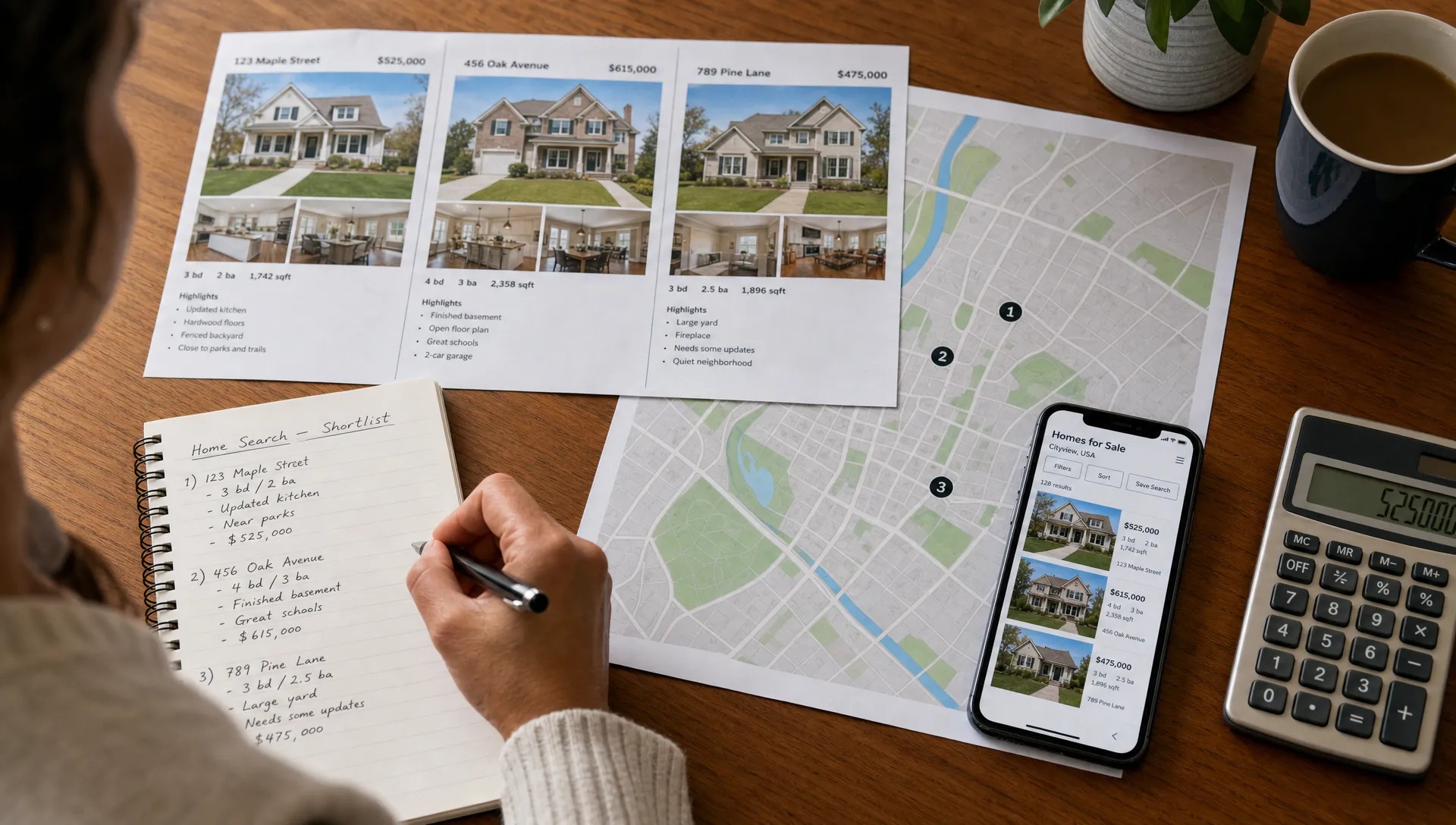
Endless browsing feels productive, but it often delays decision-making. After you have filtered by budget, area, and property type, create a shortlist of the strongest options.
A practical shortlist should include around five to eight properties per search round. Fewer than that may not give you enough comparison. More than that becomes difficult to remember and evaluate accurately.
Score each property using a simple 10-point method:
| Factor | Score range | What to consider |
|---|---|---|
| Location fit | 1 to 2 | Commute, community, access, lifestyle, tenant demand |
| Budget fit | 1 to 2 | Asking price, total costs, payment structure |
| Property quality | 1 to 2 | Layout, condition, size, light, storage, finishes |
| Availability | 1 to 2 | Vacant, tenanted, handover date, viewing access |
| Resale or rental appeal | 1 to 2 | Market demand, uniqueness, future liquidity |
A property does not need to score perfectly. It needs to outperform the alternatives for your specific goal.
Ask qualifying questions before scheduling viewings
Many wasted viewings can be avoided with a five-minute conversation. Before you visit, ask direct questions and listen for clear answers.
For buyers, confirm whether the property is vacant, owner-occupied, or tenanted. Ask if the seller has a clear asking price, whether the title deed or relevant ownership documents are available, and whether there are any restrictions on transfer. If it is an off-plan property, ask about the developer, payment plan, construction progress, expected handover, and resale rules.
For renters, confirm the move-in date, number of cheques, deposit, maintenance responsibility, parking, chiller or utility arrangements, and whether the landlord is open to your preferred contract terms.
You should also verify the agent or broker where applicable. Dubai buyers and tenants can use official channels from the Dubai Land Department to access real estate services and check relevant information. For any serious transaction, confirm documentation through licensed professionals before paying deposits or signing.
If the answers are vague, inconsistent, or rushed, keep that property lower on the shortlist until details are confirmed.
Batch your viewings by area
Do not scatter viewings across distant communities on the same day unless there is a strong reason. Travel time can distort your judgment and reduce the quality of your inspection.
Instead, group viewings by area. See three or four homes in the same community or nearby communities in one block of time. This makes comparison easier because location conditions are fresh in your mind.
Try to view at realistic times. A home that feels peaceful at 11 a.m. may feel very different during evening traffic. A building with easy parking during a weekday morning may be crowded at night. If you are serious about a property, consider a second visit at a different time before making an offer.
During each viewing, take consistent notes. Record the unit number or villa type, natural light, noise, storage, water pressure, AC condition, parking, building upkeep, nearby construction, and anything that may require repair. Photos help, but notes are faster to compare later.
Know when to stop searching and start negotiating
The goal of a house search is not to discover every possible option. It is to find a property that meets your requirements at a fair price with acceptable risk.
Decision fatigue is real. After too many viewings, buyers often become less confident, not more informed. They start comparing minor details instead of core value. This can lead to missed opportunities, especially in active UAE communities where well-priced homes may move quickly.
A good time to stop searching is when a property meets your must-haves, fits your verified budget, compares well against recent alternatives, and has clear documentation. At that point, the next smart step is not more scrolling. It is due diligence and negotiation.
If you are ready to move from search to purchase, the step-by-step guide to buying a house in Dubai can help you understand the broader transaction process.
Avoid the most common house-search time-wasters
Some habits make the search longer without improving the result. Watch for these patterns early.
- Searching without mortgage pre-approval or a clear cash budget.
- Viewing homes in communities you have not tested for commute or lifestyle.
- Contacting agents about listings that are missing basic information.
- Comparing asking prices without considering size, condition, and availability.
- Chasing suspiciously low prices without verifying the reason.
- Expanding the search area every time you feel unsure.
- Ignoring service charges, maintenance, or renovation needs.
- Treating off-plan and ready properties as if they have the same risks and timeline.
Off-plan can be efficient if your timeline is flexible and you want newer inventory, but it requires different due diligence. If that route fits your brief, you can explore new off-plan projects across the UAE and compare location, handover expectations, and payment plans before speaking with developers or agents.
A faster weekly search routine
If you are actively looking, set a routine instead of checking listings randomly all day.
Spend the first 20 minutes updating filters and reviewing new matches. Save only properties that fit the brief. Use the next 20 minutes to contact agents or owners for missing details. Then spend another 20 minutes scoring your shortlist and removing weak options.
Once or twice a week, schedule viewings in batches. After each viewing day, update your scores immediately. If a property is not a contender, remove it. If it is strong, request documents, comparable data, or a second viewing.
This routine keeps momentum without turning the search into constant distraction.
Frequently Asked Questions
What is the fastest way to search for houses? The fastest way is to define your budget, location, property type, and deal-breakers before browsing. Then use filters, save a shortlist, ask qualifying questions, and only view homes that match your brief.
How many houses should I view before making a decision? There is no perfect number, but many buyers can make a confident decision after viewing a focused shortlist of five to eight strong options. If every viewing feels wrong, your brief or filters likely need adjustment.
Should I search online first or contact an agent first? Start online to understand prices, communities, and available inventory. Then contact agents for properties that pass your initial checks. A good agent can help verify details, arrange viewings, and explain the transaction process.
How do I avoid fake or misleading property listings? Look for complete details, consistent photos, clear availability, realistic pricing, and verified agent information. Be cautious with unusually low prices or pressure to pay quickly. Always verify documents before making financial commitments.
Is it better to search for ready houses or off-plan properties? Ready homes are usually better if you need to move in or generate rental income soon. Off-plan properties may suit buyers with flexible timelines who want new developments and staged payment plans. The better choice depends on your budget, timing, and risk tolerance.
Search smarter, not longer
A successful property search is not about luck. It is about removing bad matches quickly, comparing good matches fairly, and acting when the right home appears.
Use a clear brief, realistic budget, strong filters, and disciplined shortlisting. When you are ready to search with better structure, explore current listings and market guides on Best Property to compare homes across Dubai and the wider UAE with less wasted time.


Join The Discussion