

Dubai property has spent the last few years in a strong growth cycle, but 2026 feels different. The market is still active, international, and opportunity-rich, yet it is also becoming more selective. Buyers are asking sharper questions. Investors are comparing rental returns against service charges and future supply. End users are weighing commute times, schools, walkability, and lifestyle as much as square footage.
That is the biggest change in the real estate of Dubai in 2026: it is maturing. The conversation is shifting from “Will prices rise?” to “Which asset, in which community, at what entry price, with what long-term use case?”
For buyers, tenants, owners, and investors, this creates both opportunity and risk. The market is not moving in one direction everywhere. Some communities remain highly competitive, while others require more careful pricing. Some off-plan launches still sell quickly, while other projects must work harder to prove value. Understanding these changes is now essential before making a decision.
Dubai real estate is becoming more selective
The most important 2026 trend is not simply growth or slowdown. It is selectivity.
In earlier market phases, broad optimism could lift many property types at the same time. In 2026, the difference between a strong purchase and an average one is increasingly about micro-location, building quality, layout efficiency, developer reputation, service charges, and realistic rental demand.
A well-priced apartment near transport, business districts, or lifestyle amenities may attract strong interest. A similar-sized unit in a less connected building with high service fees may struggle, even if it is in the same wider area. The same applies to villas. Family-friendly communities with schools, parks, retail, and road access remain highly desirable, but buyers are more cautious about overpaying for properties that need major upgrades.
This is why market averages can be misleading. Dubai is not one single market. It is a collection of submarkets, including waterfront luxury, branded residences, suburban villa communities, business-district apartments, short-stay rental zones, and emerging master-planned areas.
More buyers are thinking like long-term residents
One of the clearest shifts in 2026 is the growing role of end-user demand. Dubai still attracts investors from around the world, but more buyers are purchasing with a multi-year lifestyle plan in mind.
This is supported by Dubai’s broader economic positioning, long-term residency options, business-friendly environment, and continued investment in infrastructure. The Dubai 2040 Urban Master Plan also reinforces the city’s focus on livability, green spaces, mobility, and community-centered growth.
As a result, buyers are no longer looking only at potential appreciation. They are asking questions such as:
- Can my family live here comfortably for five to ten years?
- Is the commute sustainable during peak hours?
- Are there schools, clinics, supermarkets, and parks nearby?
- Will the building age well, or will maintenance become expensive?
- Is the layout practical, or does it only look attractive in photos?
This mindset is changing what counts as a “good deal.” A cheaper property may not be a better purchase if it has weak livability, limited rental depth, or high future maintenance costs.
Supply is giving buyers more to compare
Dubai’s development pipeline remains one of the most dynamic in the world. New off-plan launches continue to attract local and international buyers, especially when payment plans, locations, and developer track records are compelling.
At the same time, more handovers mean buyers have more ready-property options to compare. This changes negotiation dynamics. In some areas, sellers can still command strong prices because inventory is limited. In others, buyers have more leverage because similar units are available nearby.
The key change in 2026 is that buyers need to compare off-plan and ready property more carefully. Off-plan can offer flexible payment structures and future upside, but it also requires patience, developer due diligence, and a clear view of completion timelines. Ready property gives immediate usability, clearer rental evidence, and the ability to inspect the building and surrounding community.
If you are deciding between these two routes, it helps to compare the trade-offs in detail through a focused guide on off-plan vs ready property in Dubai, especially before committing to a payment plan or resale deal.
| 2026 market factor | What is changing | What buyers should do |
|---|---|---|
| New supply | More projects and handovers are widening choice in some areas | Compare similar units, not just headline prices |
| Buyer behavior | More end users are buying for lifestyle and stability | Prioritize livability, commute, and community quality |
| Rental market | High rents continue to influence buy-vs-rent decisions | Use realistic rental assumptions and vacancy estimates |
| Off-plan launches | Payment plans remain attractive, but quality varies | Check developer record, escrow protections, and location fundamentals |
| Luxury demand | Prime assets remain popular, but buyers are more selective | Focus on scarcity, views, privacy, and long-term management |
Rents are still shaping purchase decisions
Dubai’s rental market continues to influence buying behavior in 2026. For many residents, rising or elevated rents have made ownership more attractive, especially when they plan to stay in the UAE for several years.
This does not mean buying is automatically better than renting. The calculation depends on mortgage costs, down payment, service charges, maintenance, transfer fees, and how long the buyer expects to hold the property. But the emotional factor is also important. Tenants who have faced repeated rent increases often value the stability of owning, even if the short-term numbers are close.
Investors, meanwhile, are looking closely at rental yields. The smartest ones are not relying on optimistic advertised returns. They are checking actual asking rents, recent transaction evidence where available, building occupancy, service charge levels, furnishing costs, and whether the unit is better suited for annual leasing or short-term stays.
Dubai’s rental regulations and official tools remain important for both landlords and tenants. The Dubai Land Department and RERA frameworks continue to play a central role in market transparency, registration, and rental guidance.
The neighborhood map is evolving
The best areas to buy in Dubai are also changing. Established districts still matter, but the city’s growth is increasingly spread across multiple lifestyle and investment corridors.
Prime coastal and central areas remain attractive because they offer scarcity, views, brand value, and global recognition. Family villa communities continue to benefit from demand for space, privacy, schools, and outdoor living. Meanwhile, emerging areas can offer lower entry prices and future upside, but they require more patience and careful assessment of infrastructure delivery.
This is where investors need to avoid broad assumptions. “Dubai Marina is good” or “JVC is affordable” is not enough. The building, view, floor, layout, parking, developer, service charges, handover condition, and surrounding supply all matter.
For a location-focused breakdown, the 2026 guide to the best areas to buy property in Dubai can help you compare communities by lifestyle and investment logic rather than reputation alone.
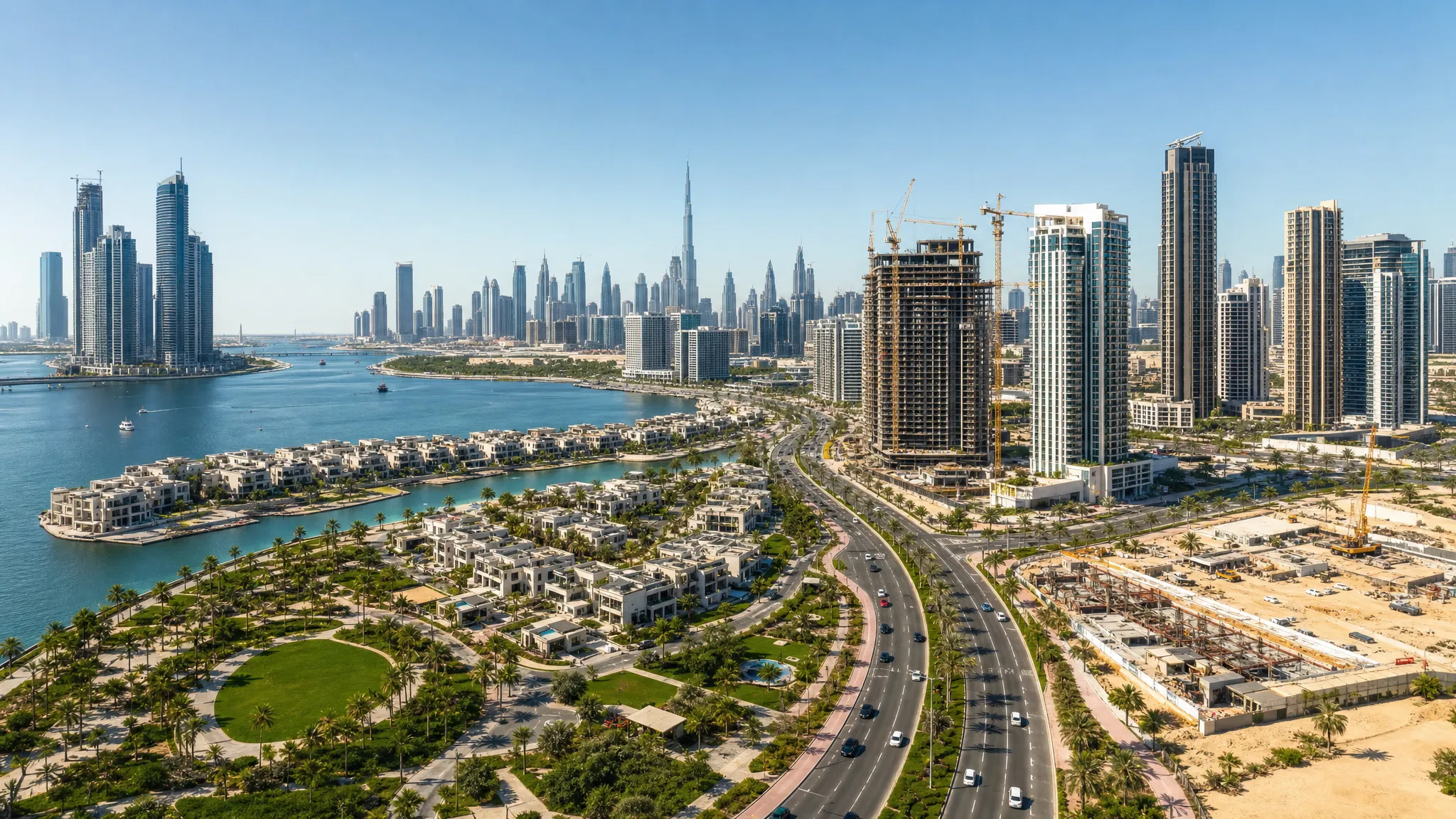
Luxury property is becoming more sophisticated
Dubai’s luxury segment remains one of the most watched parts of the market in 2026. Demand for waterfront villas, branded residences, penthouses, and high-service apartments continues to be supported by global wealth migration and Dubai’s reputation as a safe, connected, tax-efficient lifestyle hub.
However, the luxury buyer is also becoming more demanding. A high price alone does not create exclusivity. Buyers are looking for privacy, architecture, branded service quality, unobstructed views, beach or marina access, wellness amenities, and long-term building management.
In the top segment, scarcity matters more than size alone. A smaller unit with a rare view, better floor position, and strong brand management can outperform a larger property in a less distinctive location. Similarly, villas with privacy, plot value, and renovation potential may attract stronger demand than generic large homes with dated finishes.
The luxury market is also more global than ever. Buyers compare Dubai not only with other UAE communities, but with London, Singapore, Miami, Monaco, and Riyadh. This raises expectations for design, service, and legal clarity.
Technology is changing how people search and negotiate
In 2026, property search behavior is more digital and data-driven. Buyers expect detailed listings, high-quality images, virtual tours, transparent specifications, and fast communication with agents or owners.
This is a major shift from the older model of browsing vague listings and calling multiple agents just to confirm basic details. Serious buyers now shortlist faster and reject weak listings earlier. They compare price per square foot, floor plans, building amenities, handover status, service charges, and nearby alternatives before arranging viewings.
For sellers and agents, this means presentation matters. Listings with poor photos, unclear pricing, missing floor plans, or incomplete descriptions lose attention. For buyers, the advantage is better screening. Platforms such as Best Property in Dubai make it easier to search across UAE listings, apply filters, compare options, view property details, and connect directly with agents or owners.
The more transparent the listing experience becomes, the harder it is for overpriced or poorly presented properties to compete.
Operating costs are getting more attention
Another 2026 shift is the rising importance of total ownership cost. Buyers are no longer looking only at purchase price. They are asking how much the property will cost to hold.
This includes service charges, district cooling where applicable, maintenance, insurance, furnishing, property management, and vacancy risk. In some buildings, strong amenities can justify higher service fees. In others, high charges can reduce net yield and resale appeal.
Sustainability and efficiency are also becoming more relevant. Buyers increasingly pay attention to natural light, insulation, cooling efficiency, building maintenance standards, elevator quality, parking access, and community design. A property that is cheaper to operate and easier to live in can become more attractive over time.
For investors, this changes the yield conversation. Gross yield is only the starting point. Net return after service charges, maintenance, furnishing, and vacancy is what matters.
Investors are moving from hype to strategy
Dubai remains attractive for real estate investors in 2026, but the winning approach is becoming more disciplined. The market rewards buyers who understand their strategy before they search.
Some investors want stable long-term rental income. Others want capital appreciation from an emerging community. Some prefer short-term rental potential in tourist-heavy areas. Others focus on renovation, resale, or premium family homes.
Each strategy requires a different property type. A studio near a business district, a townhouse in a family community, a branded waterfront apartment, and a villa needing renovation can all be good investments, but not for the same buyer.
Before choosing a unit, define the investment thesis. If the plan is rental income, study tenant demand and net yield. If the plan is appreciation, assess future infrastructure, supply, and community maturity. If the plan is resale, think about what the next buyer will value.
A broader 2026 overview of investment fundamentals is available in the Dubai real estate investment guide, which can help you connect market trends with practical investment decisions.
What different buyers should focus on in 2026
The changing market affects each type of buyer differently. A first-time resident buyer does not need the same checklist as a global investor or luxury purchaser.
| Buyer type | Main opportunity in 2026 | Main risk to avoid |
|---|---|---|
| First-time buyer | Turning high rent into long-term ownership | Underestimating fees, maintenance, and mortgage costs |
| End user | More choice across ready and off-plan communities | Buying in a location that does not fit daily life |
| Rental investor | Strong tenant demand in well-connected areas | Relying on inflated rental projections |
| Off-plan buyer | Flexible payment plans and future growth potential | Ignoring developer history and delivery timelines |
| Luxury buyer | Access to globally competitive prime assets | Paying a premium for branding without true scarcity |
| Seller | Demand remains active for well-priced properties | Overpricing based on outdated market momentum |
Risks to watch as the market changes
A maturing market does not mean a risk-free market. In fact, selectivity makes due diligence more important.
The first risk is overpaying based on hype. Popular communities and new launches can generate urgency, but urgency should not replace analysis. Compare recent listings, similar layouts, and competing buildings before committing.
The second risk is using unrealistic rental assumptions. If an advertised yield looks high, check whether it is based on actual annual rent, short-term rental optimism, or a fully occupied scenario with no vacancy.
The third risk is ignoring service charges and building quality. Two apartments with the same purchase price can produce very different net returns if one has higher fees or weaker maintenance.
The fourth risk is buying without a clear exit plan. Even if you plan to hold long term, it is wise to understand who the future buyer might be. Is the property attractive to families, investors, tourists, or luxury end users? The wider the buyer pool, the stronger the resale position.
How to make smarter property decisions in 2026
The real estate of Dubai is changing, but the fundamentals of a smart purchase remain consistent. The best decisions combine market awareness with property-level analysis.
Start with your goal. Are you buying to live, rent, resell, diversify wealth, or secure a future home? Then narrow your search by community, budget, property type, and timeline. Once you find options, compare the details that actually affect value: layout, view, floor, building quality, service fees, parking, amenities, nearby supply, and realistic rental demand.
Do not rely only on sales brochures or headline prices. Use listing comparisons, speak with licensed agents, review community performance, and inspect properties carefully where possible. In 2026, the advantage belongs to buyers who are patient enough to compare and decisive enough to act when the right asset appears.
Frequently Asked Questions
Is Dubai real estate still a good investment in 2026? Dubai real estate can still be a strong investment in 2026, but results depend heavily on location, entry price, property type, service charges, and rental demand. The market is more selective, so due diligence matters more than ever.
How is the real estate of Dubai changing in 2026? The market is becoming more mature and data-driven. Buyers are comparing communities more carefully, focusing on livability, operating costs, developer reputation, rental evidence, and long-term value rather than relying only on broad market momentum.
Is off-plan property still attractive in Dubai in 2026? Off-plan property remains attractive for some buyers because of payment flexibility and future growth potential. However, buyers should carefully review developer track record, project location, handover timeline, escrow protections, and comparable ready-property prices.
Are rents still rising in Dubai in 2026? Rental conditions vary by area, property type, and building quality. Some communities remain highly competitive, while others are seeing more choice as supply increases. Buyers and investors should check current local listings and avoid assuming one citywide rental trend applies everywhere.
What should first-time buyers focus on in 2026? First-time buyers should focus on total affordability, including down payment, fees, mortgage payments, service charges, maintenance, and lifestyle fit. A property that works for daily life is usually a safer long-term decision than one chosen only for potential appreciation.
Find the right Dubai property with better market context
Dubai’s 2026 property market rewards informed decisions. Whether you are buying your first home, comparing investment options, or exploring rental opportunities, the right listing data and local context can make the search clearer.
Use Best Property in Dubai to explore updated UAE property listings, compare options, view detailed property information, and connect with agents or owners. In a more selective market, better comparison is not optional. It is how smarter property decisions begin.


Join The Discussion