
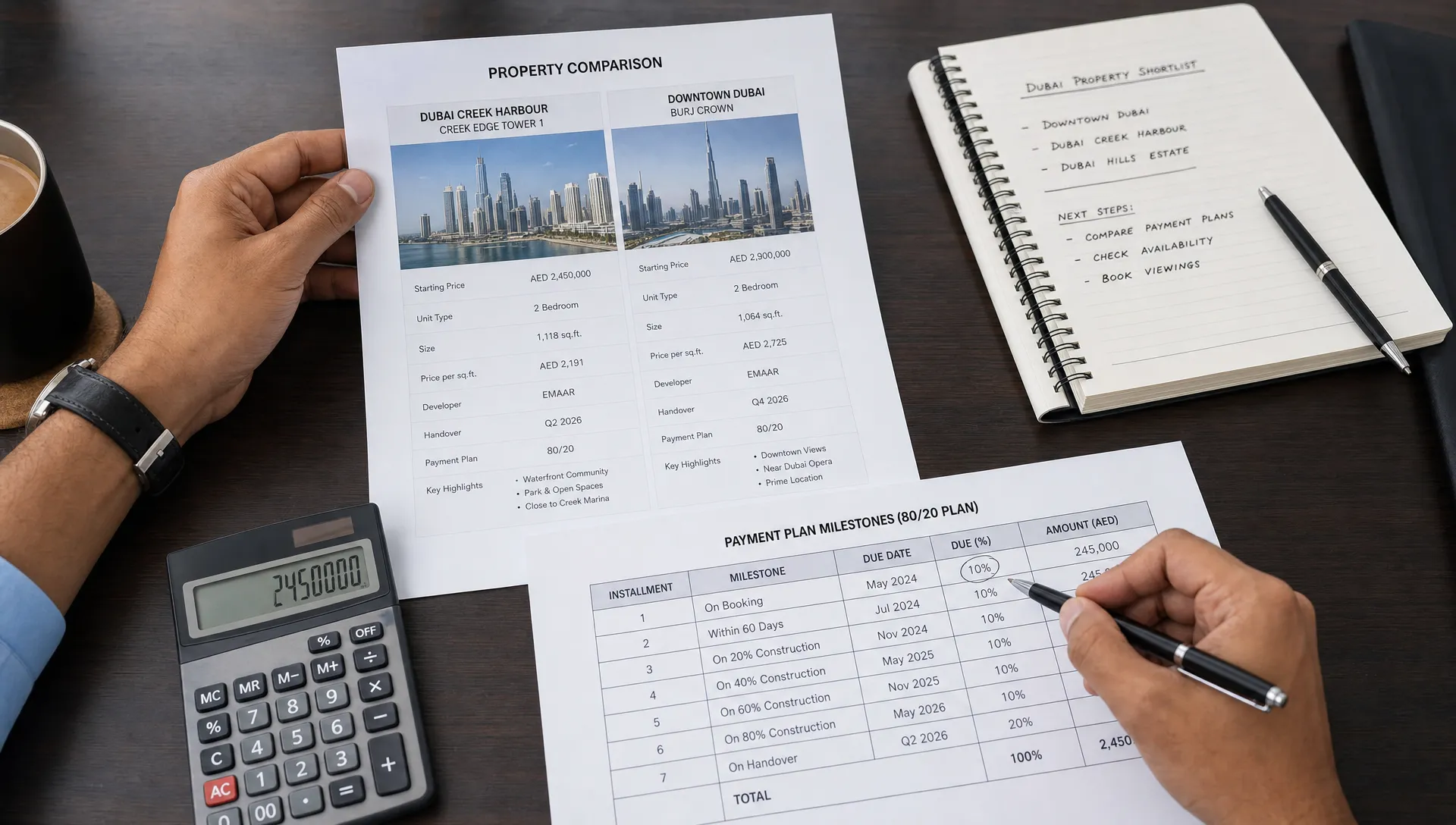
Buying with staged installments can make a Dubai home or investment feel more accessible, but payment plan properties in Dubai can also be difficult to compare if you focus only on the deposit. Two listings with the same headline price may create very different cash pressure, risk and exit flexibility once you read the schedule behind the offer.
The right comparison starts with the property, then the payment structure. A generous plan cannot fix a weak location, an inflated price or a developer you do not trust. Use the plan to support a good purchase decision, not to justify a poor one.
How to compare payment plan properties in Dubai
Start by separating three things: the asset, the payment timeline and the total cost of ownership. Buyers often mix these together, which is how an attractive monthly installment can distract from a high price per square foot or a poor handover timeline.
If you are still building your shortlist, it helps to compare listings side by side using the same filters for area, unit type, size and completion status. Best Property in Dubai has a useful guide on how to compare property for sale Dubai listings fast before you move into contract-level checks.
Compare the real price, not just the down payment
When you compare payment plan properties in Dubai, ask whether the payment flexibility is reflected in the price. A project with a smaller upfront payment may still be expensive if the price per square foot is higher than similar units in the same community.
Look at comparable properties by building quality, developer reputation, views, floor level, parking, unit efficiency and expected handover date. A 10% booking payment is not automatically better than a 20% booking payment if the first property costs significantly more overall.
Know the common payment plan structures
Payment plans vary by developer, project and market conditions, but most offers fall into a few broad categories. The label matters less than the dates, amounts and penalties written into the sales documents.
| Plan type | How it usually works | Buyer appeal | What to check closely |
|---|---|---|---|
| Construction-linked plan | Installments are tied to project progress | Payments match development milestones | Whether milestones are clear and independently verifiable |
| 60/40 or 70/30 plan | A portion is paid during construction and the balance at handover | Lower cash burden before completion | Whether the handover payment is realistic for your finances |
| Post-handover plan | Some installments continue after handover | More time to pay after receiving the unit | Final price, service charges and rental assumptions |
| Low booking offer | A small amount reserves the unit | Easier entry for first-time buyers | Next payment deadline and refund rules |
| Rent-to-own style plan | Occupancy payments may contribute toward purchase | Useful for end users testing a property | Legal structure, ownership timing and total premium |
A payment plan is only useful if you can meet every installment without forced borrowing or rushed resale. Missed payments can trigger penalties, cancellation terms or loss of amounts already paid, depending on the contract.
Match the plan to your buyer profile
For payment plan properties in Dubai, the best structure depends on why you are buying. End users usually care about handover certainty, monthly affordability and future family needs. Investors often focus on rental demand, capital appreciation potential and resale liquidity before completion.
A buyer planning to live in the unit may prefer a predictable payment path and a building close to schools, work or transport. An investor may accept a longer construction timeline if the entry price, community pipeline and rental outlook justify it. The same plan can be sensible for one buyer and risky for another.
Ready property or off-plan property?
The payment plan discussion is usually strongest in off-plan real estate, but ready properties can also come with developer-backed plans, seller flexibility or mortgage-based structures. Your due diligence should change depending on whether the unit exists today.
Off-plan properties need project-level checks
When payment plan properties in Dubai are off-plan, buyers should verify more than the brochure. Check the developer, the project registration, the escrow arrangements and the expected completion timeline. Dubai off-plan projects are regulated through official channels, and buyers can use the Dubai Land Department to review services and related property information.
You should also understand Oqood registration, the sales and purchase agreement, the payment milestone schedule and any developer rules around assignment or resale. Some projects restrict resale until a certain percentage has been paid, which matters if you may need to exit before handover.
Ready properties reduce construction risk
Ready properties let you inspect the actual unit, building, amenities and surrounding community before committing. You can also estimate service charges, maintenance condition and rental demand with more confidence.
The tradeoff is that ready units may require a larger upfront payment, a mortgage approval or faster transfer. If the seller offers flexibility, make sure the payment timing is documented properly and aligned with transfer requirements, mortgage release dates and No Objection Certificate procedures where applicable.
Costs buyers often miss in a payment plan
A fair comparison of payment plan properties in Dubai should include every cost that affects your cash flow, not only developer installments. The total amount you need can rise quickly once transaction fees, furnishing, service charges and utility setup are included.
Buyers in Dubai usually budget for the Dubai Land Department transfer fee, commonly quoted as 4% of the purchase price, plus trustee, admin and registration-related charges. Fees can change, and the correct amount depends on the transaction type, so verify figures with official channels, your broker or your conveyancer before signing.
You should also estimate service charges before handover if available, especially for apartments with extensive amenities. A lower purchase installment may be offset by higher annual building costs after completion.
If your budget is still flexible, review how different price brackets affect fees and ownership costs in this guide to property for sale in Dubai across different budgets.
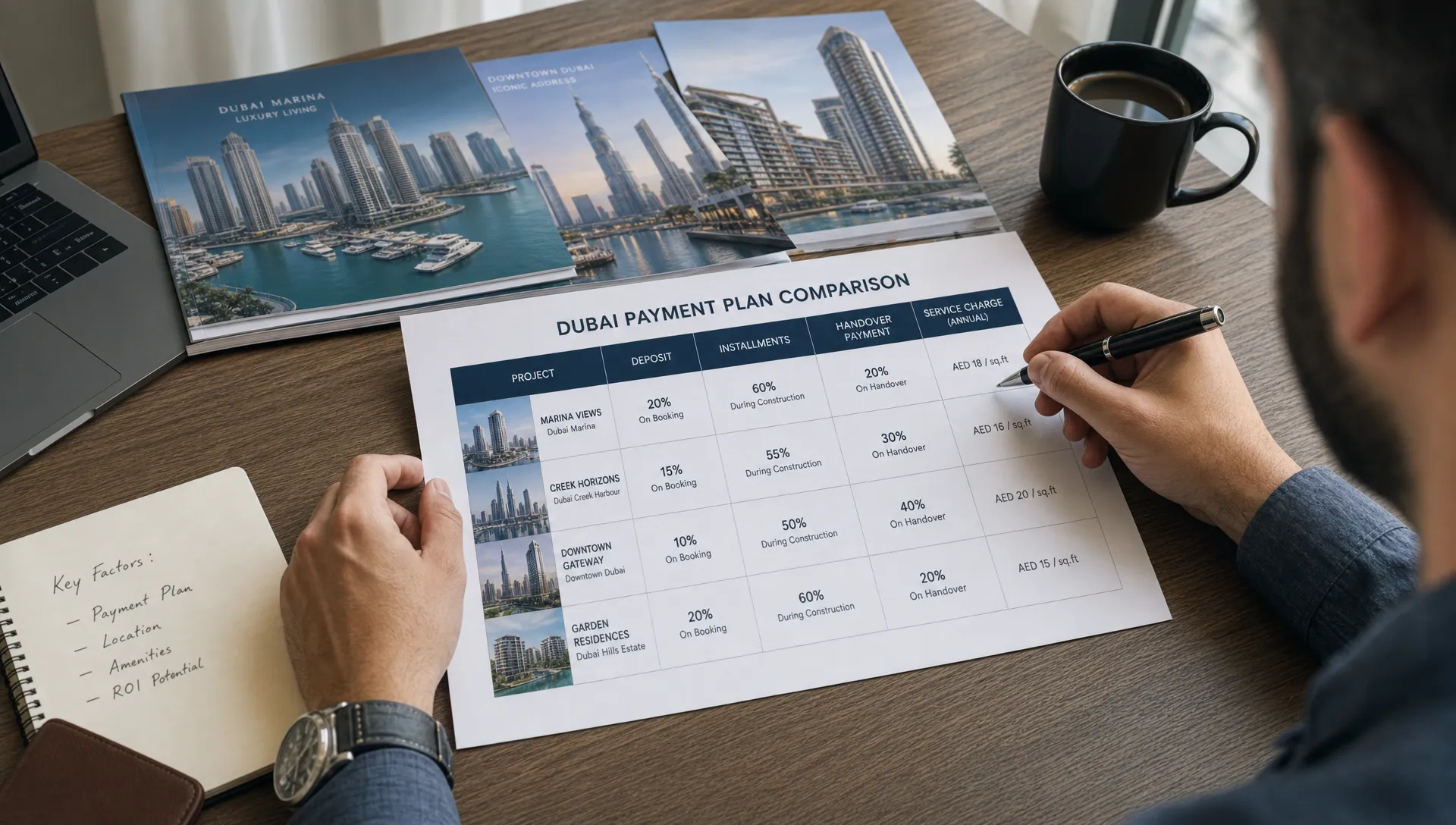
Developer, location and liquidity matter as much as the plan
A payment plan can improve affordability, but it cannot create demand where demand is weak. Before comparing installment schedules, confirm that the property fits a real buyer or tenant need.
Review the developer track record
Look at completed projects from the same developer. Review build quality, handover history, maintenance standards and how previous communities have aged. Delays can happen in any market, but a developer with transparent communication and a strong delivery record gives buyers more confidence.
For off-plan units, ask whether payments are linked to construction progress or fixed calendar dates. A fixed schedule may require you to keep paying even if the project timeline changes, subject to contract terms. This is a key detail in payment plan properties in Dubai because the risk is not only the price, it is also the timing.
Compare the community, not only the tower
Location quality affects rent, resale demand and your day-to-day life. Compare access to major roads, metro or public transport, schools, retail, parks, hospitals and employment hubs. Also consider future supply in the same area. If many similar units are due to hand over at the same time, rental competition may be stronger.
For end users, lifestyle fit can be more important than a slightly easier plan. For investors, the community should have enough demand to support occupancy and future resale. If you are unsure which neighborhoods fit your goals, use this guide on how to compare areas when buying property in Dubai.
Questions to ask before signing
Many payment plan properties in Dubai look affordable in the first brochure and more complex in the contract. Before paying a booking amount, ask direct questions and request written answers where possible.
- What is the total purchase price, including any premiums linked to the plan?
- Are installments fixed by date or linked to construction milestones?
- What fees are due at booking, registration, handover and transfer?
- What happens if an installment is delayed?
- Can the unit be resold before handover, and after what payment threshold?
- Are there post-handover payments, and do they carry any extra charges?
- What are the expected service charges and handover costs?
- Is mortgage financing possible for the unit, and at what stage should approval be arranged?
Do not rely only on verbal promises. The payment plan, cancellation terms, handover conditions and any incentives should appear in the reservation form, sales agreement or official addendum. If you are unsure, get independent legal or conveyancing advice before committing.
A simple comparison framework
Use a like-for-like framework so you do not compare a premium waterfront unit against a mid-market inland apartment as if the payment plan is the only variable. A practical comparison can fit on one page.
| Comparison factor | Property A | Property B | Why it matters |
|---|---|---|---|
| Total price | Fill in amount | Fill in amount | Shows the real purchase commitment |
| Price per square foot | Fill in amount | Fill in amount | Helps compare value across similar units |
| Booking payment | Fill in amount | Fill in amount | Measures immediate cash required |
| Largest future installment | Fill in amount | Fill in amount | Reveals the biggest cash-flow risk |
| Handover payment | Fill in amount | Fill in amount | Important for mortgage or savings planning |
| Estimated fees | Fill in amount | Fill in amount | Prevents under-budgeting |
| Developer record | Notes | Notes | Reduces delivery and quality risk |
| Resale restrictions | Notes | Notes | Affects exit flexibility |
| Community demand | Notes | Notes | Supports rent and resale potential |
The strongest option is rarely the one with the smallest first payment. It is the one where the asset quality, total price, timeline and buyer objective all work together.
Red flags buyers should not ignore
Be cautious if the offer focuses only on the deposit and avoids discussing the total price. Also be careful with vague handover dates, unclear escrow information, undocumented incentives or pressure to sign before you review the agreement.
Another red flag is a plan that depends on optimistic resale or rental assumptions. If the only way the numbers work is by flipping the unit quickly at a higher price, the investment may be more speculative than it first appears.
For payment plan properties in Dubai, the safest mindset is to assume you may need to hold the property longer than planned. If the payment schedule still works under that scenario, the purchase is more resilient.
Frequently Asked Questions
Are payment plan properties in Dubai only off-plan? No. They are most common in off-plan projects, but some ready properties may offer developer payment plans, seller flexibility or rent-to-own style structures. Always check how ownership transfer works.
Is a lower down payment always better? No. A low down payment can help cash flow, but it may come with a higher total price, larger later installments or stricter contract terms. Compare the full schedule.
Can I get a mortgage for a property on a payment plan? It depends on the property, developer, completion stage and lender criteria. Speak with banks or mortgage advisers early, especially if a large handover payment is part of the plan.
What should I verify before buying off-plan? Check project registration, escrow details, developer history, payment milestones, completion timeline, cancellation terms and resale restrictions. Use official sources and written documents, not only marketing material.
How do I compare two similar payment plans? Compare total price, price per square foot, deposit, largest installment, handover amount, fees, service charges, developer record and location demand. The better plan is the one that fits your cash flow and risk tolerance.
Find Dubai properties with payment plans more confidently
The best way to compare payment plan properties in Dubai is to start with clear filters, review detailed listings and speak with qualified agents before you commit. On Best Property in Dubai, buyers can explore updated UAE listings, compare options, save favorites and contact agents or owners directly.
Use the payment plan as one part of your decision. If the property, location, developer and numbers all make sense, the right installment structure can make your purchase smoother and more strategic.


Join The Discussion