
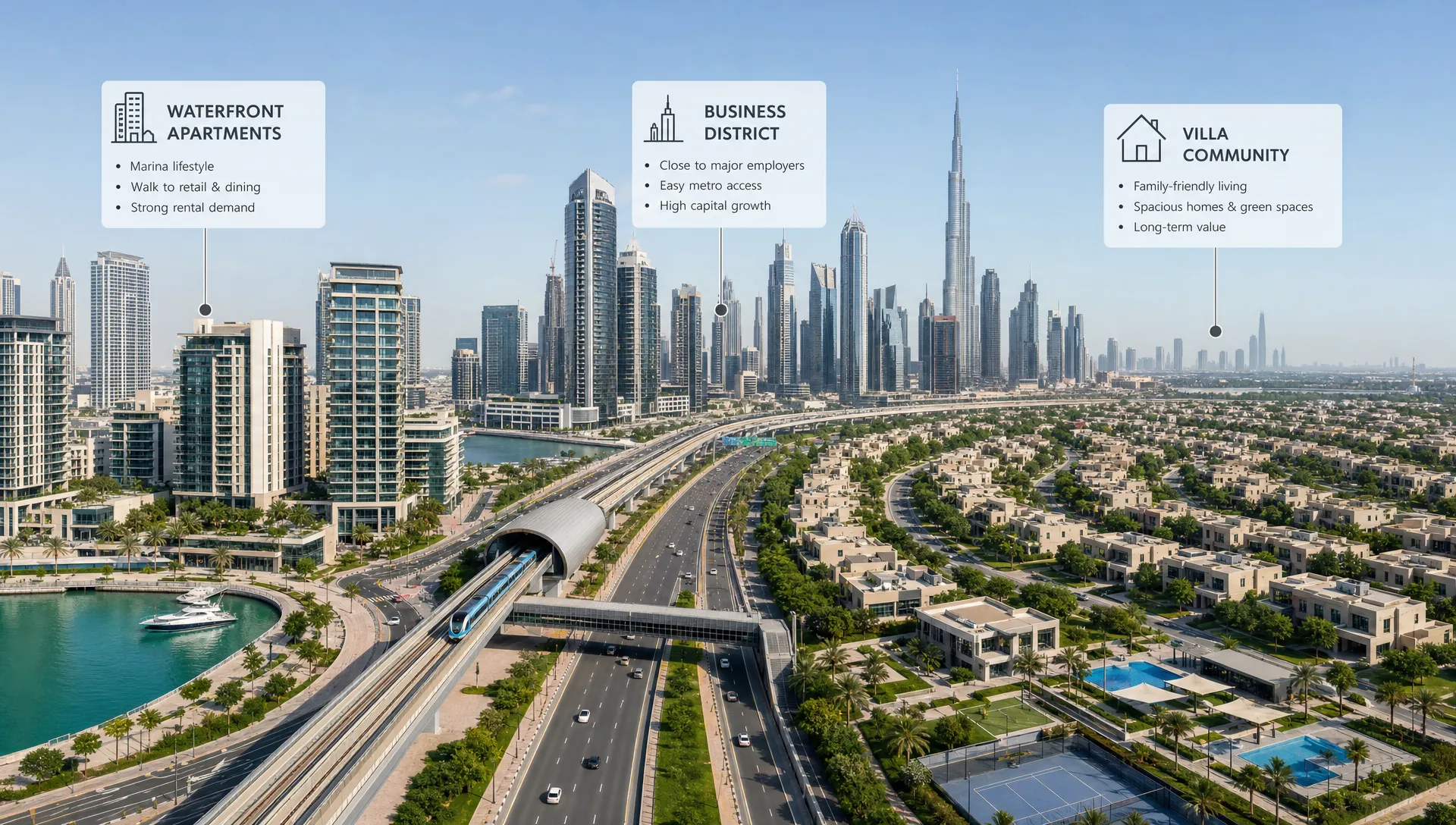
If you are searching for property to buy in Dubai, choosing the right area is often the decision that shapes everything else. The same budget can mean a waterfront apartment in one district, a larger unit in a developing community, or a townhouse farther from the city center. Each option can be valid, but only if it fits your lifestyle, risk tolerance, and investment goals.
Dubai is not one single property market. It is a collection of micro-markets, where building quality, commute patterns, nearby supply, tenant demand, service charges, and community maturity can vary sharply from one area to another. A smart comparison is not about asking, “Which area is best?” It is about asking, “Which area is best for this buyer, this budget, and this timeline?”
Below is a practical framework you can use before shortlisting homes, contacting agents, or making an offer.
Start With Your Buying Objective
Before comparing locations, define why you are buying. A family purchasing a long-term home should not evaluate areas the same way as an investor seeking rental yield. A buyer prioritizing capital appreciation may be comfortable with future infrastructure risk, while an end user may prefer an established community with schools, clinics, and retail already in place.
| Buyer goal | What matters most | Area signals to compare |
|---|---|---|
| Primary residence | Daily comfort, commute, schools, community feel | Road access, noise levels, supermarkets, parks, building management |
| Long-term rental investment | Tenant demand, net yield, maintenance, liquidity | Occupancy patterns, service charges, transport links, unit size demand |
| Capital appreciation | Future growth, infrastructure, scarcity | Master plan progress, upcoming supply, developer reputation, nearby amenities |
| Holiday home or short-term rental | Tourism demand, building rules, furnishing cost | Proximity to attractions, beach, metro, licensing rules, building policy |
| Retirement or second home | Safety, walkability, healthcare, ease of ownership | Quiet surroundings, elevators, parking, medical facilities, community services |
This first step helps you avoid a common mistake: falling in love with an area that is popular online but unsuitable for your real daily life or investment strategy.
Compare Total Cost, Not Just Asking Price
Dubai buyers often start by comparing listing prices. That is useful, but incomplete. A lower purchase price in one area can be offset by higher service charges, longer vacancy periods, renovation costs, or weaker resale demand. A more expensive area may still make sense if it offers stronger liquidity, better tenant quality, or lower long-term friction.
When comparing areas, look at the total cost of ownership. This may include the purchase price, Dubai Land Department transfer fee, agency commission, mortgage-related costs if applicable, service charges, maintenance, furnishing, chiller costs, community fees, and potential renovation work. Exact amounts depend on the property, transaction type, and current rules, so always verify costs with your agent, conveyancer, lender, and official sources.
For investment buyers, compare net returns rather than headline rent. A building with attractive rent but high service charges may underperform another building with slightly lower rent and more efficient running costs. For end users, compare monthly living cost as well as purchase price, especially if you are deciding between apartment communities and villa communities.
Judge Connectivity by Real Travel Time
Distance on a map can be misleading in Dubai. Two areas may appear close, but the actual commute can depend on road exits, bridge access, school traffic, construction diversions, parking availability, and metro connectivity.
Instead of only checking kilometers, test common routes at the times you will actually use them. If you work in DIFC, Business Bay, Dubai Marina, Jebel Ali, or Dubai Internet City, your best area may be shaped by peak-hour access more than by lifestyle preferences. Families should also test school runs, nursery drop-offs, weekend mall trips, and airport access.
Metro access can be a major advantage for rental demand in apartment-heavy districts. For villa communities, road infrastructure and exit points often matter more. If the area is still developing, check whether future roads and transport links are confirmed, under construction, or simply part of a long-term master plan.
Understand the Trade-Offs Between Area Types
Dubai areas tend to fall into recognizable categories. Comparing within each category is easier than comparing everything at once. For example, Dubai Marina and Downtown Dubai both attract apartment buyers, but the lifestyle, tenant mix, parking dynamics, views, and pricing logic are different. Likewise, comparing Dubai Hills Estate with Arabian Ranches is more meaningful than comparing either one with a high-rise waterfront district.
| Area type | Examples | Typical strengths | What to watch carefully |
|---|---|---|---|
| Prime urban and tourism districts | Downtown Dubai, Dubai Marina, JBR, Palm Jumeirah | Strong recognition, lifestyle appeal, visitor demand, resale visibility | Higher entry prices, service charges, traffic, building-by-building differences |
| Central business and mixed-use areas | Business Bay, DIFC fringe, City Walk | Business access, rental demand from professionals, urban convenience | Parking, noise, future supply, tower quality |
| Established villa communities | Arabian Ranches, The Springs, The Meadows, Jumeirah Park | Family appeal, mature landscaping, schools and community facilities | Older property condition, renovation cost, plot orientation |
| Newer master-planned communities | Dubai Hills Estate, Dubai Creek Harbour, MBR City, Tilal Al Ghaf | Modern layouts, planned amenities, potential growth | Delivery timelines, construction nearby, future supply levels |
| Value-led apartment communities | JVC, Arjan, Dubai Sports City, Al Furjan | Lower entry price, larger unit options, growing amenities | Building quality variation, road access, resale liquidity by project |
This table is not a ranking. It is a way to organize your thinking. If you want a broader area-by-area overview, the guide to the best areas to buy property in Dubai can help you build an initial shortlist before applying the comparison method below.
Compare Like With Like
One of the biggest errors buyers make is comparing completely different products as if they are the same. A one-bedroom apartment in Downtown Dubai, a one-bedroom in JVC, and a one-bedroom in Dubai Marina may all have the same bedroom count, but they are not equivalent assets.
Compare these details before deciding one area is “better value”:
- Actual usable space, not only advertised square footage
- Building age, developer, maintenance record, and common areas
- Balcony size, view, floor height, parking, and storage
- Service charges and cooling arrangements
- Current occupancy, tenancy terms, and vacancy risk
- Resale demand for that exact unit type in that exact community
For villas and townhouses, compare plot size, built-up area, layout efficiency, privacy, proximity to community facilities, and renovation condition. A larger villa in a less mature area may look attractive, but an older villa on a better plot in an established community may hold value more effectively, depending on your goals.
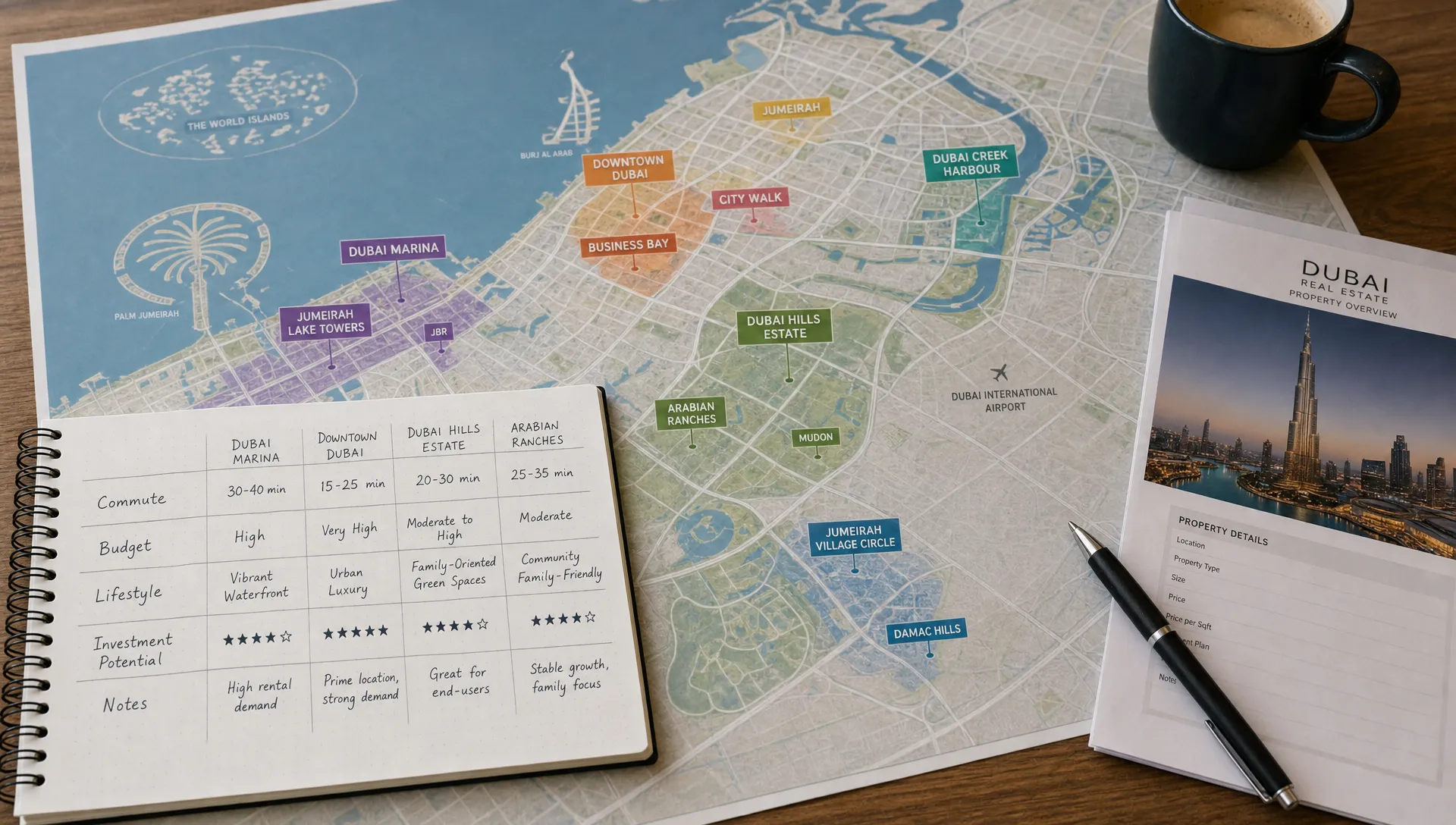
Use a Simple Area Scorecard
A scorecard turns a subjective decision into a clearer comparison. You do not need a complex financial model at the early stage. You need a consistent way to judge each area against your own priorities.
Here is an example for a buyer who wants a balanced mix of lifestyle and investment potential:
| Criterion | Suggested weight | How to evaluate it |
|---|---|---|
| Budget fit | 20% | Does the area offer suitable units within your all-in budget? |
| Commute and access | 15% | How reliable are daily routes during peak hours? |
| Lifestyle fit | 15% | Does the community match your daily habits, family needs, and preferred pace? |
| Rental demand | 15% | Is there a clear tenant pool for the unit type you are considering? |
| Resale liquidity | 15% | Are comparable properties regularly transacting, not just listed? |
| Building and community quality | 10% | Are maintenance, amenities, and management standards consistent? |
| Future supply and infrastructure | 10% | Could upcoming projects support or pressure future values? |
The weights should change based on your goal. An end user with children may give more weight to schools, parks, and commute. An investor may give more weight to rental demand, service charges, and resale liquidity. A buyer considering off-plan property may give more weight to developer track record, payment plan risk, and delivery timeline.
Check Transaction Evidence, Not Just Listings
Listings show asking prices. Transactions show what buyers actually paid. Both matter, but they are not the same. In fast-moving markets, asking prices can run ahead of concluded deals, especially in highly searched areas. In slower buildings, asking prices may remain optimistic for months.
Use registered transaction history from the Dubai Land Department as a reference point, then compare it with current listings, building condition, unit view, and seller motivation. A transaction from the same area is useful, but a transaction from the same tower, same layout, and similar floor is much more useful.
When analyzing prices, ask whether the comparable unit had a better view, a larger balcony, upgraded interiors, vacant possession, or a long-term tenant at below-market rent. These details can explain price differences that look confusing at first glance.
Read Listings for Area Clues
A good listing tells you more than the number of bedrooms and the asking price. It can reveal how the area performs, what kind of buyer or tenant the property suits, and whether the unit is priced realistically.
Pay attention to wording such as “motivated seller,” “vacant on transfer,” “rented until,” “handover soon,” “high floor,” “community view,” “park-facing,” or “near metro.” These phrases can affect value, but they must be verified. Photos, floor plans, title details, and viewing availability should support the claims.
If you are unsure how to separate useful listing information from marketing language, this guide on how to read real estate listings like a smart buyer explains what to check before you arrange viewings.
Factor in Future Supply and Community Maturity
New areas can offer modern layouts, attractive payment plans, and growth potential. Established areas can offer proven demand, completed infrastructure, and clearer resale evidence. Neither is automatically better.
In a newer community, compare what is completed today with what is promised later. A park, school, mall, or road connection can improve lifestyle and values, but timing matters. If you plan to live there immediately, nearby construction may affect noise, traffic, and convenience. If you are investing, a wave of handovers in the same area may increase rental competition in the short term.
In an established community, the key questions are different. Check building condition, renovation needs, parking, service charge history, and whether the area still attracts new buyer demand. Older does not mean worse, but maintenance quality becomes more important.
Visit Areas at Different Times
Online research is helpful, but it cannot replace visiting. A district that feels calm at noon may be congested at 6 p.m. A building that looks impressive in photos may have limited visitor parking, slow elevators, or noisy surroundings.
Try to visit your shortlisted areas at least twice. Weekday mornings show commute pressure. Weekday evenings reveal traffic, parking, and noise. Weekends show how residents use parks, retail, beaches, and community facilities. If you are buying for rental income, visit the building reception or lobby and observe how well the property appears to be managed.
For families, walk or drive the school route. For investors, speak with agents who specialize in that micro-market, not just Dubai generally. For end users, test practical routines such as grocery shopping, gym access, restaurant choices, and travel to friends or relatives.
Avoid These Area Comparison Mistakes
Even experienced buyers can misread Dubai areas if they focus on one attractive feature and ignore the rest.
| Mistake | Why it can hurt your decision | Smarter approach |
|---|---|---|
| Choosing only by lowest price per square foot | Cheaper space may come with weaker demand, poor access, or high running costs | Compare total value, liquidity, and building quality |
| Assuming all towers in one area perform the same | Dubai micro-markets can vary tower by tower | Compare the exact building, layout, view, and service charges |
| Ignoring service charges | High recurring costs can reduce net yield and resale appeal | Request current service charge information before committing |
| Buying based on future promises only | Infrastructure delays can affect lifestyle and rental demand | Separate completed amenities from planned amenities |
| Comparing off-plan and ready homes too casually | Payment plans, delivery risk, and immediate usability differ | Build separate comparisons for ready and off-plan options |
The goal is not to eliminate all risk. Real estate always involves uncertainty. The goal is to understand which risks you are accepting and whether the price reflects them.
Narrow Your Shortlist Before You Make an Offer
After comparing areas, aim to reduce your shortlist to two or three communities. More than that can create decision fatigue. For each shortlisted area, choose a preferred property type, a realistic budget range, and a clear set of must-have features.
A practical shortlist might look like this: one established area for stability, one newer master-planned area for growth potential, and one value-led area for stronger affordability. From there, compare actual units rather than general impressions.
Once you have narrowed your preferred area and property type, review the buying process carefully. The step-by-step guide on how to buy a property in Dubai can help you understand the typical transaction flow before you proceed.
Frequently Asked Questions
What is the best area to buy property in Dubai? The best area depends on your budget, lifestyle, and investment goal. Downtown Dubai, Dubai Marina, Palm Jumeirah, Dubai Hills Estate, JVC, Business Bay, and established villa communities can all make sense for different buyers. Compare each area by total cost, demand, commute, building quality, and resale potential.
How many areas should I compare before buying? Start with five to seven areas during research, then narrow your shortlist to two or three. This gives you enough market context without making the decision overwhelming.
Is a cheaper area always better for ROI? No. Lower entry prices can help rental yield, but only if tenant demand, occupancy, service charges, and resale liquidity are strong. A cheaper area with weak demand or oversupply may underperform a more expensive but more liquid location.
Should I buy in an established area or an emerging area? Established areas usually offer clearer transaction evidence and completed amenities. Emerging areas may offer growth potential and newer properties, but buyers should assess delivery timelines, future supply, and current livability.
How can I compare Dubai areas if I live overseas? Use verified listings, transaction references, virtual tours, video calls with agents, community maps, and independent inspections where possible. If you cannot visit in person, ask for detailed videos of the building, street access, parking, amenities, and surrounding area.
Compare Dubai Properties With Better Context
Finding the right area becomes easier when you can compare real listings side by side. On Best Property, you can explore properties across Dubai and the wider UAE, use search filters, review detailed listings, save favorites, compare options, and contact agents or owners directly.
Use the area framework above before you shortlist. Then compare actual homes with the same discipline: location, building quality, total cost, rental demand, and long-term fit. That is how you move from browsing properties to making a confident buying decision.


Join The Discussion