
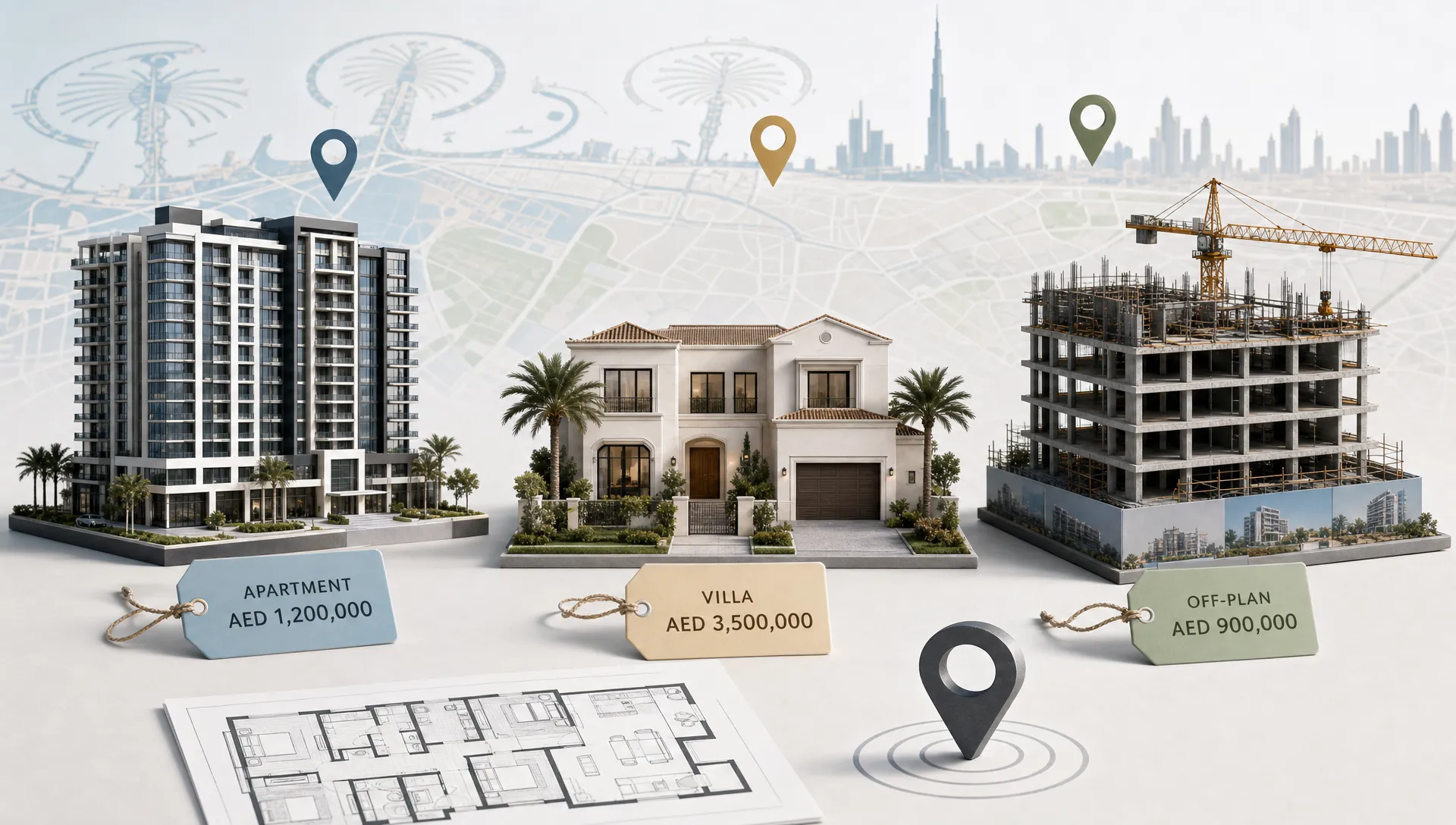
Dubai gives buyers an unusually large choice of apartments, villas, townhouses, penthouses, and off-plan homes. That choice is useful, but it also creates a problem: two listings can look similar at first glance while having very different value, ownership conditions, rental potential, and total costs.
The fastest way to compare property for sale in Dubai is not to open more tabs. It is to compare every listing against the same small set of decision points. Once you know what to check, you can reject weak listings quickly, shortlist the right ones, and contact agents with better questions.
Below is a practical system you can use whether you are buying a home, investing for rental income, or comparing ready and off-plan opportunities.
Start with your buying goal before you compare listings
A fast comparison starts before you even search. If your goal is vague, every attractive photo can feel like a possible match. If your goal is clear, most listings become easy to accept or reject.
For an end user, the key question is lifestyle fit. You will care about commute, schools, building facilities, community feel, noise, storage, parking, and future maintenance. For an investor, the same property must also be judged by rental demand, tenant profile, service charges, resale liquidity, and the likely holding period.
Use this quick filter before reviewing any listing:
| Decision point | What to decide first | Why it speeds up comparison |
|---|---|---|
| Budget | Maximum purchase price plus buying costs | Prevents wasting time on listings that are not realistic |
| Property type | Apartment, villa, townhouse, penthouse, commercial | Keeps layouts and price benchmarks comparable |
| Purpose | Own use, long-term rental, short-term rental, resale | Changes which features matter most |
| Area | 2 to 4 preferred communities | Makes price per square foot comparisons more accurate |
| Status | Ready, tenanted, vacant, off-plan | Affects handover timing, income, and risk |
| Must-haves | Bedrooms, parking, balcony, view, amenities | Helps you reject attractive but unsuitable options fast |
Do not compare a vacant Downtown Dubai apartment with an off-plan suburban townhouse as if they are the same decision. They may both be good properties, but they answer different goals.
Use filters to remove weak matches first
The biggest time saver is disciplined filtering. Start broad enough to see the market, then narrow your search in stages. On Best Property, you can use advanced search filters, detailed listings, photos, and direct agent contact options to narrow your shortlist without manually sorting through every result.
A practical first pass should filter by location, price range, property type, bedroom count, and sale status. After that, look at size, furnishing, views, parking, building amenities, and whether the unit is vacant or rented.
If you are still exploring the market, browse current Dubai property listings with a wide price range first. Once you see the typical prices in your target areas, tighten the filters and compare only the best-matching options.
The aim is not to find the perfect listing in one search. The aim is to remove poor fits quickly so your attention goes to properties that could genuinely work.
Compare price per square foot, not just total price
The listing price is the first number buyers notice, but it can be misleading. A cheaper property may be smaller, poorly located within the building, tenanted below market rent, or in need of renovation. A more expensive property may offer a better floor, larger layout, direct view, upgraded interiors, or stronger resale demand.
Price per square foot gives you a cleaner first comparison:
Price per square foot = asking price divided by built-up area
Here is a simple example:
| Listing | Asking price | Size | Price per sq ft | Initial reading |
|---|---|---|---|---|
| Apartment A | AED 1,500,000 | 750 sq ft | AED 2,000 | Compact unit, compare view and floor carefully |
| Apartment B | AED 1,700,000 | 950 sq ft | AED 1,789 | Higher price, but more space for the money |
| Apartment C | AED 1,450,000 | 680 sq ft | AED 2,132 | Cheapest total price, highest price per sq ft |
This does not mean the lowest price per square foot is always best. In Dubai, premiums can be justified by waterfront views, branded residences, walkability, metro access, building quality, developer reputation, or rare layouts. Still, price per square foot helps you spot listings that deserve deeper review and listings that are expensive without a clear reason.
For a stronger benchmark, compare against recent sales in the same building or nearby buildings. The Dubai Land Department is the official source for Dubai real estate regulatory information and transaction-related services, so it is a useful place to understand the market framework and verify official processes.
Read descriptions as data, not marketing
Listing descriptions are written to sell. Your job is to translate the marketing language into facts.
Phrases like “best deal,” “hot property,” or “investor special” do not mean much unless the listing explains why. Look for concrete details: unit size, floor level, view, parking, furnishing, service charges, occupancy status, rental contract details, handover timeline, payment plan, and whether the seller is motivated.
For ready properties, pay special attention to whether the home is vacant, owner-occupied, or tenanted. A tenanted unit can be attractive for investors because income may begin quickly, but it can be inconvenient for end users who want to move in. You should also ask whether the existing rent is below, at, or above market level.
For off-plan properties, the listing should make the developer, project name, handover estimate, payment plan, escrow status, and registration process clear. If these details are missing, the listing may still be legitimate, but you should ask questions before investing time in a viewing or booking discussion.
If you want a deeper breakdown of listing language, pricing clues, and hidden signals, this guide on how to read real estate listings like a smart buyer is a useful companion.
Compare the micro-location, not only the community name
In Dubai, the same neighborhood can contain very different property experiences. A listing in Dubai Marina, JVC, Business Bay, Downtown Dubai, Palm Jumeirah, Dubai Hills Estate, or Arabian Ranches should not be judged by the community name alone.
Micro-location affects daily life and resale value. A unit close to a metro station, park, school, mall, beach, or major road may command a premium. But the same convenience can also bring traffic, noise, limited parking, or busier surroundings.
Check these details before shortlisting:
- Distance to work, schools, airport, or frequent destinations
- Access to main roads at peak hours
- Nearby construction that may affect noise or views
- Walkability to shops, parks, restaurants, or public transport
- Building position within the community
- Floor level, view corridor, sunlight, and privacy
A “sea view” listing may have a direct open view, a partial angled view, or a view that could be affected by future construction. A “near metro” listing may mean a five-minute walk or a 20-minute walk in summer heat. These details matter.
Use photos and virtual tours to spot costly clues
Photos are not just for taste. They can reveal maintenance, layout efficiency, natural light, building quality, and whether the property matches the description.
Look for signs of water damage, uneven flooring, aging kitchens, outdated bathrooms, poorly used space, blocked views, low natural light, or cramped bedrooms. For villas and townhouses, check outdoor areas, boundary walls, landscaping, roof condition, and whether extensions appear professionally finished.
Virtual tours can save significant time because they show flow between rooms better than still images. A floor plan is even better. If a listing has beautiful photos but no floor plan, ask the agent for one before viewing. Layout efficiency can matter as much as square footage.
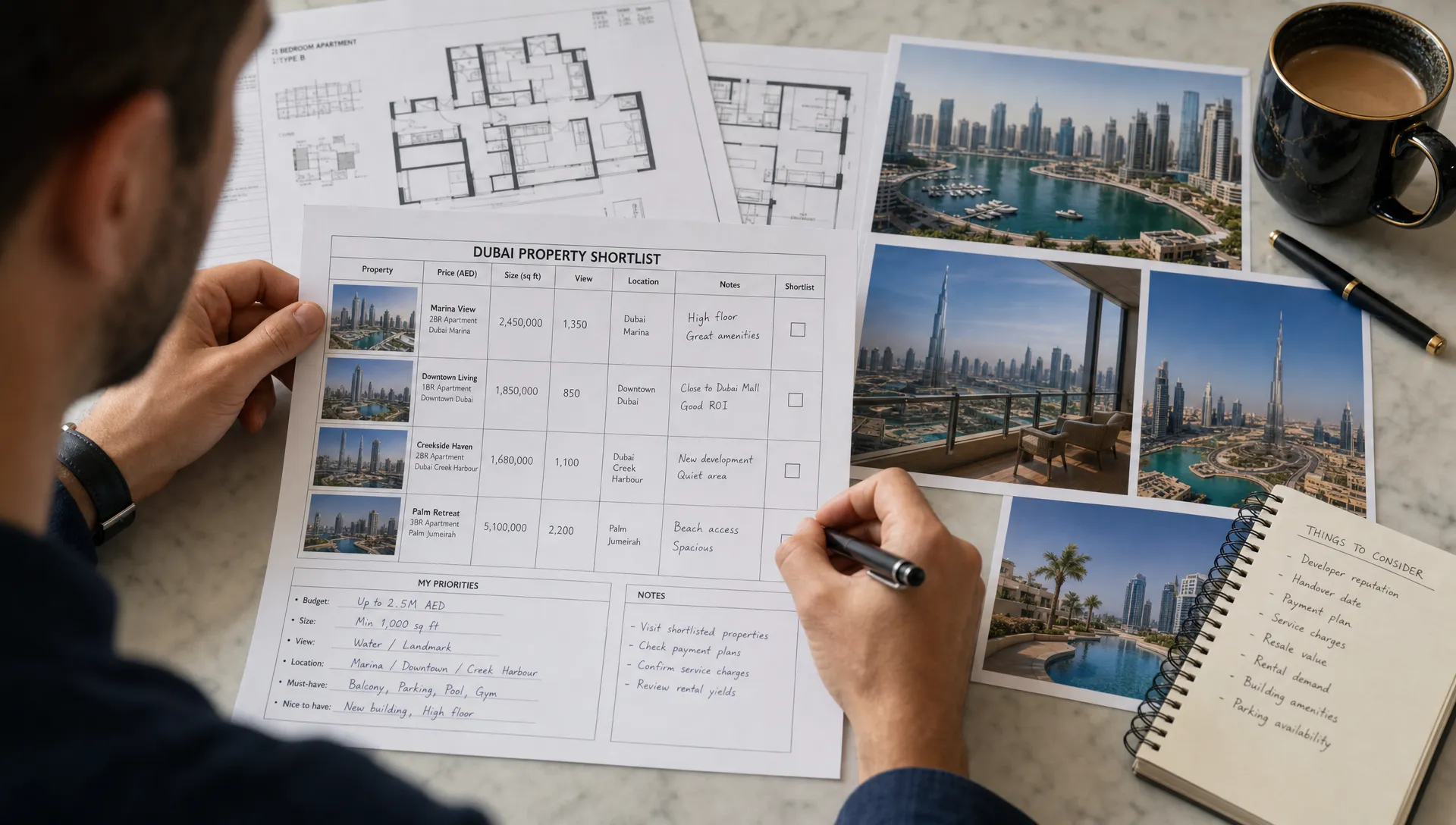
Factor in total ownership cost
A fast comparison should include more than the asking price. In Dubai, buyers commonly need to budget for transaction costs, agency commission, registration-related fees, mortgage-related costs if financing, moving expenses, furnishings, maintenance, and annual service charges.
Service charges are especially important for apartments and some villa communities. A property with a slightly lower purchase price can become less attractive if ongoing charges are high and rental income does not support them.
Ask for the annual service charge amount and compare it against similar buildings in the same area. Also ask what the fee covers. A premium tower with strong facilities may justify higher charges, while a building with average amenities and high fees deserves closer scrutiny.
For investors, compare expected net yield, not only gross yield. Gross yield uses annual rent divided by purchase price. Net yield considers service charges, maintenance, vacancy periods, management costs, and other ownership expenses. The net number is closer to your real return.
Compare ready and off-plan properties separately
Ready and off-plan listings often compete for the same buyer budget, but they should be assessed differently.
Ready property gives you a physical asset to inspect, clearer rental expectations, and usually faster transfer. You can evaluate the building, view, community maturity, actual amenities, and current market rent. The tradeoff is that payment is usually due sooner, especially for cash buyers, and the best units may command higher prices.
Off-plan property can offer staged payment plans, new designs, and access to upcoming communities or new phases of established areas. The tradeoff is uncertainty. Handover dates, final views, surrounding infrastructure, rental demand, and resale liquidity may change by completion.
When comparing off-plan listings, ask about the developer, project registration, escrow arrangements, payment schedule, handover estimate, cancellation terms, floor plan, and what is included in the sale price. A payment plan that looks easy today may still require a large final payment or mortgage approval later.
If you are mainly looking at upcoming developments, compare them separately from ready homes and focus on developer track record, handover timing, and payment structure.
Build a 10-minute listing scorecard
A simple scorecard keeps emotion under control. You do not need a complex spreadsheet. You only need enough structure to compare every listing in the same way.
Use this scoring model for each serious option:
| Category | Weight | What to check |
|---|---|---|
| Budget fit | 20% | Asking price, buying costs, payment plan, financing fit |
| Location fit | 20% | Commute, amenities, access, community demand |
| Value | 20% | Price per sq ft compared with similar listings and recent sales |
| Property quality | 15% | Layout, floor, view, condition, building reputation |
| Legal and occupancy clarity | 15% | Title status, tenancy, handover, agent details, permits |
| Exit potential | 10% | Rental demand, resale liquidity, uniqueness |
Score each category from 1 to 5, then multiply by the weight if you want a more precise ranking. If you want speed, simply mark each category as strong, acceptable, or weak.
The goal is not to remove judgment. It is to make your judgment consistent.
Red flags that should slow your comparison down
Fast does not mean careless. Some listings deserve extra caution, especially if the deal seems unusually cheap or the information is incomplete.
Be careful when you see vague descriptions, missing location details, unusually low prices, reused photos, unclear ownership status, pressure to pay quickly, or an agent who avoids basic questions. Also be cautious if the listing does not clearly identify the project, building, unit type, size, and sale conditions.
A good listing should make it easy to understand what is being sold. If you repeatedly need to chase basic information, compare that property with more transparent alternatives. For a more detailed checklist, review these real estate property listing red flags before you commit to viewings or negotiations.
A fast workflow for shortlisting Dubai property listings
Use this process when you need to compare many listings quickly:
- Set your non-negotiables: Choose your budget, areas, property type, bedroom count, and buying purpose before searching.
- Filter hard: Remove listings outside your price range, preferred locations, and required property type.
- Open only realistic matches: Review the listings that meet your core criteria, not every attractive thumbnail.
- Calculate price per square foot: Compare the asking price against size, building, view, and nearby alternatives.
- Check occupancy and total costs: Confirm whether the property is vacant, rented, off-plan, or under a payment plan.
- Save your top options: Keep only the properties that score well on budget, location, value, and clarity.
- Contact agents with specific questions: Ask about title, service charges, view, floor, tenancy, negotiation room, and viewing availability.
This workflow can reduce 50 listings to 5 serious options in less than an hour. More importantly, it helps you avoid booking viewings for properties that were never a good fit.
Questions to ask before booking a viewing
Before you visit a property, send the agent a short set of questions. This saves time for both sides and helps confirm that the listing is accurate.
Ask whether the property is available, whether the price is negotiable, whether it is vacant or tenanted, what the annual service charges are, whether there is a floor plan, what view and floor the unit has, and whether the seller is ready to transfer. For villas, ask about plot size, maintenance history, extensions, community fees, and handover condition.
If the agent gives clear answers, the viewing is more likely to be productive. If the answers are vague, keep the listing on hold until the missing information is provided.
Frequently Asked Questions
How do I compare property for sale Dubai listings quickly? Start with your budget, preferred areas, property type, and buying purpose. Then compare only realistic matches using price per square foot, occupancy status, service charges, location quality, photos, and legal clarity.
Is price per square foot the most important comparison metric? It is one of the most useful first checks, but it is not enough on its own. A higher price per square foot may be justified by view, floor, building quality, layout, developer reputation, or rare location advantages.
Should I compare ready and off-plan Dubai properties together? You can compare them at a budget level, but final evaluation should be separate. Ready properties offer inspection and faster use, while off-plan properties require more attention to developer track record, payment plan, handover timing, and project details.
How can I tell if a Dubai property listing is reliable? Reliable listings usually provide clear photos, accurate location, size, price, property status, agent details, and key sale conditions. If important details are missing or the price seems unusually low, verify before viewing.
What should I ask an agent before shortlisting a property? Ask about availability, ownership status, tenancy, service charges, floor plan, view, floor level, parking, negotiation room, and expected transfer timeline. For off-plan, ask about developer, escrow, payment plan, and handover estimate.
Compare faster, then verify deeper
The best buyers in Dubai do not simply look at more listings. They compare better. A clear system helps you move quickly while still protecting yourself from poor-fit properties, unclear offers, and expensive surprises.
Start with your goal, filter aggressively, compare value consistently, and only contact agents when a listing passes your basic checks. When you are ready to shortlist, Best Property makes it easier to search current listings, review detailed property information, save favorites, and connect with agents directly.


Join The Discussion