
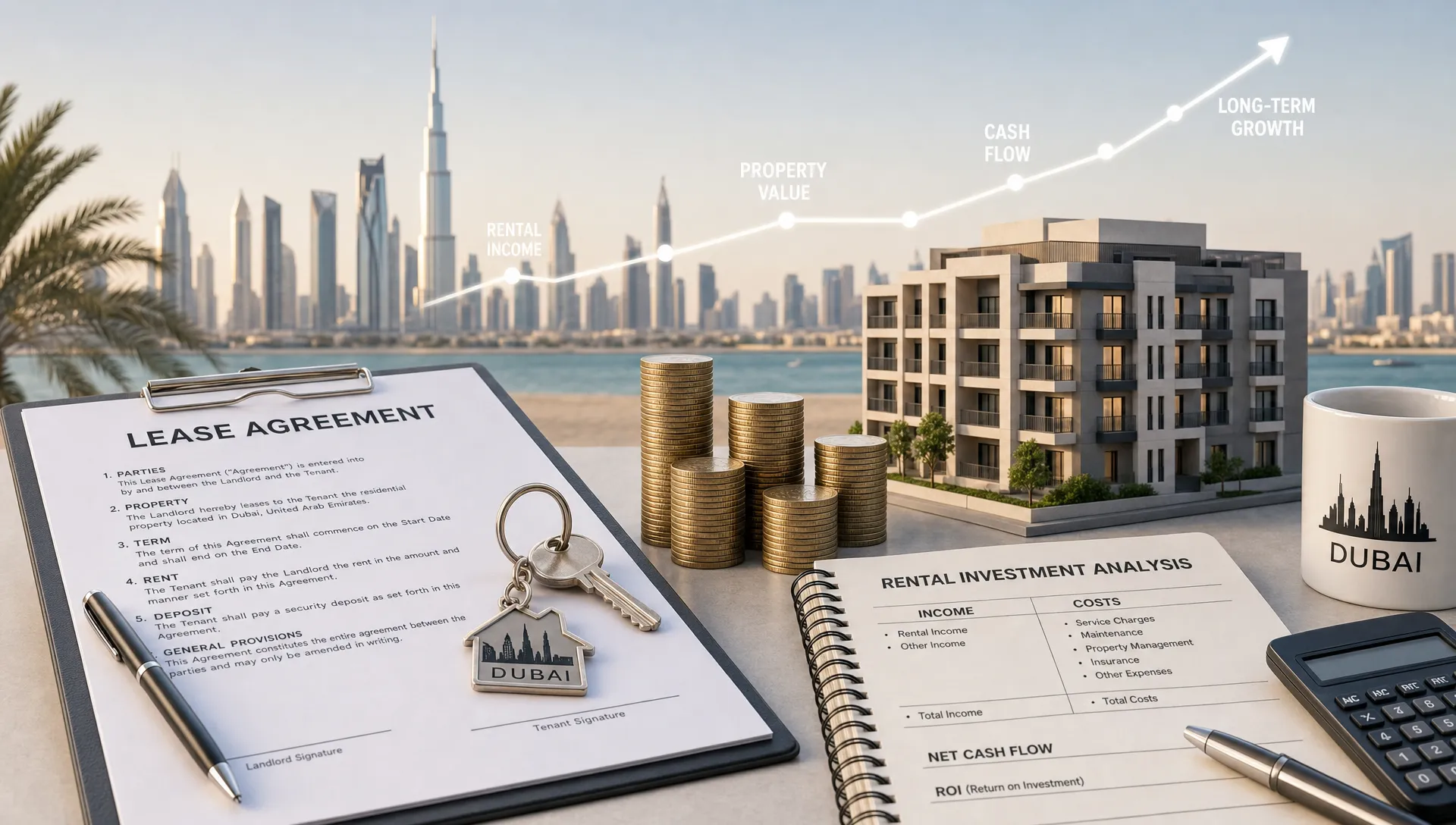
Rental properties for sale can look like the perfect real estate investment: buy an asset, place a tenant, collect income, and benefit from long-term appreciation. In Dubai and the wider UAE, that idea is especially attractive because of strong population growth, global investor demand, business-friendly policies, and a deep pool of renters across apartments, villas, townhouses, and commercial spaces.
But not every income-producing property is a good investment. A unit with a tenant already in place may still have weak net returns. A high advertised yield may disappear once service charges, vacancy, maintenance, financing costs, and management fees are included. And a property in a popular area can still be overpriced if the rent is already at its ceiling.
So, are rental properties for sale good investments? Yes, when the numbers, location, tenant demand, legal position, and exit strategy all work together. The best investors do not buy only because a property is rented. They buy because the income is sustainable, the asset is liquid, and the risk is understood before transfer.
What Does “Rental Property for Sale” Actually Mean?
A rental property for sale is any property purchased primarily to generate rental income. In the UAE, this may include a ready apartment in Dubai Marina, a family villa in Arabian Ranches, a townhouse in Dubai South, a studio near a metro station, a retail unit, or an office in a business district.
There are two common scenarios:
| Type of property | What it means | Main investor question |
|---|---|---|
| Vacant property | You buy the unit and find a tenant after handover | Can the property rent quickly at the projected rate? |
| Tenanted property | The property already has a lease and tenant in place | Are the lease terms, rent, and tenant profile attractive? |
A tenanted property may offer income from day one, which is useful for investors who want immediate cash flow. A vacant property may give you more control over furnishing, pricing, lease structure, and whether to use long-term or short-term rental strategies.
Neither option is automatically better. A below-market lease can reduce near-term income, while a vacant unit in a high-demand area may lease quickly at a stronger rent. The right choice depends on your investment goals.
Why Rental Properties Appeal to UAE Investors
Dubai’s rental market has several characteristics that make income property attractive. The city continues to draw professionals, entrepreneurs, families, and high-net-worth residents from around the world. Many residents rent before buying, and many companies prefer flexible accommodation options for employees.
For investors, rental property offers four potential advantages.
First, it can create recurring income. Unlike a pure capital appreciation strategy, a leased property may generate monthly, quarterly, or annual rent depending on the tenancy agreement.
Second, the asset may appreciate over time. This is not guaranteed, but well-located properties in supply-constrained or high-demand communities can benefit from long-term value growth.
Third, real estate can diversify a portfolio. Rental property behaves differently from stocks, bonds, or cash, especially when purchased with a long-term horizon.
Fourth, Dubai has an established property ownership framework, including freehold areas for foreign investors and official registration through the Dubai Land Department. Investors should still carry out legal checks, but the market has become increasingly transparent compared with many emerging real estate destinations.
If you are still learning the buying process, the Buying Property in Dubai 2026 guide is a useful next step before comparing individual listings.
The Real Test: Yield, Cash Flow, and Total Return
The biggest mistake investors make is focusing only on the advertised rent. A property renting for AED 120,000 per year may look excellent, but it is not enough to judge the investment. You need to know what is left after costs and how the property compares with the capital invested.
Here are the core metrics to review before buying.
| Metric | Formula | Why it matters |
|---|---|---|
| Gross rental yield | Annual rent divided by purchase price | Shows headline income potential before expenses |
| Net rental yield | Annual rent minus annual costs, divided by total acquisition cost | Gives a more realistic view of return |
| Cash flow | Rental income minus all ownership and finance costs | Shows whether the property pays you or costs you each year |
| Vacancy allowance | Expected unpaid period each year | Protects your forecast from being too optimistic |
| Total return | Net income plus capital appreciation | Captures both income and asset growth |
Gross yield is useful for quick comparisons, but net yield is far more important. In Dubai, ongoing costs may include service charges, maintenance, property management, insurance, furnishing replacement, mortgage payments, and occasional vacancy. Purchase costs can also affect your real return, including Dubai Land Department fees, agency commission, trustee fees, mortgage-related fees, and conveyancing where applicable.
A Simple Example
Imagine an investor buys an apartment for AED 1,200,000 and rents it for AED 90,000 per year. The gross yield is 7.5 percent.
Now assume annual service charges, maintenance, insurance, management, and vacancy allowance total AED 25,000. Net annual income becomes AED 65,000. If the total acquisition cost, including purchase-related fees, is AED 1,270,000, the net yield is about 5.1 percent.
That may still be attractive, but it is very different from the headline 7.5 percent. If the investor uses a mortgage, interest and principal payments will further affect cash flow. If the unit needs furnishing or repairs, first-year returns may be lower.
This is why serious investors model three cases: conservative, realistic, and optimistic. If the deal only works in the optimistic case, it may not be a safe investment.
What Makes a Rental Property a Good Investment?
A good rental property is not just one with a high rent. It is a property that can attract tenants consistently, control costs, and remain desirable when you eventually sell.
The most important factor is location. Properties near business districts, metro stations, schools, beaches, hospitals, malls, and major roads often have stronger tenant demand. For family homes, community quality matters just as much as commute time. Parks, schools, retail, security, and layout can influence both rent and resale value.
Unit type also matters. Studios and one-bedroom apartments may offer attractive yields because of lower entry prices and broad renter demand. Larger apartments and villas may attract families with longer tenancy periods, but they can require higher maintenance budgets. Commercial properties may offer longer leases, but they are usually more sensitive to business cycles and tenant quality.
Building quality is another major factor. A well-managed building with reasonable service charges can preserve returns. A building with poor maintenance, frequent elevator issues, weak parking, or high charges can reduce tenant satisfaction and resale demand.
Finally, liquidity matters. You are not only buying income. You are buying an asset you may want to sell later. A property in a proven community with broad buyer demand is usually easier to exit than a highly niche unit with limited appeal.
For a deeper look at location selection, see the Best Areas to Buy Property in Dubai 2026 guide, especially if you are comparing established communities with emerging districts.
Tenanted Properties: Advantage or Hidden Risk?
A tenanted property can be attractive because income starts immediately after transfer. This reduces the uncertainty of finding a tenant and may help mortgage-backed investors manage cash flow from the beginning.
However, the existing lease can also limit your options. If the rent is below market, you may not be able to raise it immediately. If the tenant has a long lease, you may have to honor the existing agreement. If the tenant is behind on payments or there is a dispute, the “income” may be less reliable than it appears.
Before buying a tenanted property, review the tenancy contract, Ejari registration, payment schedule, security deposit, rent cheques, outstanding notices, and any written communication about renewal or disputes. You should also understand Dubai tenancy rules and consult a qualified advisor if you plan to occupy, renovate, or change the use of the property.
A tenanted unit is best when the lease is documented, rent is close to market level, the tenant has a good payment record, and the property condition has been properly inspected.
Long-Term Rentals vs Short-Term Rentals
Many investors ask whether they should rent a property annually or operate it as a holiday home. The answer depends on location, building rules, licensing, management capacity, and your tolerance for income fluctuations.
| Strategy | Potential benefits | Main risks |
|---|---|---|
| Long-term rental | More predictable income, lower management intensity, stable tenant profile | Rent may lag market changes, tenant turnover can still create vacancy |
| Short-term rental | Higher potential income in tourist-heavy areas, flexible pricing | Licensing, furnishing, cleaning, platform fees, seasonality, active management |
Short-term rentals can work well in prime tourist and business locations, but they are not passive. You may need permits, professional management, hotel-style furnishing, frequent cleaning, and guest support. Income can vary by season and competition.
Long-term rentals are often simpler for investors who want predictable income and less operational work. They can be especially suitable for family communities, business districts, and mid-market apartments where tenant demand is consistent.
The key is to avoid comparing short-term gross revenue with long-term net rent. Short-term income may look higher, but costs are also higher. Always compare net return after all operating expenses.
Ready Property vs Off-Plan for Rental Income
If your priority is rental income, ready property has one clear advantage: you can rent it now or evaluate an existing tenancy. You can inspect the actual building, measure service charges, assess occupancy, and compare real rental transactions in the area.
Off-plan property can still be a strong investment, especially if bought at an attractive price from a reputable developer in a growing location. But off-plan investing is usually more dependent on future assumptions. You are forecasting completion quality, future rent, future supply, and market conditions at handover.
This does not make off-plan worse. It simply means it suits a different risk profile. If you are weighing both options, the Off-Plan vs Ready Property Dubai 2026 comparison can help clarify which route fits your timeline and return expectations.
Due Diligence Checklist Before Buying
A rental investment should be reviewed like a small business. The property is the asset, the tenant is the customer, rent is revenue, and costs determine profit.
Before making an offer, check the following:
- Recent rental evidence for similar units in the same building or community.
- Service charges, maintenance history, and expected annual ownership costs.
- Lease terms, Ejari status, tenant payment record, and vacancy risk if tenanted.
- Building condition, parking, amenities, elevators, noise, views, and access.
- Future supply nearby, including new handovers that may compete for tenants.
- Resale demand, not just rental demand, because exit liquidity matters.
- Mortgage affordability and stress testing if you are financing the purchase.
Also verify the listing itself. Photos, prices, floor plans, titles, and advertised returns should be checked carefully. If something looks unusually cheap or the yield appears far above comparable properties, investigate before committing.
Common Mistakes Investors Make
One common mistake is assuming that high rent equals high return. In reality, a luxury property with high service charges and expensive maintenance may produce a lower net yield than a smaller, simpler apartment.
Another mistake is ignoring vacancy. Even strong rental markets have turnover periods. A conservative model should include time for marketing, tenant negotiation, cleaning, repairs, and move-in delays.
Investors also underestimate maintenance. Air conditioning, appliances, plumbing, repainting, flooring, and general wear can reduce annual profit. Villas and townhouses may require larger reserves than apartments because of landscaping, exterior upkeep, and higher repair exposure.
A fourth mistake is buying purely for today’s yield without considering future resale. A property may rent well now but struggle to sell later if the building ages poorly, the layout is inefficient, or the area becomes oversupplied.
Finally, some investors forget currency and financing risk. Dubai property is priced in AED, which is pegged to the US dollar. This can be helpful for some international investors but may create exchange-rate exposure for buyers earning in other currencies. Mortgage rates can also affect cash flow, so a deal should be tested under different rate scenarios.
Who Should Consider Rental Properties for Sale?
Rental property can suit investors who want a tangible asset, can hold for several years, and are comfortable managing or outsourcing landlord responsibilities. It is especially suitable for buyers who value recurring income and are willing to do detailed due diligence before purchase.
It may not suit investors who need instant liquidity, cannot tolerate vacancy, or are relying on aggressive rent growth to make the numbers work. Real estate can be profitable, but it is not risk-free and not always easy to sell quickly at the desired price.
A good rule is simple: if the investment still looks reasonable after lowering the rent forecast, adding vacancy, increasing maintenance, and including all purchase costs, it may deserve serious consideration.
Final Verdict: Are Rental Properties for Sale Good Investments?
Rental properties for sale can be excellent investments in Dubai and across the UAE when they are bought with discipline. The strongest opportunities usually combine realistic pricing, proven tenant demand, manageable service charges, good building quality, and a clear exit strategy.
The weakest deals rely on inflated rent assumptions, ignore costs, or focus only on glossy photos and headline yield. Income property rewards careful buyers, not rushed buyers.
If you are comparing options, look beyond the rent. Study the lease, the building, the community, the costs, and the resale market. A property that delivers stable net income and remains desirable over time is far more valuable than one that only looks attractive in an advertisement.
Frequently Asked Questions
Are rental properties for sale better than vacant properties? Not always. A tenanted property can provide immediate income, but the existing lease may be below market or include terms that limit flexibility. A vacant property may take time to rent, but it gives you more control over pricing, furnishing, and tenant selection.
What is a good rental yield in Dubai? A good yield depends on location, property type, service charges, financing, and risk. Instead of relying only on gross yield, calculate net yield after all costs and compare it with similar properties in the same area.
Should I buy an apartment or villa for rental income? Apartments often have lower entry prices and broad tenant demand, while villas can attract families and longer leases. Villas may also have higher maintenance needs. The better choice depends on your budget, target tenant, and preferred community.
Is short-term rental more profitable than long-term rental? It can be in the right location, but it usually requires more management and higher operating costs. Licensing, furnishing, cleaning, platform fees, and seasonality must be included before comparing returns.
Can foreign investors buy rental properties in Dubai? Foreign investors can buy in designated freehold areas in Dubai. Rules, fees, financing options, and ownership structures should be verified before purchase, especially for overseas buyers.
Compare UAE Rental Investment Opportunities With Confidence
The best rental investment is not always the one with the highest advertised rent. It is the one where the numbers, location, tenant demand, and long-term resale potential make sense together.
On Best Property, you can explore residential and commercial listings across the UAE, compare property details, view photos and virtual tours where available, and connect directly with agents or owners. Use the platform to shortlist opportunities, ask sharper questions, and move from browsing to informed investing.


Join The Discussion