

Online property search has made house hunting faster, but not always easier. In Dubai and across the UAE, buyers and renters can scroll through hundreds of apartments, villas, townhouses, and off-plan homes in a single evening. The challenge is no longer finding houses online. The real challenge is comparing listings intelligently enough to spot genuine value.
A polished listing can make almost any property look appealing. Wide-angle photos, attractive starting prices, and phrases like “prime location” or “limited availability” are common. Smarter comparison means looking past the presentation and checking whether the property fits your budget, lifestyle, legal needs, and long-term plan.
Below is a practical framework for comparing online listings with more confidence, especially if you are searching in competitive UAE markets such as Dubai, Abu Dhabi, Sharjah, or Ras Al Khaimah.
Start with a clear search brief before you compare
Most online search mistakes happen before the first listing is opened. If your criteria are vague, every listing feels like a possibility. That leads to browser tabs, screenshots, WhatsApp messages, and confusion.
Before comparing properties, write a short search brief. It does not need to be complicated, but it should separate your must-haves from your preferences. For example, a buyer looking for a family villa in Dubai Hills Estate will compare very different details than an investor looking for a one-bedroom apartment near a metro station.
Use this simple structure:
| Search factor | What to define | Why it matters |
|---|---|---|
| Budget | Maximum price or rent, plus expected fees | Prevents emotional decisions based on unrealistic listings |
| Property type | Apartment, villa, townhouse, penthouse, commercial unit | Keeps comparisons fair and relevant |
| Location | Preferred communities and acceptable alternatives | Helps compare convenience, demand, and resale potential |
| Size and layout | Bedrooms, bathrooms, usable space, parking, balcony or garden | Avoids choosing only by square footage |
| Status | Ready, rented, vacant, off-plan, furnished, unfurnished | Affects move-in timing and financing options |
| Purpose | Own use, rental income, resale, holiday home, staff housing | Changes which features matter most |
Once this is clear, you can use filters properly instead of treating them as guesswork. On a platform like Best Property, search filters, detailed listings, photos, and direct contact options help you move from browsing to structured comparison.
Compare similar listings, not just attractive ones
A common mistake is comparing properties that are not truly comparable. A ready two-bedroom apartment in Downtown Dubai is not the same product as an off-plan two-bedroom in a developing community. A villa on a large corner plot should not be judged against a smaller townhouse simply because both have three bedrooms.
Try to compare properties in groups. For example, create one shortlist for ready-to-move apartments, another for off-plan units, and another for villas. This makes price differences easier to understand.
If you are still deciding which platforms to use, this guide to the best listing sites for real estate in the UAE can help you understand how different portals, developer websites, and listing sources fit into your search.
Look beyond the headline price
The headline price is only the beginning. In the UAE, a listing may look affordable until you consider service charges, maintenance, furnishing needs, parking, community fees, mortgage costs, agency commission, transfer fees, and expected vacancy periods for investors.
For rentals, the number of cheques, security deposit, chiller charges, and maintenance responsibility can change the true cost. For sales, the total cash needed at transfer is often more important than the advertised price alone.
A smarter comparison should include the full cost picture:
| Cost or value point | Questions to ask | Applies to |
|---|---|---|
| Price per square foot | Is it high, low, or average for the building and community? | Buyers and investors |
| Service charges | Are annual charges reasonable for the amenities and building quality? | Buyers |
| Rental terms | How many cheques, what deposit, and who handles maintenance? | Tenants |
| Parking | Is parking included, covered, assigned, or paid separately? | Buyers and tenants |
| Furnishing | Is the furniture included, optional, or only staged for photos? | Buyers and tenants |
| Occupancy | Is the unit vacant, rented, owner-occupied, or under notice? | Buyers |
| Handover date | Is the date confirmed, estimated, or dependent on construction progress? | Off-plan buyers |
When two listings have the same price, the one with lower running costs, better condition, stronger location, or easier financing may be the better choice.
Read the listing details like evidence
A good online listing should answer basic questions without forcing you to contact the agent immediately. It should clearly show the property type, location, size, price, number of bedrooms, bathrooms, parking availability, furnishing status, and key amenities.
Descriptions also deserve attention. Strong listings usually provide specific details: building name, view, floor level, layout features, renovation status, handover status, payment plan, or current tenancy. Weak listings rely on generic phrases without supporting facts.
For a deeper breakdown of listing language, photos, pricing, and layout details, see this guide on how to read real estate listings like a smart buyer. It can help you separate useful information from sales wording.
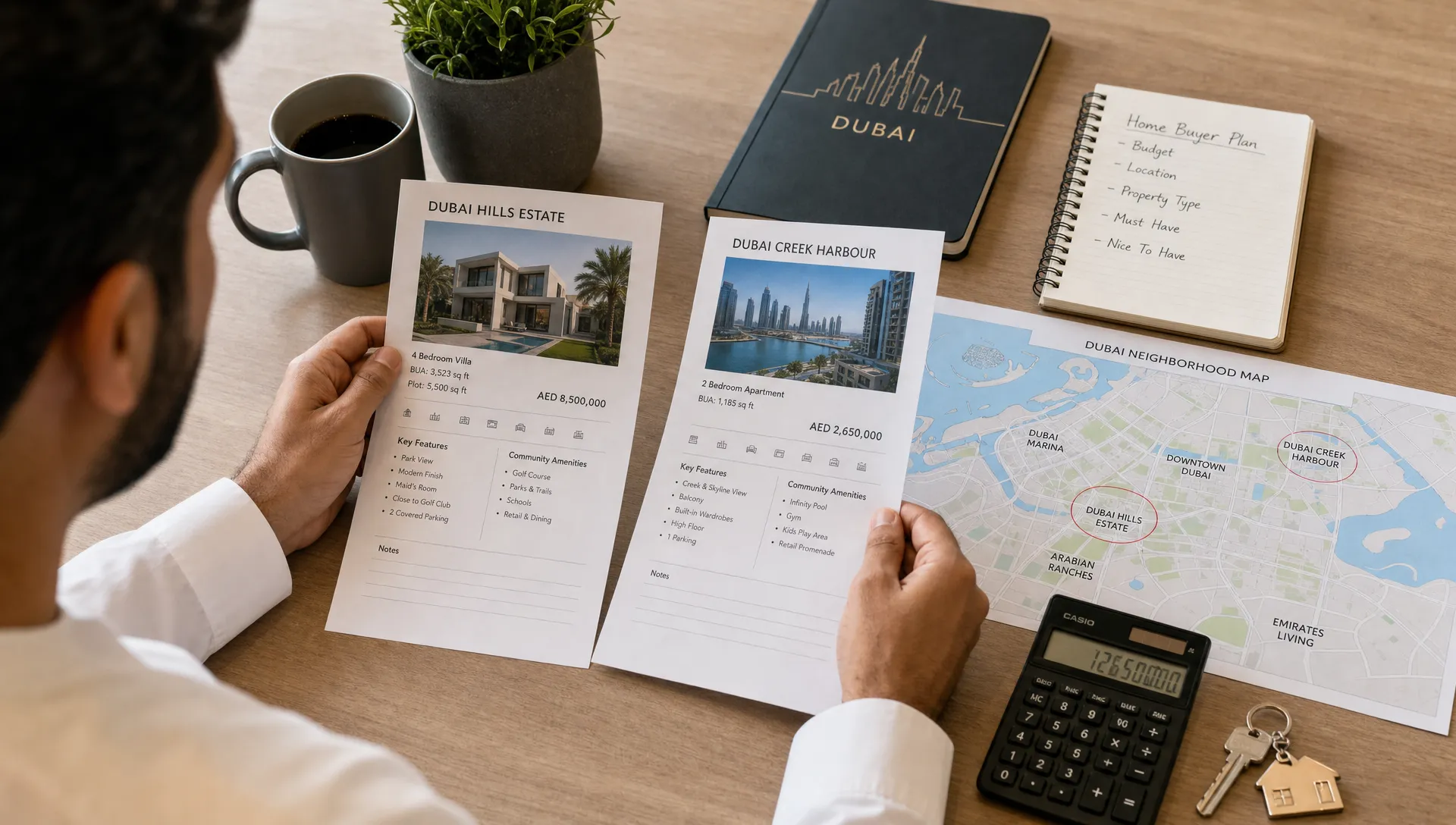
Use photos and virtual tours carefully
High-quality photos and virtual tours are helpful, but they should be interpreted with caution. Photos show what the seller or agent wants you to notice. They may not show storage areas, AC units, building corridors, parking access, nearby construction, natural light at different times of day, or signs of wear.
When reviewing photos, check for consistency. Do the windows, flooring, kitchen cabinets, bathroom tiles, and views match across the gallery? Are there enough images of bedrooms, bathrooms, balconies, and common areas? Is the same photo appearing in multiple listings for different units?
Virtual tours are useful for understanding flow. They can help you see whether the living area connects naturally to the kitchen, whether bedrooms feel private, and whether the unit has wasted corridor space. Still, they do not replace an in-person visit, especially for checking noise, smell, humidity, building maintenance, and actual views.
Compare locations by daily life, not only prestige
A prestigious address is not always the most practical choice. Location should be evaluated by how the property will function day to day.
For end users, consider commute time, school access, healthcare, supermarkets, traffic patterns, parking, walkability, public transport, and community atmosphere. For investors, consider tenant demand, nearby employment hubs, upcoming infrastructure, tourism appeal, and supply in the same property type.
In Dubai, two communities may be close on a map but very different in daily experience. A unit near a major road may offer faster access but more noise. A waterfront property may command higher rent but come with higher service charges. A developing area may offer better entry prices but require patience as infrastructure matures.
Verify market context before you contact agents
Online listings should be compared against real market evidence. If a property is priced far below similar homes, it may be a genuine deal, but it may also have an issue. If it is priced far above the market, there should be a clear reason such as renovation quality, view, layout, floor level, plot size, or branded development.
For Dubai properties, public resources from the Dubai Land Department can help buyers and investors understand official services, transactions, and regulatory context. You can also compare similar listings across multiple portals and speak with more than one broker before deciding whether a price is realistic.
The goal is not to become a valuation expert overnight. The goal is to avoid relying on one listing description as your only source of truth.
Ask every agent the same core questions
Once you have shortlisted a few properties, contact agents or owners with a consistent set of questions. This makes answers easier to compare and reduces the chance of missing important details.
Ask about availability, exact location, title or ownership status, current occupancy, service charges, payment terms, viewing times, and whether the listing photos are recent. For off-plan homes, ask about the developer, handover estimate, payment plan, escrow details, and any resale restrictions.
A serious agent should be able to answer clearly or confirm when they need to check. Vague or rushed answers are not always a deal-breaker, but they are a sign to slow down.
Use online conversations, but verify everything
Many buyers and tenants now research communities through forums, social media groups, and online discussions. These sources can reveal useful opinions about traffic, maintenance, noise, building management, schools, and lifestyle. However, they are also subjective. One person’s “too quiet” may be another person’s “peaceful.”
If you are an agent, landlord, or investor trying to understand what real buyers and tenants are asking before you market a property, tools for finding real estate leads and buyer conversations with AI can support research into demand signals. For personal home searches, treat online conversations as context, then verify claims through viewings, official data, and professional advice.
Watch for red flags while comparing listings
Red flags are easier to spot when you compare multiple listings side by side. One unclear listing might not stand out on its own, but it becomes obvious when others provide better details.
Be cautious if you notice:
- A price that is far below similar listings without a clear explanation
- Photos that look mismatched, duplicated, heavily edited, or incomplete
- A description that avoids naming the building, developer, or exact community
- Pressure to pay a deposit before viewing or verifying ownership details
- Claims such as “guaranteed returns” without written evidence
- Off-plan information that lacks developer, escrow, handover, or payment plan clarity
For a more detailed checklist, review these real estate property listing red flags before you commit to a viewing or payment.
Create a shortlist scorecard
A shortlist scorecard helps reduce emotional bias. Instead of choosing the listing with the nicest photos, you compare each property against the same criteria.
You can score each category from 1 to 5:
| Category | What a strong score means |
|---|---|
| Budget fit | Total cost is realistic, not just the headline price |
| Location | Commute, access, lifestyle, and demand are strong |
| Layout | Space is usable, not just large on paper |
| Condition | Unit, building, and common areas appear well maintained |
| Documentation | Key details are clear and verifiable |
| Investment potential | Rentability, resale, and supply-demand balance are sensible |
| Agent responsiveness | Answers are timely, specific, and consistent |
Do not expect every property to score perfectly. The best choice is usually the one with the strongest balance for your goal. A home for personal use may justify a slightly higher price if it saves daily commuting time. An investment property may prioritize yield, tenant demand, and exit liquidity over emotional appeal.
Visit only the listings that pass your online test
Viewings take time, especially in large cities like Dubai and Abu Dhabi. A smarter online comparison process should reduce unnecessary visits, not create more of them.
Before booking a viewing, confirm that the property is still available, the photos are current, the price is accurate, and the viewing person is authorized to show it. During the visit, check what the listing could not show: noise, smell, maintenance quality, lift waiting times, parking access, natural light, AC performance, water pressure, and the condition of shared areas.
After the visit, update your scorecard immediately. Fresh impressions are more reliable than memory after several viewings.
Frequently Asked Questions
What is the best way to compare houses online? The best way is to compare similar properties using the same criteria: total cost, location, size, layout, condition, status, documentation, and agent responsiveness. Avoid comparing ready and off-plan homes, or villas and apartments, as if they are the same product.
How many listings should I shortlist before viewing? Most buyers and renters benefit from a shortlist of 5 to 10 strong listings. Too few may limit your options, while too many can make decisions confusing. The goal is to view only the properties that pass your online checks.
Are online property photos reliable? Photos are useful, but they are not complete evidence. They may not show noise, building condition, parking access, nearby construction, or maintenance issues. Use photos and virtual tours to shortlist, then verify through a viewing.
What should I ask an agent before visiting a property? Ask whether the property is still available, whether the price is current, who owns or represents it, whether the photos are recent, what fees apply, and what the occupancy or handover status is. For purchases, also ask about service charges and documentation.
Is finding houses online enough to make a decision? Online search is enough to build a strong shortlist, but not enough to make a final decision. Always verify key details, compare market context, inspect the property, and seek professional advice when needed.
Make your online property search more focused
Finding houses online becomes easier when you compare evidence, not impressions. Start with a clear brief, group similar listings together, check total costs, verify market context, and ask consistent questions before booking viewings.
Best Property helps UAE buyers, tenants, owners, and agents explore detailed listings, use search filters, review photos and virtual tours, save favorites, compare options, and connect directly with agents or owners. If you are starting your search, browse current UAE listings on Best Property and build a shortlist that is worth your time.


Join The Discussion