
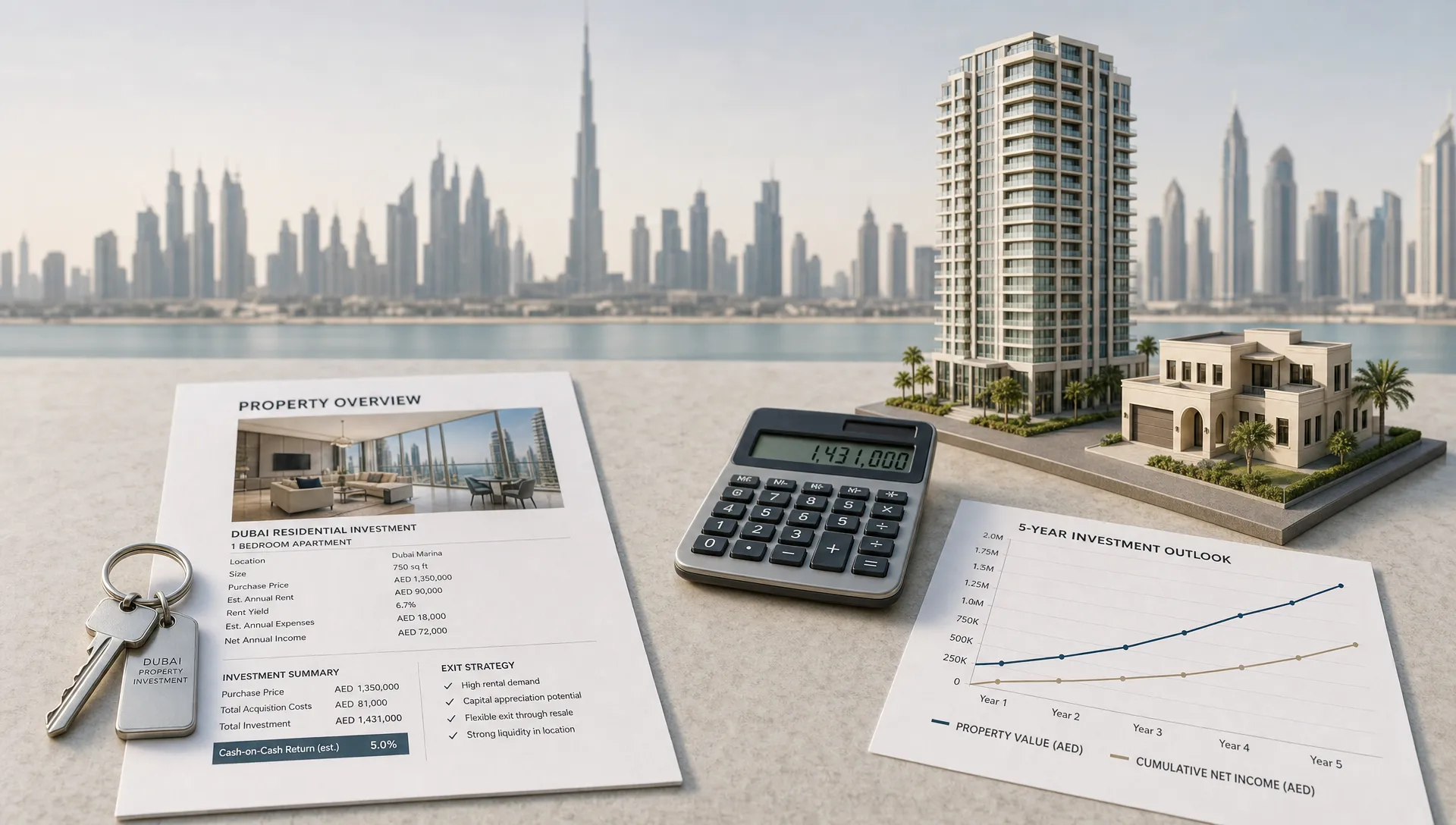
A stronger ROI in Dubai does not come from buying the loudest launch, the tallest tower, or the neighborhood everyone is suddenly talking about. It comes from disciplined numbers, a clear investment thesis, and the patience to compare properties the way a lender, tenant, and future buyer would.
Dubai remains one of the world’s most watched real estate markets because it combines international demand, tax efficiency, modern infrastructure, and a large rental base. But a profitable Dubai real estate investment still depends on the details: entry price, service charges, vacancy risk, rental demand, financing, and exit liquidity.
Use the tips below as a practical framework before you shortlist, negotiate, or transfer a deposit.
Start with the ROI you actually want
Many investors talk about ROI as if it means one number. In reality, you should separate at least four metrics before comparing opportunities.
| ROI metric | What it measures | Why it matters |
|---|---|---|
| Gross rental yield | Annual rent divided by purchase price | Useful for a quick first comparison, but incomplete |
| Net rental yield | Annual rent minus ownership costs, divided by total acquisition cost | Better for real income expectations |
| Capital appreciation | Increase in resale value over time | Key for off-plan, prime, and long-hold strategies |
| Cash-on-cash return | Annual net cash flow divided by cash invested | Important when using a mortgage |
Gross yield is the easiest number to market, but net yield is the number investors should care about. A property with a high advertised rent can underperform if service charges are heavy, maintenance is frequent, furnishing costs are high, or vacancy periods are longer than expected.
A useful net yield formula is:
Net yield = annual rent minus annual ownership costs, divided by purchase price plus acquisition costs, multiplied by 100.
For a full-cycle view, add expected resale value and selling costs. A property that produces modest rent but has strong resale demand may outperform a higher-yield unit in a weaker building. Likewise, a unit with strong rental income can still disappoint if you overpay at entry.
If you are still shaping your strategy, it is worth reading a broader Dubai real estate investment guide for 2026 before you go deep into individual listings.
Match the property type to your investment thesis
There is no single best property type for every investor. A studio near a metro station, a townhouse in a family community, and a luxury waterfront residence can all make sense, but not for the same reasons.
| Property type | Often suited for | ROI watch-outs |
|---|---|---|
| Studio or 1-bedroom apartment | Rental yield, lower entry ticket, broad tenant demand | Tenant turnover, building service charges, competition from similar units |
| Larger apartment | Family tenants, longer occupancy, balanced income | Higher entry price, layout efficiency, school and commute access |
| Townhouse or villa | End-user demand, family rental market, land value appeal | Maintenance costs, garden and pool upkeep, community fees |
| Luxury or branded residence | Capital preservation, prestige, global buyer demand | Higher price sensitivity, narrower tenant pool, premium service charges |
| Commercial property | Longer leases and business tenants | Fit-out rules, vacancy risk, tenant quality, location dependence |
Before choosing, define your priority. If you need monthly cash flow, focus on tenant demand and net yield. If you are investing for appreciation, study supply, scarcity, developer reputation, and resale liquidity. If you want a balanced strategy, favor established communities with both rental depth and long-term buyer demand.
The mistake is buying an appreciation asset while expecting income-property behavior, or buying an income asset while expecting luxury-level capital growth. The asset must match the job you want it to do.
Pick locations by tenant demand, not headlines
Dubai’s best investment areas are rarely defined by one factor. A popular neighborhood can still be overpriced, while a less hyped location may offer better rent-to-price balance. Strong ROI usually comes from micro-market selection: the exact building, street, view, layout, and access point matter.
A good location test starts with three questions. Who will rent this property? Why will they choose this building over nearby alternatives? Who will buy it from you later?
For rental-led investments, look for repeatable demand drivers such as metro access, business districts, schools, hospitals, retail, beach access, or proximity to major road networks. For appreciation-led investments, study future infrastructure, limited land supply, waterfront access, community maturity, and the quality of nearby projects.
You can compare neighborhood fundamentals in this guide to the best areas to buy property in Dubai, then narrow your search to specific buildings and communities.
Official market data should also be part of your process. The Dubai Land Department open data portal is a useful reference point for transaction trends, sale volumes, and market activity. Do not rely only on asking prices, because listing prices can reflect seller optimism rather than completed transactions.
Calculate net yield before making an offer
ROI can look excellent until you include the true cost of ownership. Dubai has a transparent real estate ecosystem, but investors still need to model transaction costs and running expenses before committing.
| Cost or assumption | Why it affects ROI | Investor tip |
|---|---|---|
| Dubai Land Department transfer fee | Commonly 4% of the purchase price | Include it in total acquisition cost from day one |
| Broker commission | Often applies on secondary market purchases | Confirm the amount and VAT treatment before signing |
| Registration and trustee fees | Add to upfront costs | Ask for a full closing cost estimate |
| Service charges | Reduce annual net income | Compare charges per square foot across similar buildings |
| Maintenance and repairs | Can reduce cash flow, especially in older units | Inspect AC, plumbing, appliances, windows, and common areas |
| Furnishing | Can improve rentability but adds capital outlay | Budget replacement cycles, not just initial furniture cost |
| Vacancy period | Rent is not guaranteed for 12 full months every year | Underwrite conservatively, especially for short-term rentals |
| Mortgage costs | Affect cash-on-cash return | Stress test interest rates and monthly payments |
Here is a simple illustrative example. Suppose an apartment is purchased for AED 1,200,000 and can rent for AED 95,000 per year. The gross yield is about 7.9%. If annual service charges, maintenance, management, and vacancy assumptions total AED 22,000, the net rental income becomes AED 73,000. If total acquisition cost is closer to AED 1,270,000 after fees and setup costs, the net yield falls to about 5.7%.
That gap is not a failure. It is the difference between marketing math and investor math.
The same discipline applies to resale. If you expect to sell after three to five years, include selling costs, potential mortgage settlement fees, and realistic capital appreciation. A property does not need perfect numbers to be attractive, but the numbers should be honest before you buy.
Compare ready and off-plan property through the lens of timing
Ready property and off-plan property can both produce strong returns, but they create ROI in different ways.
Ready property gives you more visibility. You can inspect the unit, assess the building, review actual service charges, estimate current rent, and generate income soon after transfer. This is useful for investors who value cash flow, immediate occupancy, or a lower level of completion risk.
Off-plan property can offer flexible payment plans, lower initial cash outlay, and potential price appreciation before handover. But it also carries timing risk. Your capital may be tied up before rental income starts, and the final return depends on handover quality, market conditions at completion, and how much similar supply enters the area.
The better choice depends on your timeline and risk tolerance. If you want income quickly, ready units often make more sense. If you can wait and you trust the project, location, and developer track record, off-plan may support stronger capital growth.
For a deeper comparison, review this breakdown of off-plan vs ready property in Dubai before choosing a route.
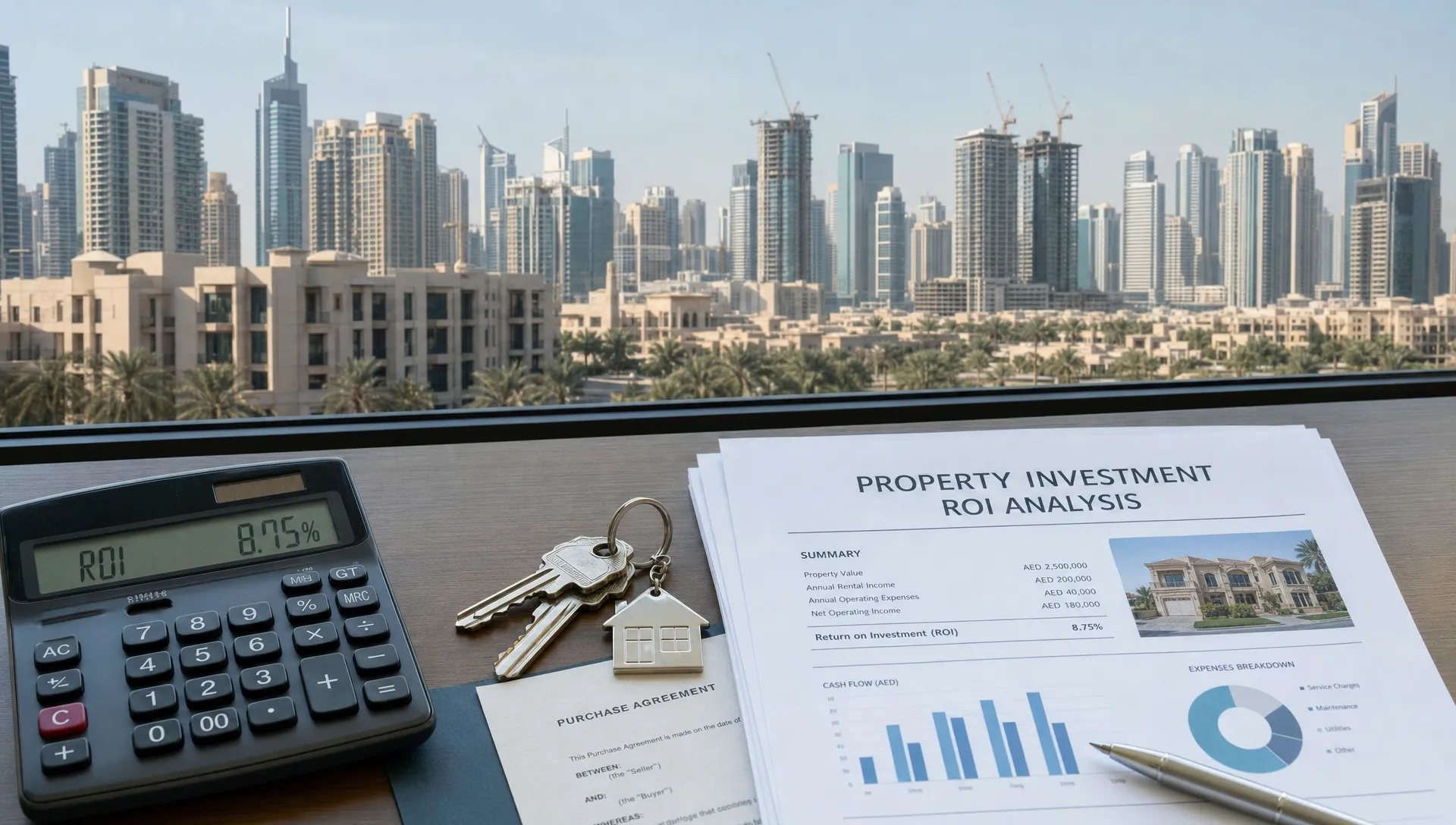
Improve rentability before you buy
The strongest rental investments are not always the cheapest units. They are the units tenants can understand quickly and choose confidently. A practical layout, good natural light, clean common areas, functional parking, and easy access can matter more than a small discount on price.
Think like a tenant during every viewing. If the apartment is difficult to furnish, has wasted corridors, lacks storage, sits far from parking, or faces constant construction noise, the rent may need to be discounted later. If a villa has poor maintenance history or high cooling costs, family tenants may negotiate harder or leave sooner.
A strong rental property usually has several of these traits:
- Efficient layout with minimal wasted space
- Clear tenant profile, such as professionals, families, or students
- Good access to transport, roads, schools, retail, or offices
- Competitive service charges for the community
- Building amenities that tenants actually use
- Parking, storage, balcony, view, or outdoor space when relevant
- A condition level that supports fast leasing after handover or transfer
Short-term rentals can increase income in certain areas, but they require more active management, furnishing, cleaning, guest communication, and seasonality planning. Long-term rentals are often simpler and more predictable. The right choice depends on location, building rules, licensing requirements, and your willingness to operate the property like a hospitality asset.
Do due diligence like an investor, not a tourist
Dubai attracts international buyers, and the buying process is relatively streamlined compared with many global markets. Still, due diligence protects ROI. The goal is not only to avoid legal problems. It is to avoid hidden costs, weak liquidity, and poor rentability.
For secondary market purchases, verify ownership documents, title deed details, outstanding service charges, tenancy status, notice periods, and any disputes or restrictions. If the unit is rented, review the tenancy contract carefully because the existing rent and tenant rights can affect your immediate income and plans.
For off-plan purchases, check the developer’s track record, escrow arrangements, project registration, payment plan, construction progress, handover terms, and penalties. The UAE government portal provides useful official context on real estate services and regulations, but investors should also verify project-specific information through authorized channels.
A simple due diligence checklist can save you from expensive assumptions.
| Check | What to verify | ROI impact |
|---|---|---|
| Ownership and title | Seller authority, title deed, no unresolved transfer issues | Prevents transaction delays and legal risk |
| Service charges | Current and historical charges, pending balances | Protects net yield assumptions |
| Building condition | AC, lifts, parking, lobby, amenities, maintenance | Affects rent, vacancy, and resale demand |
| Rental status | Existing lease, rent amount, expiry, notices | Determines immediate income and flexibility |
| Developer track record | Delivery history, quality, after-sales support | Reduces off-plan completion and quality risk |
| Comparable transactions | Recent sales in same building or community | Helps avoid overpaying |
Do not skip physical inspection because the listing looks attractive. Photos and virtual tours are helpful, but they do not always reveal noise, smell, maintenance quality, corridor condition, parking access, or the feel of the surrounding area at different times of day.
Use financing strategically, not emotionally
Leverage can improve cash-on-cash returns when rent is strong and financing costs are controlled. It can also reduce flexibility if interest rates rise, rent softens, or you need to sell quickly.
Before using a mortgage, ask lenders for current loan-to-value limits, interest rates, arrangement fees, valuation fees, insurance requirements, and early settlement terms. Then model the property at today’s payment and at a stressed payment. A conservative investor should still be comfortable if the unit is vacant for one or two months, rent renews lower than expected, or maintenance costs arrive sooner than planned.
Cash buyers also need discipline. Paying cash removes financing risk, but it does not automatically make a deal strong. The capital still has an opportunity cost. Compare your expected net rental yield and appreciation against other uses of the same funds.
The best financing structure is the one that supports your holding period. A short-term flip, a five-year rental hold, and a long-term family wealth asset may all require different debt levels.
Negotiate on evidence, not pressure
Dubai’s market can move quickly, especially in popular communities, but urgency should not replace evidence. Before making an offer, compare recent transactions, active listings, unit condition, floor level, view, service charges, vacancy status, and seller motivation.
If a unit is priced above comparable transactions, ask what justifies the premium. A superior view, upgraded interior, rare layout, or vacant-on-transfer status may support a higher price. A tired unit, high service charges, weak layout, or difficult tenant situation should usually be reflected in the offer.
Your strongest negotiating position comes from being ready. Have financing pre-approval if needed, know your maximum price, understand transfer costs, and be prepared to walk away if the deal only works under optimistic assumptions.
Plan the exit before you transfer
A profitable investment is not complete until you can exit well. Before buying, ask who the future buyer will be. Is the property attractive to end users, investors, or both? Is the buyer pool local, regional, or international? Is the unit type common or scarce?
Liquidity should be part of ROI. A property that takes a long time to sell may force price reductions, extend holding costs, or cause you to miss better opportunities. Prime locations and rare assets can support resale, but overpaying for scarcity can still hurt returns.
Your exit plan should include an expected holding period, target resale price range, minimum acceptable rent, renovation budget, and conditions that would make you sell earlier. The more clearly you define these before buying, the less likely you are to make emotional decisions later.
Common mistakes that weaken ROI
Even experienced investors can lose returns through small errors that compound over time. The most common mistakes are not always dramatic. They are often basic underwriting gaps.
Avoid comparing gross yields across buildings without checking service charges. Avoid assuming every off-plan project will appreciate before handover. Avoid paying a premium for features tenants will not pay for. Avoid ignoring future supply in the same area. Avoid buying a large unit simply because the price per square foot looks lower, since total ticket size affects rentability and resale liquidity.
Most importantly, avoid buying before you know your tenant, your costs, and your exit. Dubai offers many opportunities, but selectivity is where ROI is created.
Frequently Asked Questions
Is Dubai real estate investment still attractive in 2026? Yes, Dubai remains attractive for many investors because of its international demand, infrastructure, rental market, and business-friendly environment. However, returns vary by property type, location, entry price, financing, and management quality.
What is a good ROI for Dubai property? There is no universal number. A good ROI depends on whether you prioritize net rental yield, capital appreciation, or cash-on-cash return. Always compare net returns after fees, service charges, vacancy, maintenance, and financing costs.
Is off-plan property better for ROI than ready property? Off-plan can offer capital growth potential and flexible payment plans, while ready property offers more visibility and faster rental income. The better option depends on your timeline, risk tolerance, and the specific project or unit.
How do service charges affect property ROI in Dubai? Service charges directly reduce net rental yield. Two units with similar rent and purchase price can produce very different returns if one building has much higher annual charges.
Should I choose short-term or long-term rentals? Short-term rentals may generate higher income in the right location, but they require licensing, furnishing, cleaning, management, and seasonality planning. Long-term rentals are usually more predictable and easier to manage.
How can I compare investment properties more efficiently? Use consistent filters for price, location, unit size, rent potential, service charges, amenities, and condition. Comparing similar units in the same building or community is usually more useful than comparing broad area averages.
Turn ROI research into a smarter shortlist
Strong returns come from better comparisons, cleaner numbers, and access to current listings. On Best Property, you can explore Dubai and UAE properties for sale or rent, review detailed listings, compare options, and connect directly with agents or owners.
Use the platform to build a shortlist around your investment thesis, then run the ROI checks above before making an offer. In a competitive market, the best investors are not the fastest buyers. They are the best-prepared buyers.


Join The Discussion