
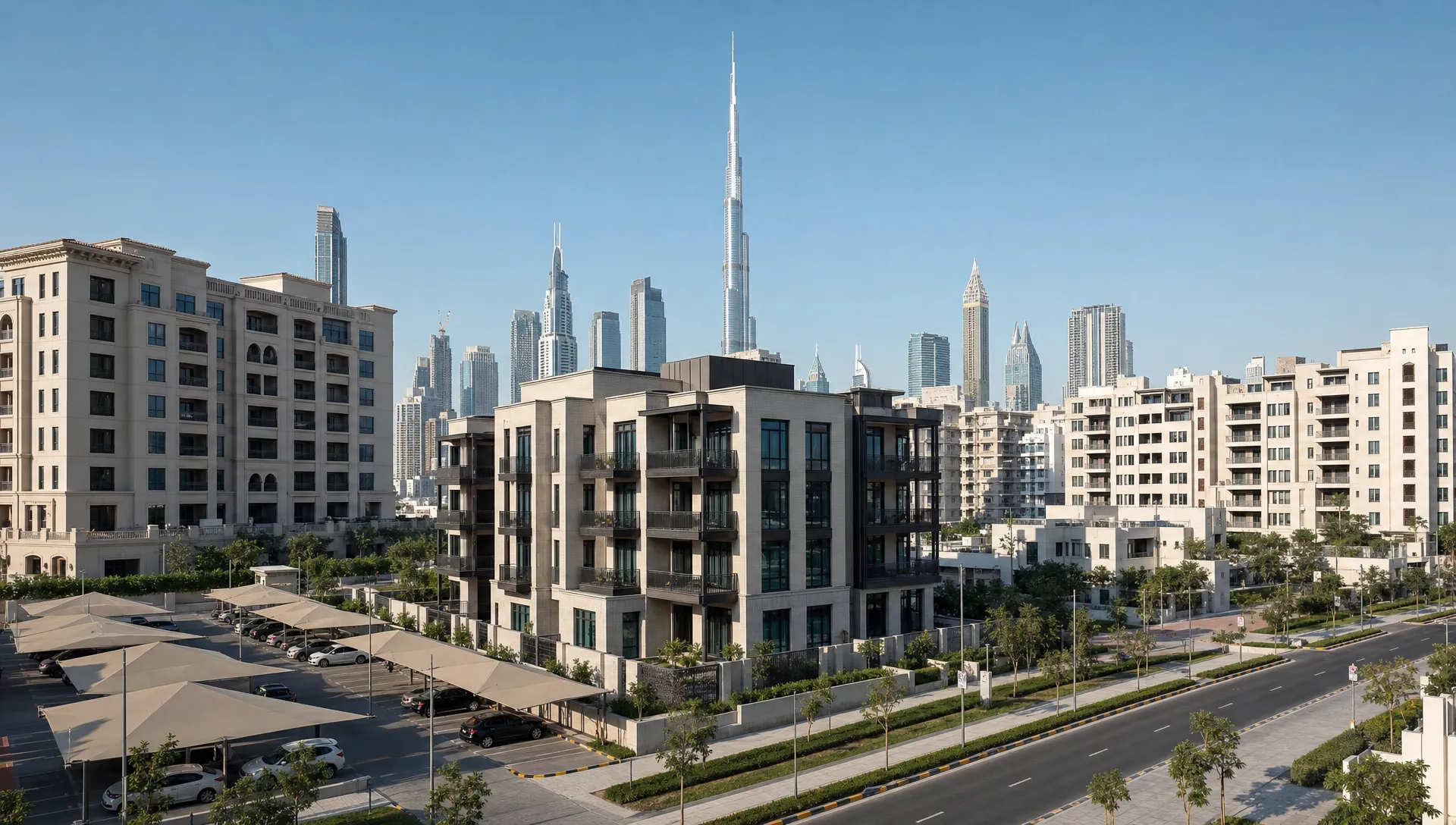
Dubai is one of the few global property markets where a buyer can compare an entry-level studio, a waterfront one-bedroom, a branded residence, and a penthouse in the same city. That range is exactly why searches for apartments for sale in Dubai UAE are so broad. Some buyers want a first home. Others want a rental asset, a holiday base, or a luxury address with long-term capital appeal.
The challenge is not finding apartments. It is understanding what your budget really buys, which areas match your goal, and which extra costs should be included before you make an offer.
This guide breaks down Dubai apartment buying by budget, with practical advice on locations, property types, ownership costs, ready versus off-plan choices, and how to shortlist with confidence.
Why Dubai apartments work for many budgets
Dubai’s apartment market is diverse because the city was built around multiple lifestyle and investment zones. You can find compact studios in emerging communities, family-sized apartments near schools and business districts, hotel-style residences in tourist hubs, and ultra-prime homes in waterfront districts.
For international buyers, Dubai is also attractive because designated freehold areas allow foreign ownership, the city has no annual property tax in the way many global cities do, and the rental market remains active across both affordable and premium segments. Transaction rules and ownership registration are overseen by the Dubai Land Department, which gives buyers a structured legal framework.
Still, every budget comes with trade-offs. A lower price may mean a longer commute, a smaller layout, or an area still developing its infrastructure. A higher price may secure location, views, brand value, or scarcity, but it still needs to be judged against service charges, rental demand, and resale liquidity.
Start with your real budget, not only the listing price
Many buyers begin with a headline price, such as AED 700,000 or AED 2 million. That is useful, but it is not the full picture. Your real budget should include the purchase price, transaction fees, possible mortgage costs, furnishing, moving, maintenance, and a cash buffer.
If you are investing, you should also consider vacancy periods, property management, service charges, and whether the building’s rental demand is strong enough to support your expected yield.
A practical way to think about budget is to divide it into four parts:
- Purchase budget for the apartment itself
- Transaction budget for registration, agency, trustee, and mortgage-related costs
- Setup budget for furnishing, minor upgrades, utilities, and moving
- Holding budget for service charges, repairs, and vacancy risk
This approach prevents a common mistake: buying at the top of your available cash and then struggling with the costs that come immediately after transfer.
What different apartment budgets can buy in Dubai
Dubai prices change by community, building quality, view, floor level, layout, developer, and market cycle. The table below is a practical guide, not a fixed pricing sheet. Always compare live listings and recent transactions before deciding.
| Buyer budget | Typical apartment options | Common buyer goal | What to watch closely |
|---|---|---|---|
| Under AED 700,000 | Studios and some compact one-bedroom units in more affordable or emerging communities | Entry-level investment or first purchase | Service charges, rental demand, building age, commute time |
| AED 700,000 to AED 1.5 million | Larger studios, one-bedroom units, and some two-bedroom options depending on area | Balanced home or rental property | Layout efficiency, parking, amenities, nearby supply |
| AED 1.5 million to AED 3 million | Quality one and two-bedroom apartments in established lifestyle locations | End-use, mid-market investment, family living | View premium, community maturity, resale liquidity |
| AED 3 million to AED 7 million | Larger apartments, premium towers, waterfront or central locations | Lifestyle purchase and stronger tenant appeal | Service charges, building management, price per square foot |
| AED 7 million and above | Luxury apartments, branded residences, penthouses, rare views | Prestige, wealth preservation, trophy asset | Scarcity, brand reputation, privacy, long-term demand |
The best budget is not always the highest one. A well-located AED 1.2 million apartment with strong rental demand can outperform a more expensive unit in a building with weak management or oversupply. Likewise, a premium apartment may justify its price if it has genuine scarcity, a top-tier view, high-quality finishing, and a location that wealthy tenants or buyers consistently prefer.
Affordable apartments for budget-conscious buyers
If your priority is affordability, focus on value rather than the lowest ticket price. Studios and compact one-bedroom apartments can be attractive because the total entry cost is lower, they are easier to rent to singles and young professionals, and they often have a larger tenant pool.
Affordable areas can appeal to investors because demand is supported by Dubai’s growing workforce. However, the unit must be practical. A low price is less compelling if the layout wastes space, parking is inconvenient, public transport is limited, or the building has high service charges relative to rent.
For lower-budget buyers, the smartest questions are simple. Is the building well maintained? Is there proven rental demand? Is the community still improving? Are similar units renting quickly? Are there many identical apartments for sale in the same tower?
If several units in one building are listed at the same time, ask why. It may be normal in a large tower, but it can also signal landlord exits, upcoming maintenance concerns, or weak tenant demand.
Mid-range apartments for lifestyle and investment balance
The mid-range budget is often the most competitive segment because it suits both residents and investors. Buyers in this range typically compare one and two-bedroom apartments in established communities, newer master developments, or areas with good access to business hubs.
For end-users, this budget can bring better layouts, larger balconies, modern amenities, and shorter commutes. For investors, it can offer a balance between rental yield and future resale appeal. The key is to avoid paying only for surface-level features. A modern lobby and pool look appealing, but long-term value depends on location, building management, floor plan, view, parking, and community demand.
Mid-range buyers should compare price per square foot, but not blindly. A cheaper apartment per square foot may have a poor layout, less natural light, or a less desirable view. A slightly higher price may be justified if the usable space is better and tenants are likely to pay more.
For a broader comparison of communities, it is worth reviewing this 2026 guide to the best areas to buy property in Dubai, then narrowing your search by budget and lifestyle needs.
Premium and luxury apartments for high-end buyers
At the premium end, buyers are not just buying square footage. They are paying for address, view, exclusivity, brand, design, privacy, amenities, and long-term desirability. Waterfront apartments, skyline-view units, branded residences, and penthouses can command significant premiums when they offer something genuinely rare.
Luxury buyers should be especially careful with comparisons. Two apartments with the same bedroom count can have completely different values if one has a full sea view, better ceiling heights, direct beach access, a branded operator, or a limited number of units in the building.
The best luxury apartments usually have several of these qualities:
- A prime or scarce location with strong global recognition
- High-quality finishing and building management
- Practical layouts with privacy between living and sleeping areas
- Views that are protected or difficult to replicate
- Amenities that match the expectations of premium tenants and buyers
Luxury does not automatically mean better investment performance. Some high-end apartments are excellent long-term assets, while others are overpriced because they rely too heavily on branding or short-term hype. Due diligence matters even more when the ticket size is large.
Ready apartments vs off-plan apartments
One of the biggest decisions for apartment buyers in Dubai is whether to buy a ready unit or an off-plan property. Both can make sense, but they suit different budgets, timelines, and risk profiles.
Ready apartments give you certainty. You can inspect the building, see the actual view, estimate rent more accurately, and move in or lease the unit shortly after transfer. Off-plan apartments can offer staged payment plans and access to newer projects, but they require trust in the developer, location, handover timeline, and future market demand.
| Option | Best suited for | Main advantages | Key risks |
|---|---|---|---|
| Ready apartment | Buyers who want immediate use or rental income | Inspect before buying, faster rental potential, clearer market value | Higher upfront cash requirement, older buildings may need upgrades |
| Off-plan apartment | Buyers with flexible timelines and interest in new developments | Payment plans, new layouts, potential capital appreciation before handover | Handover delays, changing market conditions, limited ability to inspect final product |
| Recently handed-over apartment | Buyers wanting a newer unit without full construction risk | Modern building, visible finished product, possible early rental demand | Community may still be maturing, service charge history may be limited |
If you are exploring new developments, compare locations, handover dates, and payment plans through the platform’s new off-plan projects in the UAE section before speaking with agents or developers.
Extra buying costs to include before making an offer
Dubai has a relatively transparent property transfer process, but buyers should still budget for more than the advertised price. Costs vary by transaction type, property value, mortgage use, and whether the apartment is resale or developer-direct.
A common cost to plan for is the Dubai Land Department transfer fee, generally 4% of the property price. Resale purchases often include an agency commission, commonly 2% plus VAT, although buyers should confirm the exact agreement before signing. There can also be trustee office fees, title deed fees, mortgage registration fees if financing is used, bank valuation charges, and administrative costs.
For mortgage buyers, banks usually require a down payment, income documentation, and approval based on the borrower’s profile. Loan-to-value limits depend on residency status, property value, and whether the property is completed or off-plan. Because rules and bank policies can change, always get a mortgage pre-approval before committing to a purchase.
For a step-by-step overview of the legal and practical stages, you can use Best Property’s guide on how to buy a house in Dubai as a broader buying process reference, even if you are purchasing an apartment rather than a villa.
Choosing the right apartment based on your goal
The best apartment for an investor may not be the best apartment for a family. Before you compare buildings, define your primary goal.
If you are buying to live in, prioritize daily comfort. Commute time, parking, storage, noise, schools, supermarkets, public transport, and building maintenance will matter more than a small difference in projected yield. A slightly more expensive apartment may be the better choice if it improves your daily routine.
If you are buying for rental income, prioritize tenant demand. Look for communities close to employment hubs, transport links, universities, hospitals, beaches, or lifestyle attractions. Compare realistic annual rent, not only optimistic broker estimates.
If you are buying for capital growth, focus on supply and demand. Areas with improving infrastructure, limited future supply, strong developer credibility, or major lifestyle upgrades can be attractive. However, growth-focused purchases often need patience.
If you are buying a holiday home, think like a guest. Walkability, views, beach or landmark access, building amenities, and short-term rental rules can affect performance. Also confirm whether the building and community allow the rental strategy you have in mind.
How to compare apartment listings like a professional
A strong shortlist saves time and reduces buyer regret. Instead of viewing every property in your budget, filter aggressively and compare only apartments that match your goal.
Start with the basics: location, price, bedroom count, size, completion status, parking, and whether the unit is vacant or rented. Then compare deeper factors such as floor plan, view, orientation, balcony usability, service charges, and building reputation.
For investors, ask for rental evidence. Recent rental contracts, comparable listings, and occupancy trends are more useful than general statements about high demand. For end-users, visit the building at different times of day if possible. Traffic, noise, parking, and lift waiting times can feel very different in the evening than they do during a quiet afternoon viewing.
On Best Property, buyers can use advanced search filters, detailed listings, photos, virtual tours where available, favorites, and comparison tools to narrow options before contacting agents or owners directly. This is especially useful when comparing apartments across multiple budgets and communities.
Budget mistakes to avoid
Even experienced buyers can make mistakes in a fast-moving market. The most common problem is focusing too much on the apartment and not enough on the building or community.
A beautiful unit in a poorly maintained tower can become difficult to rent or resell. A cheap apartment with high service charges can produce weaker net returns than a more expensive apartment with better efficiency. A large floor plan can look attractive until you realize much of the space is in corridors or unusable corners.
Another mistake is ignoring exit strategy. Before buying, ask who the next buyer is likely to be. Is it another investor? A resident family? A holiday home buyer? A luxury end-user? If you cannot clearly identify future demand, resale may be harder.
Finally, do not rely only on future promises. Metro extensions, malls, schools, parks, and new attractions can improve value, but timelines can change. Buy based on current fundamentals first, then treat future upgrades as upside.
A practical apartment shortlisting checklist
Before you book viewings or reserve an off-plan unit, use this quick checklist to test whether the property fits your budget and goal:
- The total purchase cost, including fees, fits your available funds
- The location matches your lifestyle or tenant profile
- The apartment has a practical layout, not just a large stated size
- The building is well managed and has reasonable service charges
- The view, floor, and orientation support resale or rental appeal
- Comparable sales and rents support the asking price
- The ownership status, title, and seller documents are clear
- Your financing, if needed, is pre-approved before signing
A good apartment should still make sense after this checklist. If it only looks attractive because of a low headline price or a sales promotion, slow down and compare alternatives.
Frequently Asked Questions
Can foreigners buy apartments in Dubai UAE? Yes. Foreign buyers can purchase freehold property in designated areas of Dubai. Always confirm the property’s ownership status and registration process before signing any agreement.
What is the minimum budget for apartments for sale in Dubai UAE? Entry-level budgets vary by market conditions, but studios in more affordable or emerging communities are usually the lowest-cost option. Buyers should include transaction fees and setup costs, not just the listing price.
Are Dubai apartments better for investment or living? They can be suitable for both. Investors should focus on rental demand, net yield, and resale liquidity, while end-users should prioritize commute, amenities, layout, and long-term comfort.
Is off-plan cheaper than ready property in Dubai? Off-plan property can offer flexible payment plans and early access to new projects, but it is not always cheaper on a like-for-like basis. Compare the final price, handover timeline, developer track record, and expected rent after completion.
What fees should I expect when buying an apartment in Dubai? Buyers commonly budget for the DLD transfer fee, agency commission on resale deals, trustee and registration charges, and mortgage-related costs if financing is used. Exact costs depend on the transaction.
Find the right Dubai apartment for your budget
Dubai has apartments for almost every budget, but the right choice depends on more than price. The strongest purchases combine a realistic total budget, a suitable community, a practical layout, clear ownership, and demand from future tenants or buyers.
If you are ready to compare options, start with live listings on Best Property in Dubai. Use filters, review detailed photos and virtual tours where available, save favorites, compare properties, and contact agents or owners directly when a listing matches your goals.


Join The Discussion