
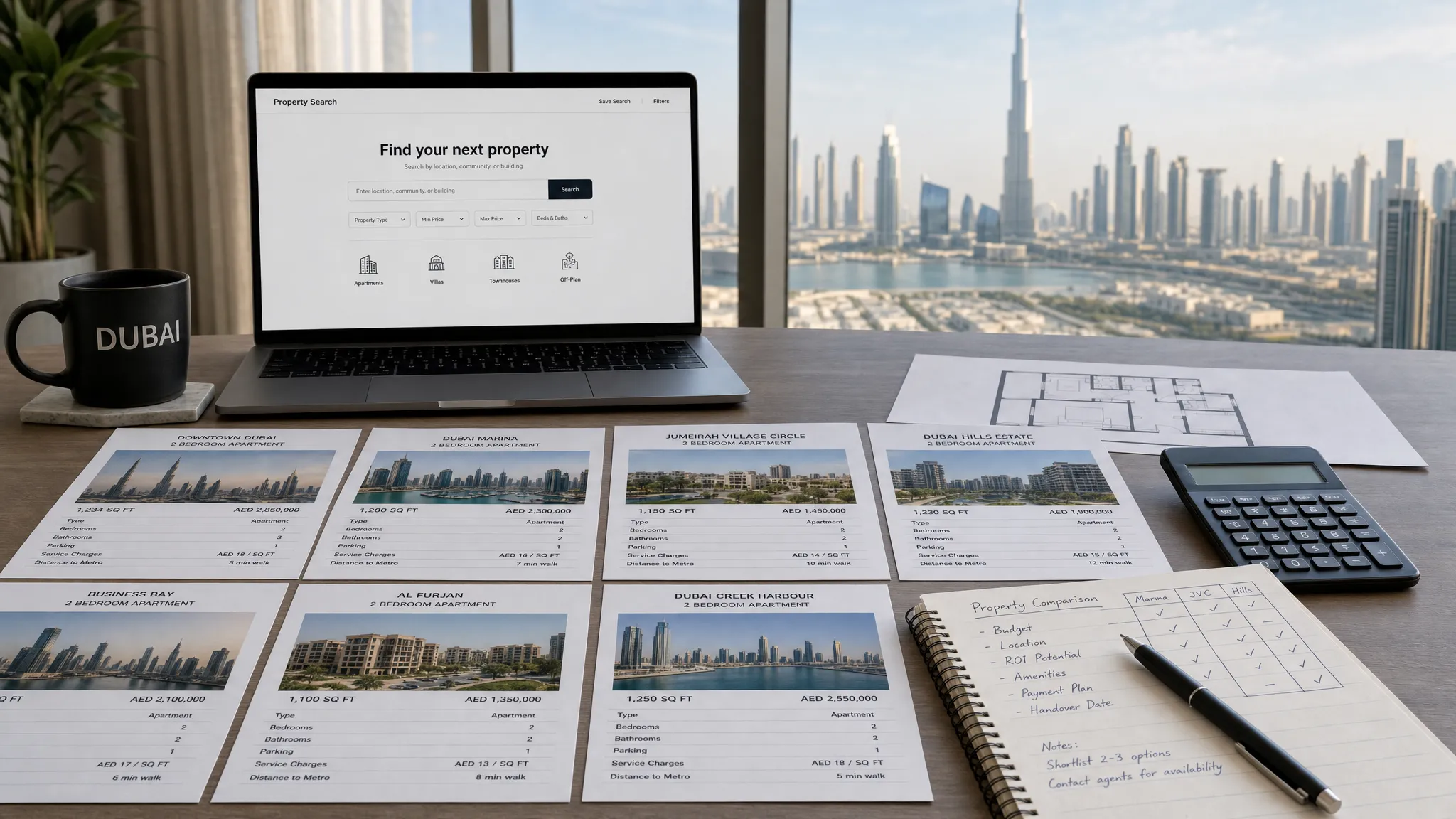
Dubai property portals can shorten your search from weeks to days, but only if you use them with a clear process. If you typed “property finder Dubai” into Google and opened several similar portals, you have probably already seen the challenge: hundreds of listings, repeated units, different prices for similar homes, and descriptions that are sometimes more marketing than fact.
The goal is not to browse more. The goal is to filter better, read listings critically, verify the important details, and contact agents only when a property deserves your time. Whether you are buying, renting, or comparing off-plan opportunities, the habits below will help you get more value from every real estate portal you use.
Start with a property brief before opening any portal
A property portal is only as useful as the search you give it. Before you start scrolling, write a simple brief that defines what a good match looks like. This saves time and protects you from attractive listings that do not fit your real needs.
Your brief should include:
- Purpose: end-use, rental income, long-term capital growth, or a future resale plan.
- Property type: apartment, villa, townhouse, office, retail, or plot.
- Target locations: two or three priority communities, plus one or two backup areas.
- True budget: not just the asking price, but the total cost of moving, buying, or renting.
- Timeline: immediate move-in, ready property purchase, or off-plan handover later.
- Deal breakers: commute time, building age, view, parking, chiller costs, pet rules, or service charges.
For buyers, the true budget should account for transaction fees, possible mortgage-related costs, agency commission, conveyancing, service charges, and moving costs. For renters, think beyond annual rent and include the security deposit, agency commission, Ejari, DEWA, internet setup, chiller, furniture, and renewal terms. Fees can change, so always confirm the latest amounts before signing anything.
If you are still choosing which platforms to include in your search, it helps to understand the differences between the main UAE real estate listing sites before you compare individual homes.
Use filters to reduce noise, not to hide risk
Many users either apply too few filters or too many. Too few filters create a long list of irrelevant options. Too many filters can hide good properties that are slightly outside your assumptions, especially in areas where layouts, building quality, and pricing vary from tower to tower.
Use filters in stages. Start broad enough to understand the market, then tighten your search once you see realistic prices and availability. A smart filter strategy should help you compare like with like.
| Filter | How to use it well | Mistake to avoid |
|---|---|---|
| Location | Search by community first, then narrow to buildings or sub-communities. | Searching all of Dubai and comparing areas with completely different demand drivers. |
| Budget | Set a realistic range that leaves room for fees, deposits, and negotiation. | Sorting only by the lowest price and assuming the cheapest listing is the best deal. |
| Property type | Separate apartments, villas, townhouses, and commercial units. | Comparing a villa community with an apartment district using the same criteria. |
| Size | Compare usable layouts, not only square footage. | Assuming a larger unit is better when the layout wastes space. |
| Completion status | Separate ready properties from off-plan projects. | Mixing ready-to-move homes with units that may hand over years later. |
| Furnishing | Filter furnished and unfurnished separately, especially for rentals. | Assuming “furnished” means the same quality, completeness, or condition in every listing. |
| Amenities | Focus on amenities you will actually use. | Paying a premium for facilities that do not improve your lifestyle or rental appeal. |
Price per square foot is useful, but it is not a complete valuation method. A higher price per square foot may be justified if the building has better maintenance, a stronger location, superior views, easier access, or lower vacancy risk. A lower price may be a bargain, or it may reflect noise, poor condition, high service charges, bad layout, or legal complexity.
Read every listing like a verifier
A listing is a lead, not final proof. Dubai portals can contain excellent opportunities, but they can also contain outdated prices, duplicated units, vague descriptions, or availability that changes quickly. Your job is to separate useful listings from noise before you invest time in calls and viewings.
Start with the basics: listing date, permit information, property size, location, photos, availability, and agent details. Then look for missing information. A serious listing should make it easy to understand what is being offered, what the cost structure looks like, and what the next step is.
| Listing detail | What to check | Why it matters |
|---|---|---|
| Permit or reference details | Ask the agent to confirm the advertising permit and agency information. | It helps confirm that the listing is being marketed properly. |
| Size and layout | Request a floor plan and clarify whether the size is built-up, net, or sellable area. | Two units with the same bedroom count can feel very different. |
| Photos and virtual tours | Check whether images show the exact unit, a similar unit, or a show apartment. | Old or generic photos can create unrealistic expectations. |
| Availability | Confirm whether the unit is vacant, tenanted, owner-occupied, or still under construction. | Availability affects viewing, move-in, mortgage, and investment planning. |
| Price and terms | Ask whether the price is negotiable and what is included. | Parking, furniture, appliances, and payment terms can change the real value. |
| Running costs | Ask about service charges, chiller, maintenance, and community fees where relevant. | Ongoing costs affect affordability and net yield. |
Marketing phrases such as “best deal,” “genuine listing,” “motivated seller,” and “limited availability” are not proof. They may be true, but they need confirmation. For a deeper breakdown of listing language, photos, layouts, and pricing signals, use this guide on how to read real estate listings like a smart buyer.
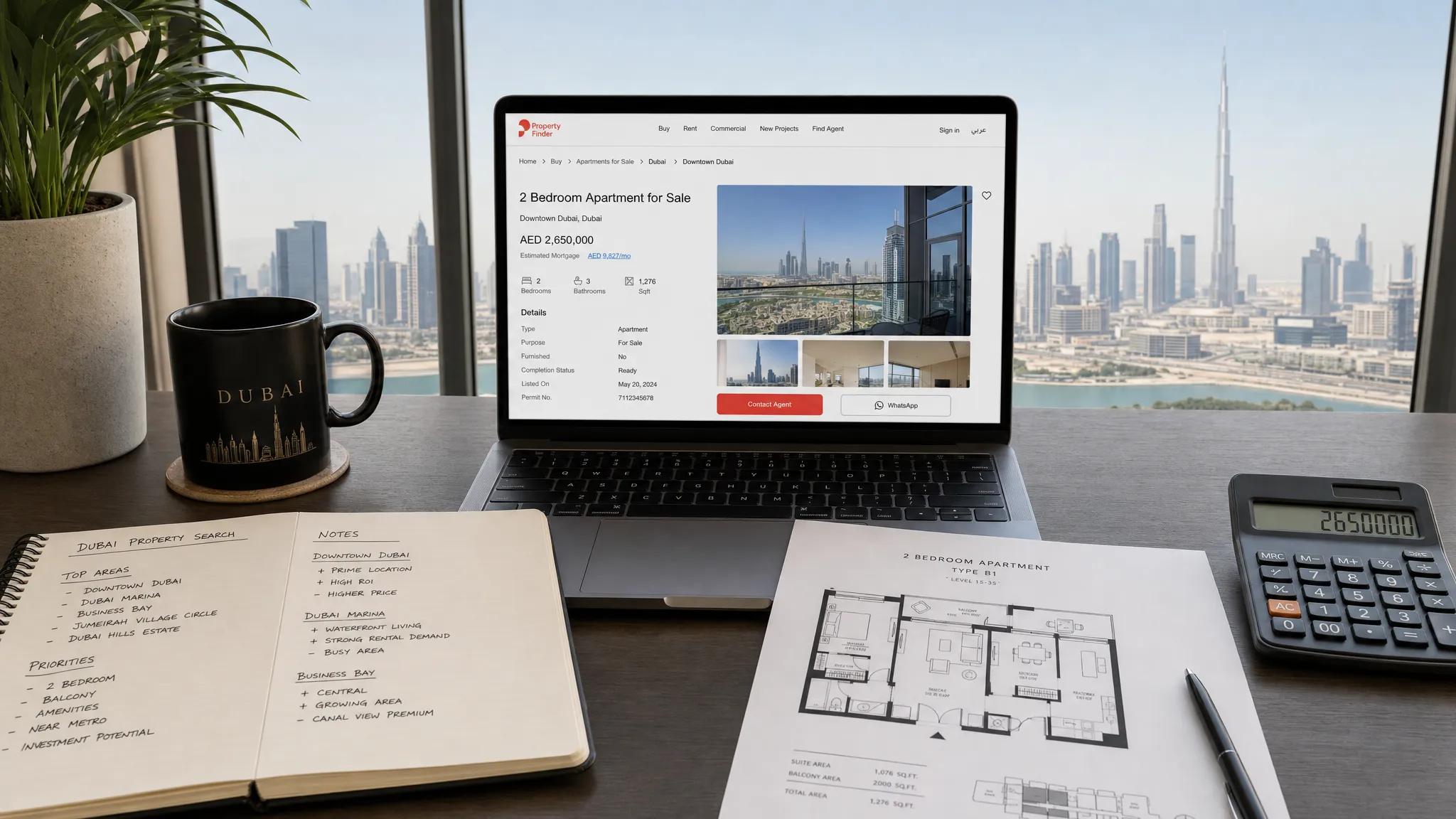
Use Property Finder Dubai and other portals as comparison tools, not final proof
Property Finder Dubai and similar portals are excellent for discovering supply, comparing asking prices, and identifying active agents in a building or community. They are not a substitute for legal checks, official data, or direct confirmation from the agent, owner, developer, or trustee office.
If you find a property you like, search for similar listings by building name, number of bedrooms, size range, view, and price. You may discover that the same or similar unit appears on multiple portals with slightly different photos, prices, or descriptions. That does not always mean something is wrong, but it does mean you should clarify which listing is current and who has authority to market it.
For market context, compare portal asking prices with official information where available. The Dubai Land Department provides government services and data connected to Dubai real estate, including transaction-related resources. Asking prices show what sellers or landlords want. Registered activity gives you a stronger sense of what the market has recently accepted.
For rentals, also pay attention to renewal rules, Ejari registration, payment cheques, maintenance responsibilities, and whether chiller or utilities are separate. For off-plan purchases, confirm the developer, project registration, payment plan, handover timeline, escrow account details, and what happens if there are construction or handover delays.
Contact agents like a serious buyer or tenant
Good agents respond better when your inquiry is specific. Instead of sending a generic message asking whether a listing is available, show that you understand the property and ask for the details that matter.
A simple first message could look like this:
Hi, I’m interested in the listed unit in [building or community]. Please confirm whether this exact unit is still available, the advertising permit number, exact size, floor or view, parking, occupancy status, service charges or rental terms, and the earliest viewing time.
Before booking a viewing, ask the agent to clarify:
- Whether the exact unit in the photos is available.
- The floor, view, parking allocation, and total area.
- Whether the property is vacant, tenanted, or owner-occupied.
- For sales, the title status, annual service charges, and seller’s preferred timeline.
- For rentals, the number of cheques, deposit, agency commission, maintenance responsibility, and move-in date.
- Whether a recent video walk-through, floor plan, or virtual tour is available.
The quality of the response is a useful signal. A strong agent will usually answer directly, provide supporting details, and explain the next steps. Be cautious if the agent avoids basic questions, pushes you to view a different property immediately, or says the listed unit is gone but has “something similar” without explaining the difference.
Build a shortlist instead of saving everything
Portals are designed to make browsing easy, but serious property decisions require comparison. After your first search session, reduce your options to a shortlist of five to ten properties. Then compare them using the same criteria rather than relying on first impressions.
| Shortlist factor | What to compare |
|---|---|
| Location quality | Commute, access, community maturity, nearby schools, retail, and transport. |
| Building or community condition | Maintenance, common areas, parking, lifts, facilities, and management quality. |
| Layout efficiency | Room sizes, storage, balcony usability, natural light, and wasted space. |
| Total cost | Asking price or rent plus fees, running costs, deposits, service charges, and utilities. |
| Liquidity or rental appeal | Demand in the area, tenant profile, resale potential, and vacancy risk. |
| Legal and availability status | Permit, title or tenancy status, handover timing, and viewing access. |
Favorites and comparison tools are useful here, especially on platforms that let you organize listings instead of keeping dozens of open tabs. On Best Property, for example, users can browse detailed property pages, use search filters, review photos or virtual tours where available, and contact agents or owners directly. Those tools work best when you have already defined what makes a listing worth your attention.
Once your shortlist becomes serious, stop thinking like a browser and start thinking like a negotiator. For buyers, this means confirming finance, understanding the transfer process, reviewing documents, and knowing the steps from offer to ownership. For renters, it means confirming contract terms, payment schedule, move-in readiness, and Ejari requirements.
Common mistakes to avoid on Dubai property portals
The biggest mistake is treating the portal ranking as a recommendation. Sponsored positions, fresh uploads, and attractive photos can influence what you see first, but they do not prove value. A property that appears lower in search results may still be a better fit.
Other common mistakes include:
- Chasing the cheapest listing without asking why it is priced below similar units.
- Ignoring service charges, chiller costs, maintenance, or renovation needs.
- Comparing communities only by price instead of lifestyle, demand, and access.
- Assuming every map pin is exact, especially in large master communities.
- Booking too many viewings before verifying availability and key terms.
- Forgetting to check traffic, noise, parking access, and building condition at different times of day.
A good portal search should make you more selective, not more overwhelmed. If each search session leaves you with clearer criteria and fewer stronger options, you are using the platform well.
Frequently Asked Questions
Is Property Finder Dubai enough to find a home or investment? It can be a strong starting point, but you should compare across portals, verify details with agents, and check official sources where relevant. No portal should be your only source of truth.
How do I know if a Dubai property listing is genuine? Check the advertising permit or reference details, confirm the exact unit is available, ask for a floor plan or recent video, and verify the agent’s answers. For serious transactions, use official channels and professional advice before signing.
Why do the same properties appear at different prices? Duplicates can happen when multiple agents advertise similar units, when prices change, or when an old listing remains online. Always ask whether the exact unit, price, and terms are current.
Should I sort listings from cheapest to most expensive? You can do it for a quick market scan, but do not rely on it alone. The cheapest listing may have drawbacks such as poor condition, high running costs, limited availability, or less favorable terms.
Are property portals useful for off-plan projects? Yes, they are useful for discovery and comparison, but off-plan buyers should verify the developer, project registration, payment plan, escrow details, handover timeline, and contract terms before committing.
Search smarter with Best Property
Dubai has many property portals, but the best results come from disciplined searching and careful verification. Use filters, compare listings, ask better questions, and confirm the facts before you view, offer, or sign.
If you want a UAE-focused platform with advanced search filters, detailed listings, daily updates, photos, virtual tours where available, and direct contact options, start your search with Best Property. Use it to build a focused shortlist, then make decisions with confidence instead of guesswork.


Join The Discussion