

An easier home find is rarely about opening more tabs. It is about reducing uncertainty, removing weak options faster, and knowing exactly why a property deserves a viewing.
For buyers and renters in Dubai and across the UAE, the property search can become overwhelming quickly. One portal shows hundreds of apartments. Another shows villas with similar prices but very different sizes. Agents may call back at different times, listings can change daily, and the most attractive homes often move fast.
The good news is that your home find process becomes much easier when you treat it like a decision system, not a browsing session. The tips below will help you narrow your options, compare properties fairly, and move from search to shortlist with more confidence.
Clarify the job your next home must do
Before using filters, write a short home brief. This is not a wish list for a perfect property. It is a practical guide that tells you what the home must achieve for your life, family, or investment plan.
A strong brief should answer the basic questions that listings cannot answer for you. Are you buying for long term family use, rental income, capital appreciation, or a future move to Dubai? Are you renting because you need flexibility, or because you are testing an area before buying? Do you need proximity to schools, business districts, transport links, healthcare, or community amenities?
Your brief should separate needs from preferences:
- Must have requirements such as budget range, number of bedrooms, parking, commute limit, or pet policy
- Flexible preferences such as view, floor level, balcony size, furnishing, or gym quality
- Deal breakers such as poor access, no parking, high noise, weak maintenance, or unclear ownership details
- Timing needs such as immediate move in, mortgage approval window, tenancy end date, or off-plan handover expectations
This small exercise saves time because every listing must now pass a purpose test. If a home looks attractive but fails the reason you are moving, it is not really a match. For a more detailed workflow, this guide on how to search for houses without wasting time explains how to create a focused buyer brief before you start viewing.
Build your budget from the full picture, not the listing price
A common home find mistake is searching at the edge of your budget before calculating the full cost of ownership or occupancy. The listing price or annual rent is only one part of the decision. Upfront costs, recurring fees, maintenance, financing, moving costs, and furnishing can change what is truly affordable.
Rules and fees differ by emirate, property type, and whether you are renting, buying ready property, or buying off-plan. Always confirm current costs with the agent, developer, lender, or relevant authority before making a decision.
| Budget item | Why it matters | What to confirm before shortlisting |
|---|---|---|
| Listing price or annual rent | It is the starting point, not the full cost | Whether the price is aligned with comparable properties |
| Upfront transaction costs | Deposits, agency fees, registration costs, and mortgage related costs affect cash needed | Current amounts, payment timing, and who receives each payment |
| Ongoing costs | Service charges, utilities, cooling, maintenance, and community fees can reshape the monthly total | Latest available charges and what is included or excluded |
| Financing assumptions | Mortgage pre-approval, interest rate, loan term, and down payment change affordability | Pre-approval status and total monthly payment estimate |
| Moving and setup costs | Furnishing, curtains, appliances, repairs, and moving services can be significant | What is included in the property and what must be added |
Once you know the full budget, set your search range slightly below the absolute maximum. This gives you room to negotiate, cover unexpected costs, and compare better options instead of feeling pushed into every property that appears affordable on paper.
Search locations by daily routine, not only by reputation
Dubai and the wider UAE property market is full of well known communities, but reputation alone does not tell you whether an area fits your day. A popular tower may be wrong for you if the commute is difficult. A quieter villa community may be perfect if it reduces school run stress or gives you more space for the same budget.
Think of location as a routine map. Check how your life works from the front door at the times you actually travel. A 20 minute drive at midday can become much longer during peak hours. A building that looks close to the metro may still involve an uncomfortable walk in summer. A villa with generous space may require a second car if daily errands are not nearby.
Look beyond the area name and assess access to work, schools, nurseries, supermarkets, clinics, parks, public transport, and main roads. Also consider noise, construction activity, parking availability, visitor access, delivery convenience, and future development around the community.
This approach often reveals better choices. Instead of asking which area is best, ask which area makes your daily life easier while staying within budget.
Use filters like a funnel
Advanced property filters are powerful, but they work best when used in stages. If you start too narrow, you may miss good homes that are slightly outside one preference. If you start too broad, you will waste time on listings that never had a real chance.
Begin with the filters that protect your core brief: budget, property type, bedrooms, emirate, community, and sale or rent status. Then add practical filters such as parking, furnishing, completion status, balcony, view, amenities, or developer. After that, sort by relevance, newest listings, price, or size depending on your goal.
The key is to review results after each filter change. If the search drops from hundreds of options to only two, you may have over-filtered. If you still have dozens of weak matches, tighten the criteria. A good home find process balances discipline with flexibility.
Make every shortlist earn its place
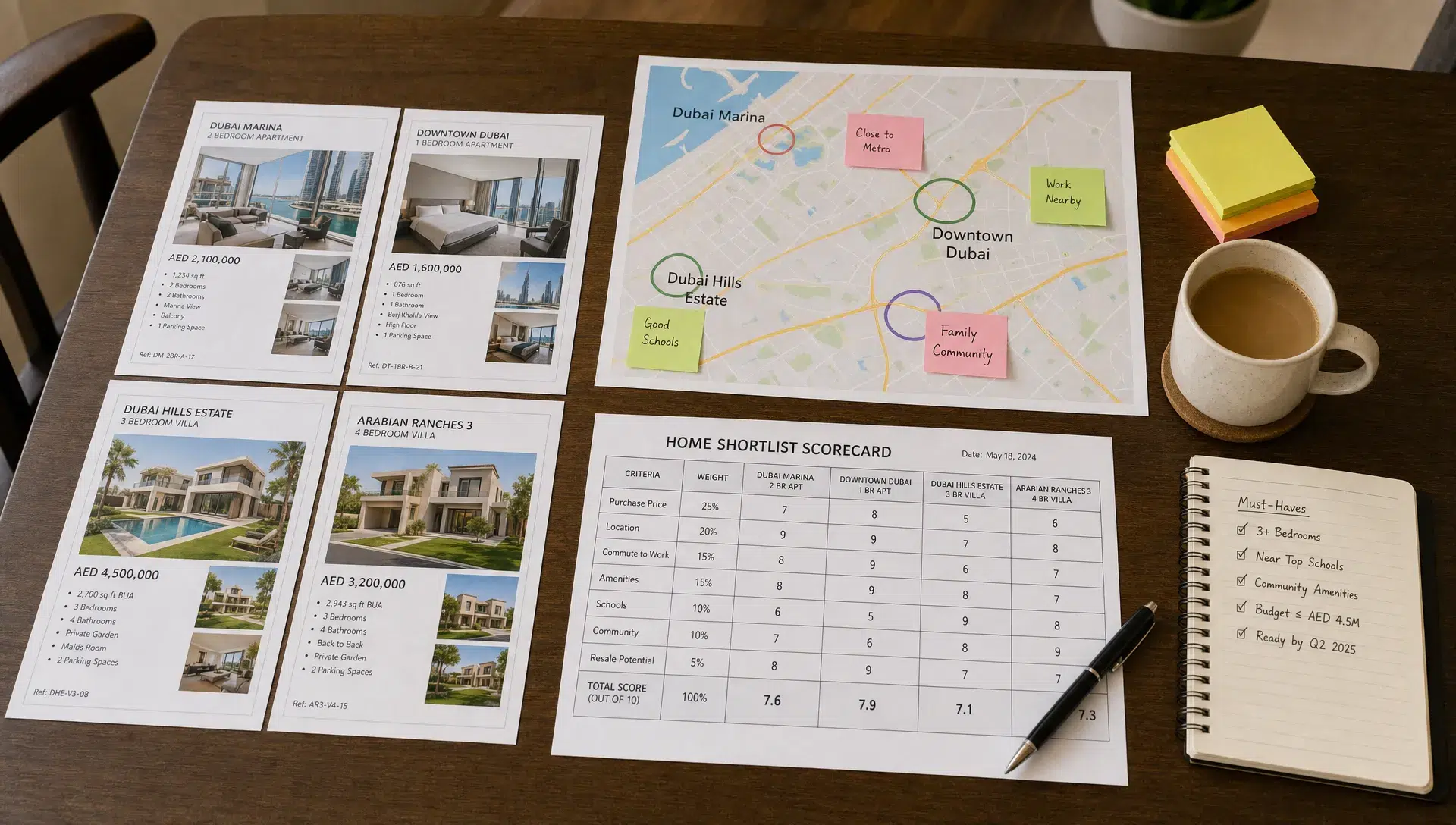
Shortlisting should not mean saving every attractive property. It should mean identifying homes that deserve your time, questions, and possibly a viewing. A simple scorecard helps you compare emotional impressions with practical facts.
Use a 1 to 5 score for each factor, then add a note explaining the score. The note matters because it captures why you liked or rejected a property.
| Shortlist factor | Question to ask | Why it helps |
|---|---|---|
| Budget fit | Does this property fit the full cost picture? | Prevents overcommitting based on headline price |
| Location fit | Does the location support daily routines? | Keeps lifestyle needs central |
| Layout efficiency | Does the floor plan use space well? | Avoids paying for unusable square footage |
| Building or community condition | Are shared areas, access, and maintenance acceptable? | Protects comfort and future value |
| Listing credibility | Are photos, details, size, and agent information clear? | Reduces time spent on weak or unclear listings |
| Exit potential | Would the home appeal to future buyers or tenants? | Helps investors and long term buyers think ahead |
A property does not need a perfect score to remain on your list. It does need a clear reason to stay there. If two homes score similarly, the notes will help you identify which one fits your real priorities.
Read listings like an investigator
A listing is a marketing document, not a full due diligence report. Good listings make your search easier because they provide enough information to decide whether the property deserves attention. Weak listings create more questions than answers.
Strong listings usually include clear recent photos, accurate property details, size information, floor plan when available, community notes, viewing availability, and transparent agent or owner contact information. For off-plan property, you should expect clear information about developer, project stage, payment plan, handover timing, and what is included.
Be cautious when a listing has very limited photos, vague descriptions, unusually low pricing without explanation, inconsistent size details, or pressure to pay quickly before basic verification. These signals do not always mean a listing is bad, but they do mean you should ask more questions before spending time or money.
A more detailed checklist is covered in this guide on how to find reliable home listings for sale, especially if you are comparing properties online before speaking with agents.
Compare like with like before judging price
Two homes can have the same number of bedrooms and still be completely different products. A three bedroom apartment in a prime tower with full marina views is not the same as a three bedroom apartment farther from transport with a less efficient layout. A townhouse and a villa may both offer family space, but land size, privacy, maintenance, and community facilities can be very different.
When comparing prices, keep the comparison as similar as possible. Match property type, community, building quality, size, floor level, view, condition, furnishing, parking, occupancy status, and payment terms. For buyers, also consider service charges, building age, developer reputation, and future supply in the area. For renters, compare contract terms, maintenance responsibility, number of cheques, renewal expectations, and move in condition.
This is where many people make the search harder than it needs to be. They compare the cheapest option in one area with the best quality option in another, then feel confused. Fair comparison makes the decision clearer.
Prepare for viewings before you leave home
Viewings are not only about whether you like the property. They are your chance to test the listing against reality. Before you go, review your brief, confirm the exact location, ask whether the property is still available, and request any missing details that could make the trip unnecessary.
Try to group viewings by area so you can compare communities on the same day. Visit at different times when possible, especially if traffic, noise, sunlight, or parking could affect your decision.
| Viewing check | What to look for |
|---|---|
| Natural light | Direction, blocked views, heat exposure, and privacy |
| Noise | Road noise, construction, elevators, nearby venues, or building systems |
| Storage | Wardrobes, kitchen storage, laundry space, and utility areas |
| Condition | Signs of leaks, cracks, odors, poor finishes, or neglected maintenance |
| Cooling and utilities | Air conditioning performance, water pressure, and visible equipment condition |
| Common areas | Lobby, lifts, corridors, parking, security, pool, gym, and waste areas |
| Practical access | Drop off points, visitor parking, delivery access, and route to main roads |
Take photos and notes immediately after each viewing, but only if permitted. After seeing several homes, details blend together quickly. A short note on what felt strong, weak, and uncertain will make the final comparison much easier.
Ask better questions at every viewing
The best questions reveal motivation, costs, and risk. Ask why the property is available, how long it has been listed, whether the price is negotiable, what is included, whether there are known maintenance issues, and when the seller or landlord wants to complete.
For buyers, ask about title status, mortgage status if relevant, service charges, occupancy, handover condition, and any planned community work. For renters, ask about maintenance response, contract terms, deposit rules, renewal expectations, and how the tenancy will be registered.
If answers are vague, do not panic, but do not ignore the gap. Ask for confirmation in writing and verify important details through official or professional channels before paying any deposit.
Verify the people and paperwork
A smoother search is not only about finding attractive homes. It is also about avoiding preventable problems. In Dubai, the Dubai Land Department and RERA provide official channels connected to property regulation, broker licensing, and real estate services. For other emirates, use the relevant local authority and confirm procedures before moving forward.
You should be able to identify who you are dealing with, what authority they have to market the property, and what documents support the transaction. For ready property purchases, this may include title related information, seller identification, agency agreements, and bank or mortgage coordination where applicable. For off-plan property, confirm the developer, project details, payment plan, and escrow related information through official sources. For rentals, confirm ownership or authorization and the tenancy registration process.
This is not a replacement for legal, financial, or professional advice. It is a reminder that verification is part of the property search, not a final detail after you have already emotionally committed.
Know when to pause and when to act
A good home find process has two opposite skills: patience and decisiveness. You need patience when the property does not match your brief, when information is unclear, or when pressure replaces proof. You need decisiveness when a property fits your needs, the price is supported by comparable options, the paperwork is clear, and your budget is ready.
After each viewing or agent conversation, place the property into one of three categories: reject, watch, or act. Reject means it fails the brief. Watch means it could work if price, timing, or missing information improves. Act means it is worth a serious next step, such as negotiation, second viewing, document review, mortgage coordination, or offer discussion.
This simple system prevents endless browsing. It also helps you avoid the two most common search problems: rushing into the wrong home or delaying so long that the right one disappears.
Frequently Asked Questions
What is the first step in a home find process? Start with a clear brief that explains why you are moving, what you can afford, which locations fit your routine, and which requirements are non-negotiable. This gives every search and viewing a clear purpose.
How many properties should I shortlist before viewings? There is no perfect number, but a focused shortlist of 5 to 8 strong options is usually more useful than saving dozens of average listings. Quality matters more than volume.
How can I tell if a UAE property listing is reliable? Look for clear photos, consistent details, realistic pricing, identifiable agent or owner contact information, and answers that can be verified. Be careful with vague listings, unusually low prices, or pressure to pay before basic checks.
Should I search by budget or location first? Use both together. Budget protects affordability, while location protects daily quality of life. If you start with only one, you may find homes that look good online but do not work in practice.
Is it better to view homes online first or visit immediately? Start online to remove weak matches, then view only the strongest options. Photos, virtual tours, maps, and listing details can save time, but an in-person viewing is still important before making a serious commitment.
Make your home find simpler with Best Property
The easiest property search is structured, realistic, and supported by reliable listing information. Start with your brief, calculate your full budget, compare similar homes, verify details, and use viewings to test what you have learned online.
With Best Property, you can explore UAE properties for sale and rent using advanced search filters, detailed listings, high-quality photos, virtual tours, direct agent and owner contact, favorites, and comparison tools. Use the platform to narrow your options faster, then move forward with the homes that truly fit your goals.


Join The Discussion