

Comparing property listings is not just about finding the lowest price or the nicest photos. In Dubai and across the UAE, two apartments with the same bedroom count can differ dramatically in service charges, view quality, floor plan efficiency, developer reputation, handover risk, rental potential, and long-term resale value.
That is why experienced buyers use a repeatable comparison process. Whether you are searching broadly or typing “property on sale near me” because you want something close to work, school, or family, the goal is the same: separate attractive listings from genuinely good opportunities.
Below is a practical framework you can use to compare property on sale listings like a pro, avoid costly assumptions, and build a shortlist with confidence.
Start With Your Buyer Brief Before You Open Listings
Most buyers start by scrolling. Professionals start with criteria.
Before comparing listings, define what the property must achieve. A homebuyer looking for a family villa in Dubai Hills Estate is not comparing value in the same way as an investor evaluating a studio in JVC or Business Bay. Without a clear brief, every nice photo can feel like a new possibility, and your shortlist becomes confusing.
Your buyer brief should include:
- Budget range, including purchase costs and expected monthly costs
- Preferred emirate, community, or commute radius
- Property type, such as apartment, townhouse, villa, office, or retail unit
- Minimum bedrooms, bathrooms, parking, and usable space
- Ready property or off-plan preference
- End-use goal, such as living, renting out, flipping, or long-term holding
- Non-negotiables, such as balcony, maid’s room, school access, metro access, or waterfront views
Once your brief is clear, you can compare listings against a fixed standard instead of reacting emotionally to each property.
Compare Like With Like, Not Just Bedroom Counts
A common mistake is comparing “2-bedroom apartment vs 2-bedroom apartment” as if the label tells the full story. It does not.
In the UAE, bedroom count is only one part of the value equation. A 2-bedroom unit with a poor layout, small balcony, limited storage, and no view may feel less spacious than a well-designed 1-bedroom plus study. A villa with a larger built-up area may still sit on a smaller plot. A “near metro” apartment could mean a 5-minute walk or a 20-minute walk in summer heat.
When comparing property on sale listings, normalize the basic details first:
| Comparison factor | What to check | Why it matters |
|---|---|---|
| Price per square foot | Asking price divided by listed size | Helps compare value across similar units |
| Net usable layout | Floor plan, storage, balcony, corridor space | Large size is not always efficient size |
| Building age and condition | Completion year, maintenance, common areas | Affects repair risk and resale appeal |
| View and floor level | Road, community, skyline, sea, golf, or obstruction | Can strongly influence price and demand |
| Parking allocation | Number, location, title status if applicable | Important for end users and tenants |
| Occupancy status | Vacant, rented, owner-occupied, short-term let | Affects move-in timing and rental strategy |
| Service charges | Annual community or building charges | Impacts net yield and ownership cost |
If you want to sharpen how you interpret listing wording, photos, layouts, and pricing clues, Best Property’s guide on how to read real estate listings like a smart buyer is a useful companion to this comparison framework.
Normalize the Price Before Calling Anything a Deal
The cheapest listing is not always the best value. Sometimes it is priced low because it has a weaker view, an awkward floor plan, higher service charges, an upcoming maintenance issue, or a tenancy that limits immediate use.
Start with price per square foot, but do not stop there. In Dubai, you should also compare asking prices against recent transaction data where available. The Dubai Land Department publishes official real estate information and transaction-related services, which can help buyers understand market context. For other emirates, local land departments and official platforms can provide useful reference points.
Then calculate the total cost of ownership. In Dubai, buyers commonly account for costs such as the DLD transfer fee, agency commission where applicable, conveyancing, mortgage-related costs if financing, valuation, moving costs, furnishing, and ongoing service charges. Exact costs can vary by transaction structure, emirate, lender, and agreement, so use them as part of your estimate and confirm before making an offer.
A simple comparison can reveal why one listing is better than another:
| Listing | Asking price | Size | Price per sq ft | Annual service charges | Immediate usability |
|---|---|---|---|---|---|
| Apartment A | AED 1,250,000 | 850 sq ft | AED 1,471 | Medium | Vacant |
| Apartment B | AED 1,190,000 | 780 sq ft | AED 1,526 | High | Rented |
| Apartment C | AED 1,310,000 | 920 sq ft | AED 1,424 | Medium | Vacant on transfer |
In this example, Apartment B looks cheaper at first glance, but it is more expensive per square foot and may have less flexibility if it is rented. Apartment C may offer better usable value if the layout and condition are strong.
Compare Location at Street Level, Not Just Community Level
Location is not only the name of the neighborhood. Within the same community, values can shift from tower to tower, street to street, and even side of the building to side of the building.
For example, two Dubai Marina apartments can both claim marina access, but one may face a premium waterfront view while the other faces traffic. Two villas in the same master community may have very different appeal depending on proximity to parks, schools, mosques, retail, traffic exits, and construction zones.
When comparing listings, ask practical location questions:
- How long is the real commute during peak hours?
- Is the property close to public transport, and is that distance walkable year-round?
- Are there schools, clinics, supermarkets, gyms, and parks nearby?
- Is the unit near noise sources such as highways, nightlife, loading bays, or construction?
- Are there future developments that could improve access or block views?
- How easy is guest parking or visitor access?
If you are buying for investment, compare tenant demand in the micro-location, not just the wider district. A building with easy access, good amenities, and a practical layout may outperform a flashier building that is harder to live in.
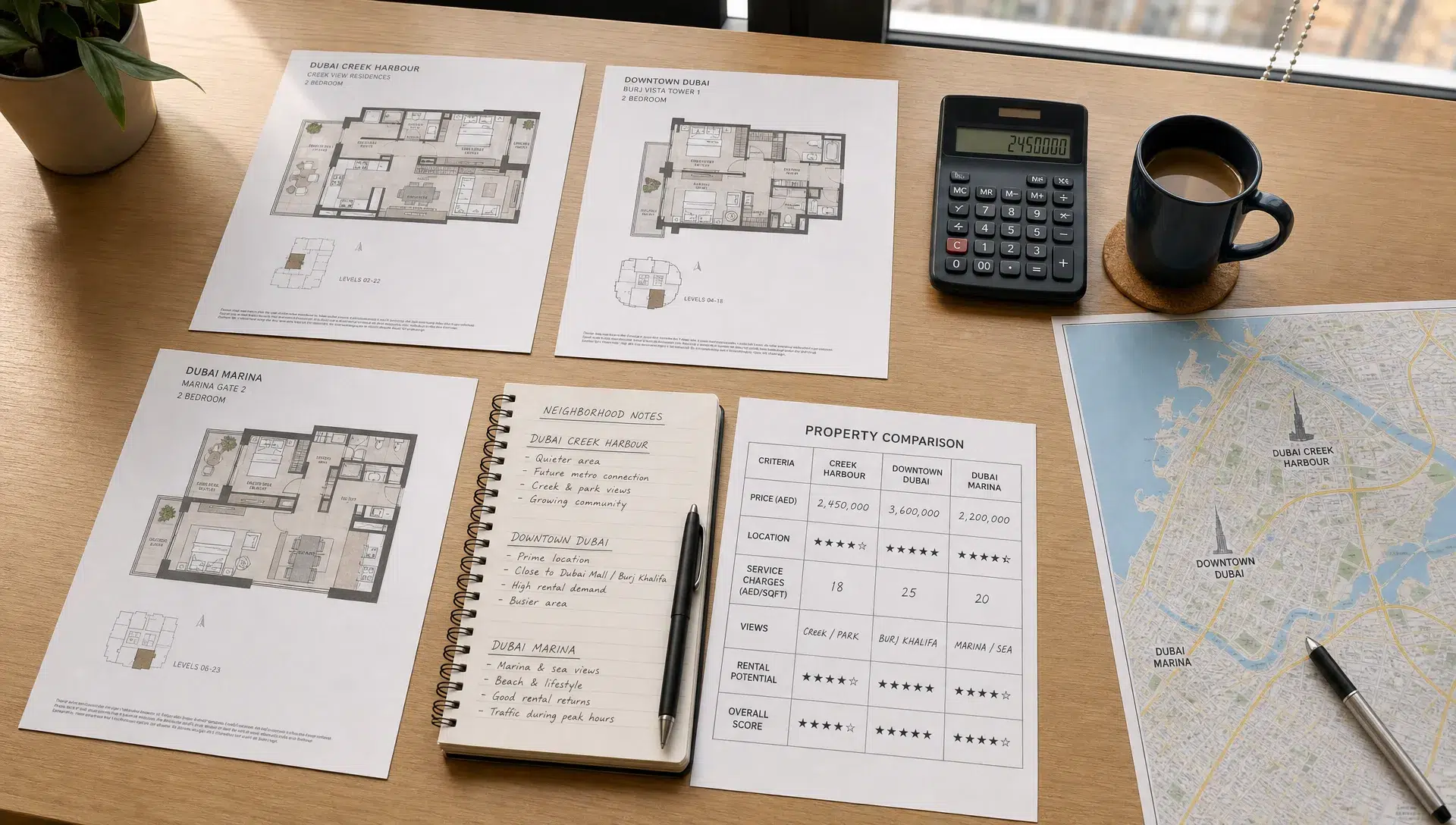
Look Beyond Photos and Check the Evidence
High-quality photos and virtual tours are helpful, but they should support your decision, not drive it entirely. Listing photos can be taken with wide-angle lenses, staged furniture, ideal lighting, and carefully selected angles. A property can look bright online but feel dark in person if it faces another tower or receives little natural light.
Compare visual evidence across listings by checking:
- Whether all rooms are shown, including bathrooms, kitchen, balcony, storage, and view
- Whether the floor plan matches the advertised bedroom count and size
- Whether the view is shown clearly or avoided
- Whether the building exterior and common areas are included
- Whether photos look current or reused from an old listing
Descriptions also matter. A strong listing usually gives clear details about size, floor level, parking, balcony, view, occupancy, amenities, and payment terms. Vague phrases such as “best deal,” “hot offer,” or “investor special” are not necessarily wrong, but they should be backed by facts.
Verify Listing Legitimacy and Agent Details
In a competitive market, duplicate, outdated, or incomplete listings can waste time. Before you book multiple viewings, verify that the property is available, the price is current, and the person advertising it is authorized to discuss it.
In Dubai, ask for the listing permit details where applicable and confirm the agency or broker information. For off-plan projects, check the developer, project registration, escrow details where relevant, payment plan, handover date, and what is included in the sale price. For ready properties, confirm the title deed status, ownership structure, tenancy details, and whether there are any outstanding payments that could affect transfer.
Be especially careful when a listing has:
- A price far below similar properties without a clear reason
- No exact location or building name
- Repeated stock photos instead of real property photos
- Pressure to pay quickly before viewing or verification
- Inconsistent size, bedroom count, or payment details
- An agent who avoids basic documentation questions
For a deeper checklist of warning signs, review these common real estate property listing red flags before you make a viewing plan or submit an offer.
Compare Ready and Off-Plan Listings Differently
Ready properties and off-plan properties require different comparison methods.
With ready properties, you can inspect the unit, building, amenities, parking, noise levels, and maintenance condition. You can also evaluate current rent, vacancy, tenant profile, and immediate usability. The main questions are condition, price, title clarity, occupancy, and total ownership cost.
With off-plan properties, you are comparing the future. The most important factors include developer track record, project location, payment plan, escrow protection, handover timeline, unit selection, floor plan, surrounding infrastructure, and likely market demand at completion. A low entry price can be attractive, but payment schedule, handover risk, and resale restrictions can change the true investment picture.
If you are deciding between immediate ownership and a future handover, this guide to off-plan vs ready property in Dubai can help you compare the trade-offs more clearly.
Score Listings With a Simple Decision Matrix
Once you have narrowed your options, use a scoring system. This prevents one attractive feature, such as a view or a discount, from overpowering more important fundamentals.
Rate each property from 1 to 5 across the categories that matter to your goal. Weight the categories if needed. For example, an investor may give rental yield and liquidity more weight, while an end user may prioritize commute, layout, and community feel.
| Category | End-user importance | Investor importance | What a strong score means |
|---|---|---|---|
| Price vs market | High | High | Fair or below comparable market value |
| Layout efficiency | High | Medium | Practical rooms, minimal wasted space |
| Location convenience | High | High | Strong access, amenities, and demand |
| Building quality | High | High | Good maintenance, reputation, amenities |
| Ownership costs | Medium | High | Reasonable service charges and upkeep |
| Rental potential | Low to medium | High | Good demand and realistic rent outlook |
| Exit liquidity | Medium | High | Easy to resell due to broad buyer appeal |
| Lifestyle fit | High | Low to medium | Matches daily needs and preferences |
The “best” listing is rarely perfect across every category. The right property is the one with the strongest overall fit for your purpose and the fewest unacceptable weaknesses.
Ask Better Questions Before Booking a Viewing
A viewing should confirm what you already know, not uncover basic facts that should have been available earlier. Before visiting, ask the agent or owner direct questions that make comparison easier.
Useful questions include:
- Is the property currently vacant or rented?
- What is the exact built-up area and source of the size figure?
- Are there annual service charges or community fees?
- Is the price negotiable, and what is motivating the seller?
- Are there any outstanding payments, maintenance issues, or disputes?
- What is included in the sale, such as appliances, furniture, or parking?
- Can you share the floor plan, title details, or listing permit information where applicable?
The quality of the answers often tells you as much as the listing itself. Clear, specific answers are a good sign. Evasive or inconsistent answers are a reason to slow down.
Compare Lifestyle Value and Investment Value Separately
Many buyers blur personal preference with investment logic. That can lead to overpaying for features they love but the wider market may not value as much.
For end users, lifestyle value matters. Morning commute, school run, natural light, storage, noise, building culture, pet policies, and nearby amenities can justify paying more for the right property. A slightly higher price may be reasonable if the home genuinely improves daily life and reduces future moving risk.
For investors, emotion should play a smaller role. Focus on tenant demand, rental competitiveness, service charges, vacancy risk, building reputation, future supply, and resale liquidity. A beautiful unit in a weak rental location may not be as strong as a simpler unit in a consistently demanded community.
If you are both living in the property now and thinking about resale later, compare both sides. The strongest listings usually combine livability with broad future appeal.
Use Platform Tools to Keep Your Comparison Organized
When you compare more than five or six listings, details start to blend together. This is where a structured property platform can save time.
On Best Property, buyers can use search filters to narrow listings by location, property type, budget, and other key criteria, then review detailed listings with photos, available media, and contact options. Features such as favorites and comparison tools can help you keep track of serious options instead of losing them in browser tabs or chat threads.
A practical workflow is simple:
- Filter by your non-negotiables first.
- Save only listings that match your buyer brief.
- Compare price, size, location, condition, and ownership costs side by side.
- Contact agents for missing details before viewing.
- Visit only the strongest candidates.
This approach makes your search faster, calmer, and more evidence-based.
Final Checklist Before You Shortlist a Property
Before a listing makes your final shortlist, confirm that it passes these core checks:
- The asking price is reasonable compared with similar properties
- The size, layout, and floor plan support the advertised value
- The location works at street level, not just community level
- Photos and descriptions are clear, complete, and consistent
- Service charges, occupancy status, and transfer considerations are understood
- Agent, owner, or developer details can be verified
- The property fits your end-use goal, not just your budget
A professional comparison process does not guarantee that every deal will be perfect, but it dramatically reduces the chance of choosing based on incomplete information.
Frequently Asked Questions
What is the best way to compare property on sale listings? Start by defining your buyer brief, then compare listings using price per square foot, layout efficiency, location quality, service charges, occupancy status, building condition, and resale or rental potential. Avoid comparing only by bedroom count or headline price.
How do I know if a property listing is overpriced? Compare the asking price with similar properties in the same building, community, size range, view category, and condition. Where possible, check recent transaction data and calculate price per square foot. Also factor in service charges and required upgrades.
Should I choose the cheapest property listing? Not automatically. A cheaper listing may have a weaker view, poor layout, high fees, difficult tenancy terms, or maintenance issues. The better choice is the property with the strongest overall value after all costs and risks are considered.
What should I ask before viewing a property in Dubai or the UAE? Ask about availability, ownership status, occupancy, exact size, service charges, parking, included items, maintenance condition, and required documents or permits. For off-plan properties, ask about the developer, payment plan, escrow arrangements where applicable, and handover timeline.
How many listings should I compare before making an offer? There is no fixed number, but comparing at least five to ten similar listings gives you better market context. Once you understand pricing and availability in your target area, you can act faster when a genuinely strong listing appears.
Compare Smarter With Best Property
The best property decision is rarely made from one listing alone. It comes from comparing options clearly, asking the right questions, and understanding what each property is really worth.
Use Best Property to explore daily updated listings across the UAE, filter by your priorities, review detailed property information, and connect directly with agents or owners when you are ready to take the next step.


Join The Discussion