

The Sharjah real estate market is drawing more attention from UAE buyers who want value, larger living spaces and access to established family communities without moving too far from Dubai. In 2026, the opportunity is not just about finding a cheaper alternative. It is about understanding which locations, property types and ownership structures are gaining depth, and which listings only look attractive on the surface.
Sharjah has its own demand drivers. It is a cultural and education hub, it has long-standing residential districts, and it is increasingly shaped by master-planned communities, waterfront projects and better lifestyle amenities. For buyers, that means the smartest decisions come from tracking local patterns rather than applying Dubai assumptions to a different emirate.
Sharjah real estate market trends defining 2026
The first trend buyers should follow is Sharjah’s shift from a primarily value-led housing market to a more segmented one. Older apartment districts, new lifestyle communities, villa neighborhoods and waterfront developments can move in different directions at the same time. A single market average will not tell you enough.
In practical terms, the Sharjah real estate market now rewards buyers who compare micro-locations carefully. Two properties with similar square footage can have very different long-term appeal if one is closer to schools, arterial roads, retail and reliable building management. This is especially true for end users who plan to live in the property for several years.
For investors, the segmentation matters because rental demand is not uniform. A low entry price can be useful, but only if the unit appeals to a tenant pool that is deep enough to support occupancy, rent stability and resale liquidity.
Affordability is still the main entry advantage
Sharjah remains attractive because many buyers can access larger homes or better layouts for budgets that may be stretched in Dubai. Families often compare Sharjah apartments and villas with Dubai’s outer communities, especially when they need more bedrooms, parking or school access.
The Sharjah real estate market benefits from this affordability gap, but buyers should avoid treating every discount as value. A lower asking price may reflect building age, limited amenities, traffic bottlenecks, high service charges or weaker resale demand. The right question is not “Is this cheaper than Dubai?” but “Is this fairly priced for this exact building, view, layout and handover status?”
Before judging a deal, compare the asking price against similar active listings, recent building-level evidence where available, expected service costs and the condition of common areas. If you are comparing listings online, this guide on how to read real estate listings like a smart buyer can help you look beyond headline claims and focus on the details that affect value.
End-user demand is becoming more selective
Sharjah’s buyer base includes residents who want a permanent home, cross-emirate commuters, investors looking for rental income and families upgrading from smaller apartments. That broad demand supports market activity, but it also raises expectations.
In the Sharjah real estate market, end users increasingly look for practical daily-life benefits. They want usable layouts, enough storage, parking, nearby supermarkets, good schools, healthcare access and predictable commutes. A beautiful lobby is helpful, but it will not compensate for poor sound insulation, difficult access roads or a building with weak maintenance.
This is why newer master-planned communities have gained visibility. Many buyers are willing to pay more for environments that combine residential, retail, leisure and community facilities in one area. The same logic also supports demand in established districts that offer mature infrastructure, even if the buildings are not new.
Area trends buyers should monitor
Location analysis in Sharjah should be more specific than “near Dubai” or “near the waterfront.” Commute routes, school zones, building age, developer reputation and future supply all affect a property’s outlook.
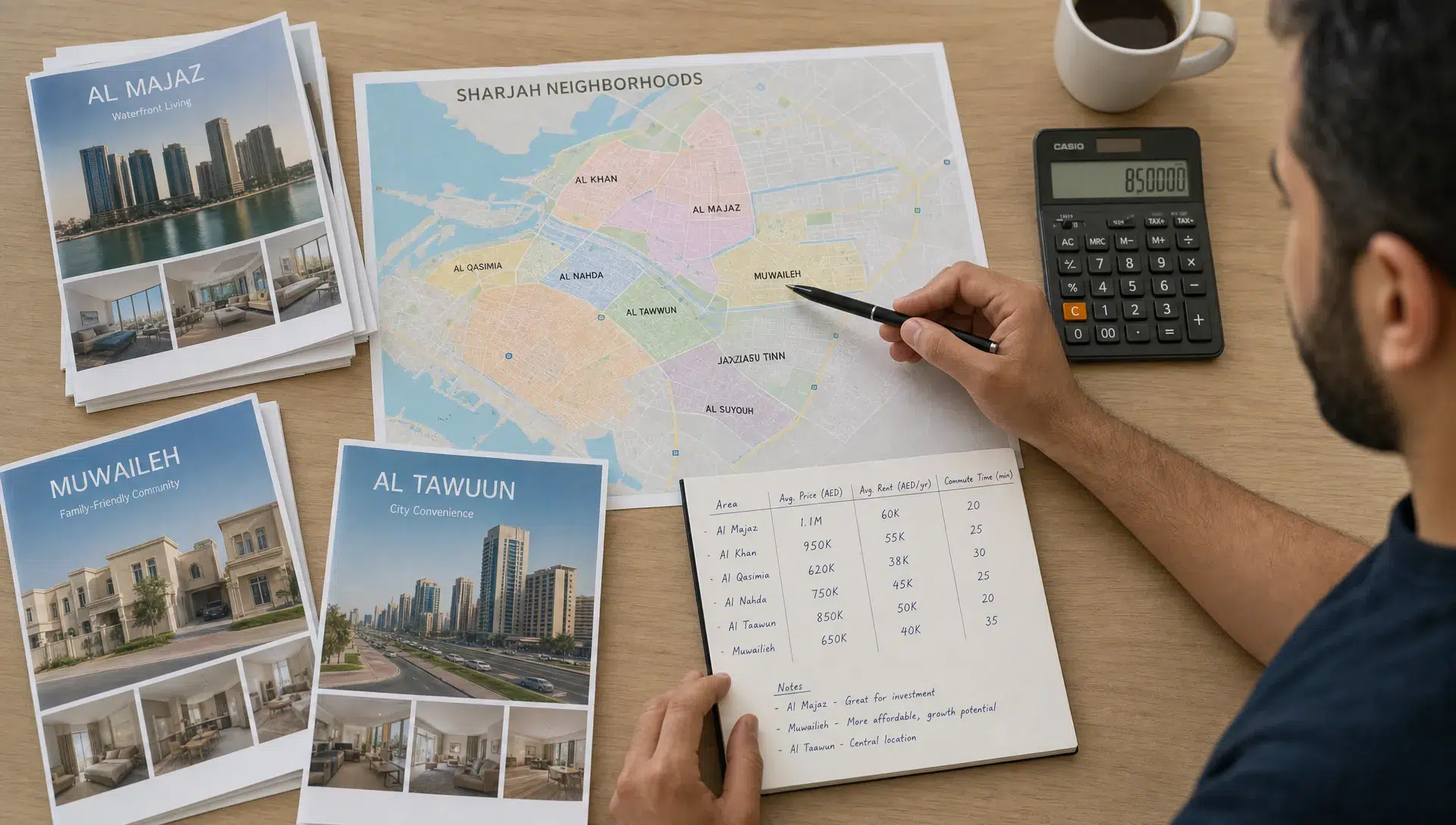
The Sharjah real estate market includes several area types that serve different buyer goals. The table below is a practical way to frame your search before shortlisting units.
| Area type | Typical buyer appeal | What to watch before buying |
|---|---|---|
| Master-planned communities such as Aljada | Newer homes, lifestyle amenities, family appeal | Handover timelines, service charges, future construction nearby |
| Established apartment districts such as Al Majaz and Al Khan | Central living, waterfront access in some locations, mature services | Building condition, parking, maintenance quality |
| University and family-focused areas such as Muwaileh | Tenant demand from families and education-linked residents | Traffic flow, building quality, exact distance to schools |
| Villa and townhouse zones | More space, privacy, longer-term family use | Plot position, maintenance cost, road access |
| Waterfront and lifestyle projects | Views, leisure appeal, possible premium rents | Premium pricing, supply pipeline, resale depth |
A buyer focused on rental yield may prefer a different location from a family buyer seeking a ten-year home. The strongest choice is the one that fits the intended use, not the one with the most impressive marketing materials.
Off-plan supply is widening the choice set
Off-plan projects have become an important part of the UAE property conversation, and Sharjah is no exception. Buyers are attracted by new designs, phased payment plans and the chance to secure a property before completion. This can be useful, especially for buyers who do not need immediate occupancy.
The Sharjah real estate market is seeing more interest in planned communities and branded lifestyle projects, but off-plan buying requires discipline. A payment plan is not the same as affordability. You need to understand the total purchase cost, the post-handover obligations, the expected service charges and whether similar completed units can support the developer’s pricing.
Ask direct questions before signing. What is the handover schedule? What happens if there is a delay? What is included in the finish? Are appliances included? How will the unit be registered? Which entity manages the community after completion? Clear answers reduce the risk of surprises later.
Ownership rules and buyer eligibility need careful checking
Sharjah has become more accessible to a wider range of buyers in designated areas and projects, but ownership eligibility should never be assumed. The rules can vary depending on nationality, project approval, property type and the latest regulatory framework.
For the Sharjah real estate market, this means due diligence begins before negotiation. Confirm whether the property is freehold, leasehold or available under another ownership structure. Ask the agent or developer for written clarification, and verify the registration process with the relevant authority or a qualified professional before transferring funds.
Buyers should also understand transaction costs. Beyond the listed price, a purchase may involve registration fees, agency commission, mortgage-related charges, valuation fees, service charges and moving costs. The exact cost stack depends on the transaction, so build a full budget before deciding whether a listing is truly within reach.
Financing conditions can change buyer behavior
Mortgage affordability remains a key trend across the UAE. Even when prices are stable, monthly repayments can shift buyer decisions because interest rates, down payment requirements and bank eligibility criteria affect purchasing power.
In the Sharjah real estate market, financing conditions can influence which units sell fastest. Smaller, mortgage-friendly apartments may attract a wider buyer pool, while larger homes depend more on household income, available cash and long-term confidence. Cash buyers can sometimes negotiate better, but mortgage buyers who obtain pre-approval early can move quickly when a suitable property appears.
Do not rely only on the maximum loan amount a bank offers. Stress-test the payment against possible changes in income, service charges and family expenses. A property that is affordable only under perfect conditions can become uncomfortable after handover.
Rental demand should be measured building by building
Investors often enter Sharjah because the entry price may be lower than in nearby Dubai locations. That can support attractive income potential, but rental performance depends on more than the purchase price.
The Sharjah real estate market requires a local rental check at the building or community level. Look at comparable asking rents, vacancy signs, tenant profiles, parking availability, maintenance responsiveness and how quickly similar units appear to lease. A large apartment with a weak layout may underperform a smaller unit in a better-managed building.
Property management also matters, especially for investors who live outside Sharjah or own more than one unit. The same principles apply in mature rental markets elsewhere: tenant screening, maintenance coordination, rent collection and vacancy control can protect returns. For example, a firm focused on full-service rental management shows how professional oversight can turn a property from a passive asset into a better-managed investment, even though local laws and practices differ by market.
Infrastructure and commute patterns shape long-term demand
Sharjah’s connection to Dubai is one of its biggest advantages and one of its biggest practical challenges. Many residents live in Sharjah and work in Dubai, so road access, peak-hour congestion and proximity to key routes can affect both quality of life and tenant demand.
The Sharjah real estate market should be evaluated through actual commute behavior, not just map distance. A property that appears close to Dubai may still involve a difficult daily drive depending on the exit route and timing. Buyers should test the commute during realistic hours, especially if school runs and office schedules are part of the household routine.
Infrastructure upgrades, new retail centers, community facilities and improved public services can strengthen an area’s appeal over time. Still, buyers should separate confirmed improvements from speculation. Marketing claims about future growth are useful only when they are backed by visible progress, official announcements or credible developer delivery.
Resale liquidity is becoming a bigger differentiator
A good purchase is easier to exit. This matters even if you plan to hold the property for years. Life changes, financing needs and better opportunities can all make resale important.
In the Sharjah real estate market, liquidity tends to be stronger where buyer demand is broad. Units with practical layouts, fair service charges, clean title, easy access and credible management usually attract more attention than highly specialized properties. The most liquid unit is not always the cheapest or most luxurious. It is often the one that fits the largest number of future buyers.
Pay attention to supply around your chosen area. If many similar units are due for handover at the same time, resale competition may increase. On the other hand, a well-located completed unit in a managed building can stand out if buyers want certainty over construction risk.
How buyers should track the market without getting overwhelmed
The easiest way to follow the market is to turn your search into a system. Start with a budget, preferred areas, property type, required size and intended use. Then monitor a short list of buildings or communities instead of browsing every new listing.
For the Sharjah real estate market, useful tracking signals include new asking prices, price reductions, days on market, repeated listings, rental comparisons, developer launches and changes in mortgage offers. If you are actively searching, saved filters and alerts can help you notice fresh opportunities before they are widely circulated. This guide on tracking new property listings before others explains how to build that routine.
It can also help to compare Sharjah with Dubai, but only as a benchmark. Dubai trends influence buyer expectations across the UAE, especially in financing, off-plan launches and investor sentiment. For context, you can review the main Dubai real estate market trends buyers should know and then adjust your assumptions for Sharjah’s lower entry prices, different tenant base and community profile.
Practical buyer checklist for 2026
Before making an offer, slow down and test the property from several angles. A polished listing can be a good starting point, but it should not replace verification.
Use this checklist to keep the process focused:
- Confirm the ownership structure and buyer eligibility for the exact project or unit.
- Compare the asking price with similar active and recent listings in the same building or community.
- Review service charges, maintenance history, parking allocation and common-area condition.
- Test commute times during realistic peak hours, not just on a quiet weekend.
- Ask for expected rental evidence if the purchase is investment-led.
- Check developer reputation, handover timeline and contract terms for off-plan purchases.
- Speak with multiple agents if the listing information feels incomplete or inconsistent.
On Best Property, buyers can use search filters, detailed listings, photos, virtual tours, favorites and comparison tools to narrow the field before contacting agents or owners. That makes the offline work more efficient because you arrive at viewings with clearer questions and fewer unsuitable options.
Frequently Asked Questions
Is Sharjah a good place to buy property in 2026? Sharjah can be a strong choice for buyers who want more space, family-friendly communities and lower entry prices than many Dubai areas. The best opportunities depend on exact location, building quality, ownership structure and long-term demand.
What areas should buyers watch in Sharjah? Buyers often monitor master-planned communities, established districts such as Al Majaz and Al Khan, family-focused areas such as Muwaileh, villa zones and selected waterfront projects. The right area depends on whether the goal is living, renting or resale.
Can foreign buyers purchase property in Sharjah? Foreign ownership is possible in certain designated projects and under specific rules, but eligibility should be verified for the exact property before paying a deposit. Always request written confirmation and check the registration process.
Is off-plan property in Sharjah risky? Off-plan buying can be useful when the developer is credible, pricing is realistic and the payment plan fits your cash flow. The main risks are delays, unclear specifications, future supply competition and service charge uncertainty.
How can investors estimate rental return in Sharjah? Start with comparable rents in the same building or community, then subtract service charges, vacancy allowance, maintenance, management costs and transaction expenses. Net return is more useful than a headline gross yield.
Make a sharper Sharjah property decision
The Sharjah real estate market offers real opportunities for buyers who do the local homework. Affordability, space and community living remain powerful advantages, but the best results come from comparing buildings carefully, verifying ownership rules and thinking about future tenant or resale demand before committing.
Use Best Property to explore current Sharjah listings, compare options and connect directly with agents or owners. A structured search will help you move faster when the right property appears and avoid listings that only look good at first glance.


Join The Discussion