

Emaar South Dubai attracts a specific type of buyer: someone who is not only looking at today’s rental yield or handover date, but also asking what the southern corridor of Dubai could become over the next decade.
That makes the community different from established districts such as Downtown Dubai, Dubai Marina or Dubai Hills Estate. Emaar South is not a fully matured prime address where most of the growth has already been priced in. It is a master-planned community inside Dubai South, close to major infrastructure, employment zones and long-term airport expansion. For buyers seeking future growth, that mix deserves attention.
The opportunity, however, is not automatic. In emerging communities, returns depend heavily on project selection, timing, layout, quality, payment structure and how quickly the wider area matures. This guide breaks down what buyers should know before choosing a property in Emaar South Dubai in 2026.
What makes Emaar South Dubai different?
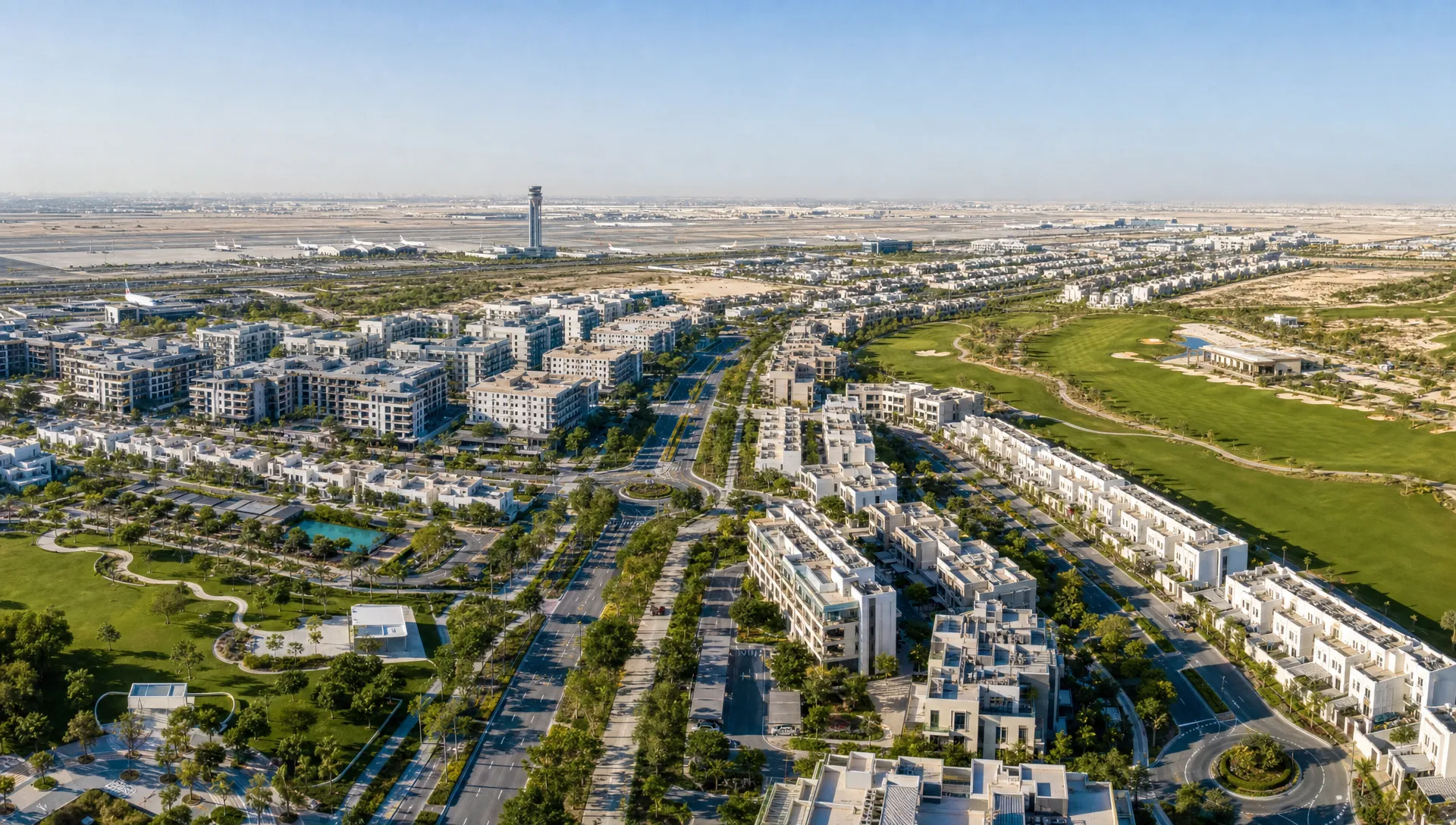
Emaar South is a residential master community by Emaar within Dubai South, one of Dubai’s largest planned urban districts. The area is associated with Al Maktoum International Airport, Expo City Dubai, logistics activity, aviation-linked business and the broader growth of the emirate’s southern corridor.
The community offers a more suburban profile than inner-city Dubai. Buyers typically look at apartments, townhouses and villas, with the appeal coming from open layouts, community planning, family-friendly surroundings and the Emaar brand. The setting is also closely linked to golf course living, low to mid-rise residential clusters and future neighborhood amenities.
That positioning matters. A buyer choosing Emaar South is usually not paying for a finished central lifestyle in the way they would in Dubai Marina or Downtown. They are buying into a growth corridor where infrastructure, population movement and community maturity are expected to play a large role over time.
If you are comparing it with other Emaar master communities, it helps to benchmark the trade-offs against more established options covered in our guide to top Emaar Dubai communities for buyers and investors.
Why buyers are watching Emaar South in 2026
The main reason Emaar South Dubai is on more buyer shortlists is the long-term infrastructure story around Dubai South.
In April 2024, Dubai Media Office announced approval for a new passenger terminal at Al Maktoum International Airport, with an AED 128 billion investment and planned capacity of 260 million passengers a year once fully developed. That does not mean every nearby property will rise in value at the same pace, but it gives the southern corridor a powerful long-term demand driver.
Airport expansion can influence property demand in several ways. It can support job creation, improve the case for surrounding commercial activity and increase the need for housing near the work base. In Dubai, where travel time and road access strongly affect residential choices, proximity to future employment clusters can become a meaningful advantage.
Emaar South also benefits from relative affordability compared with mature Emaar communities. Buyers who want an Emaar-developed environment but cannot justify central Dubai prices may see the area as a more accessible entry point. For investors, that lower base can make future appreciation more attractive if the community matures as expected.
Still, this is a long-term thesis. Buyers should avoid treating the airport announcement as a guarantee of short-term capital gains. Large infrastructure projects reshape districts over years, not weeks.
Who is Emaar South Dubai best suited for?
Emaar South is not a universal fit. Its strengths depend on the buyer’s lifestyle, time horizon and tolerance for an emerging location.
| Buyer profile | Why Emaar South may fit | What to check before buying |
|---|---|---|
| Long-term investor | Exposure to Dubai South growth and infrastructure-led demand | Exit liquidity, competing supply and realistic rental assumptions |
| End-user family | Larger homes and a quieter suburban setting than central Dubai | School access, commute time and community amenities already operating |
| First-time Dubai buyer | Possible entry into an Emaar community at a lower price point than mature areas | Total buying costs, service charges and mortgage affordability |
| Off-plan buyer | Payment plans and potential price uplift before or after handover | Construction timeline, contract terms, escrow details and handover risk |
| Yield-focused landlord | Tenant demand from nearby employment zones may deepen over time | Current rents, vacancy periods and net yield after costs |
For end-users, the key question is daily life. If your work, school runs and social routine are tied to central Dubai, Emaar South may feel remote. If your life is connected to Dubai South, Expo City, Jebel Ali, Abu Dhabi routes or flexible work, the location can make more sense.
For investors, the key question is holding power. Emaar South is more compelling for buyers who can wait for the wider district to mature, rather than those who need immediate resale momentum.
Property types buyers should compare
The community includes different property types, and each one behaves differently from an investment perspective.
Apartments usually offer a lower entry point and may appeal to single professionals, couples and tenants working in surrounding business zones. They can be easier to rent when priced correctly, but investors should watch service charges and competition from new apartment supply.
Townhouses and villas appeal more to families and long-term residents. They may benefit from demand for larger homes, especially as Dubai continues to attract residents looking for space, privacy and community living. The trade-off is a higher purchase price and potentially a smaller tenant pool compared with apartments.
Off-plan properties can provide structured payment plans and possible appreciation before completion. Ready or near-ready homes provide more visibility on quality, rent and actual community conditions. Neither is automatically better. The right choice depends on the buyer’s cash flow, financing ability and risk tolerance.
| Property type | Main advantage | Main caution |
|---|---|---|
| Apartments | Lower entry point and broader rental audience | More direct competition from future supply |
| Townhouses | Strong family appeal and more livable space | Higher ticket size and fewer comparable rentals in early phases |
| Villas | Better suited to end-users seeking privacy and long-term use | Liquidity can depend heavily on layout, plot and price band |
| Off-plan units | Payment flexibility and exposure to future appreciation | Handover timing, construction progress and resale rules matter |
| Ready units | Easier to inspect, rent and finance with confidence | Upside may be partly reflected in the asking price |
How to judge whether a listing has real growth potential
In a future-growth market, buyers need to look beyond the headline price. Two properties in the same community can perform very differently if one has a stronger layout, better orientation, cleaner payment structure or closer access to amenities.
Start by checking the basics: built-up area, plot size for villas and townhouses, view, floor level, handover status, service charges, payment plan and whether the property is vacant, tenanted or off-plan. If an advertised yield looks attractive, calculate it again using realistic rent, vacancy, maintenance, service charges, agency fees and transfer costs.
A smart buyer should also compare asking prices with recent transaction evidence where available. In Dubai, listing prices can show seller expectations, but completed transactions provide a better signal of market acceptance. Ask the agent for comparable sales in the same project, not only in the wider district.
Before shortlisting units, it is worth reviewing our guide on how to read real estate listings like a smart buyer, especially if you are comparing multiple off-plan and ready options.
The main growth drivers and the risks to balance
Emaar South Dubai has a clear long-term story, but buyers should weigh both sides of the equation. Growth potential is strongest when infrastructure, population demand and limited high-quality supply align. Risk rises when buyers overpay for a weak unit simply because the area has a compelling narrative.
| Factor | Growth upside | Buyer risk |
|---|---|---|
| Al Maktoum International Airport expansion | More jobs, business activity and housing demand over time | Timeline is long and benefits may phase in gradually |
| Dubai South development | Wider district maturity can improve lifestyle and rental demand | Some pockets may mature faster than others |
| Emaar brand | Stronger buyer confidence and clearer master community planning | Brand premium can reduce upside if entry price is too high |
| Relative affordability | Lower base than mature Emaar locations can attract buyers | Affordability alone does not guarantee capital growth |
| Family-focused housing | Demand for larger homes remains an important Dubai trend | Tenant demand depends on schools, retail, access and amenities |
| New supply | More projects can make the district more active and livable | Too much similar supply can pressure rents or resale prices |
The most important risk is patience. A buyer expecting Emaar South to behave like a mature prime district may be disappointed. Liquidity in emerging areas can be thinner, especially during softer market periods. The best defense is to buy a unit that makes sense on its own merits, not just because the broader area sounds promising.
Location reality: access matters more than map distance
On a map, Emaar South sits in Dubai’s southern growth corridor. In daily life, the value of that location depends on where you actually need to go.
For residents working near Dubai South, Expo City, Dubai Investments Park, Jebel Ali or Abu Dhabi-facing routes, the location can be practical. For someone commuting daily to DIFC, Downtown Dubai, Business Bay or Dubai Marina, the drive can feel very different depending on traffic, school timings and work hours.
This is why buyers should visit the community at realistic times, not only on a quiet weekend. Drive the route during your expected commute. Check grocery access, nursery and school options, clinics, gyms, parks and the level of retail already operating. Future amenities are valuable, but current livability affects both rentability and end-user satisfaction.
Public transport assumptions also need caution. Buyers should not purchase based only on hoped-for transport links unless those links are officially confirmed and relevant to the exact location.
How Emaar South compares with other growth areas
Dubai has several communities competing for growth-focused buyers in 2026, including Dubai South, Jumeirah Village Circle, Arjan, Al Furjan, Meydan and Dubai Creek Harbour. Each area has a different demand base.
Emaar South stands out because it combines a master developer brand with a major infrastructure corridor. JVC and Arjan, for example, may offer stronger current rental depth in some segments because they are more central and already densely occupied. Al Furjan has established connectivity and proximity to Jebel Ali and Ibn Battuta. Dubai Creek Harbour offers a premium waterfront and skyline-led proposition.
The question is not which area is universally best. The better question is which area matches your budget, holding period and preferred risk profile. For a broader comparison of emerging districts, see our analysis of Dubai real estate for sale in areas with growth potential.
Practical buying checklist for Emaar South Dubai
A disciplined checklist can protect buyers from overpaying or choosing the wrong unit type. Before making an offer, work through the following steps.
- Define your purpose clearly: Decide whether the purchase is for end-use, rental income, capital appreciation or a mix of these goals.
- Compare similar units only: Benchmark apartments against the same building or phase where possible, and compare townhouses by layout, plot, location and handover status.
- Verify the payment structure: For off-plan purchases, review the payment plan, handover schedule, resale restrictions and any post-handover obligations.
- Calculate net yield: Include service charges, maintenance, vacancy, management fees and transaction costs instead of relying on gross yield.
- Check commute and amenities in person: Visit during real usage times and test the routes that matter to your household or target tenant.
- Plan your exit: Ask who the future buyer is likely to be, such as a family, airport-linked professional, investor or first-time homeowner.
The strongest purchase is usually not the cheapest unit. It is the one with the clearest tenant or end-user appeal, the most defensible price and the fewest surprises.
Is Emaar South Dubai a good future-growth buy?
Emaar South Dubai can be a strong candidate for buyers who believe in the long-term development of Dubai South and want exposure to an Emaar master community at a more accessible entry point than mature central districts.
Its growth case is supported by major infrastructure, future employment potential and Dubai’s ongoing population expansion. Its risks are also clear: distance from central Dubai, phased community maturity, future supply and the need for a longer holding period.
For many buyers, the right approach is selective optimism. Emaar South deserves attention, but not every listing deserves your money. Focus on quality, location within the community, realistic pricing and whether the property can appeal to real tenants or end-users even before the full long-term vision is complete.
Frequently Asked Questions
Is Emaar South Dubai good for investment in 2026? It can be a good investment for buyers with a medium to long-term horizon, especially those seeking exposure to Dubai South growth. The best results are likely to come from well-priced units with strong layouts, clear rental demand and manageable holding costs.
Is Emaar South better for end-users or investors? It can suit both, but the buyer profile is different. End-users may value the quieter suburban environment, while investors are typically looking at future infrastructure-led growth and tenant demand from the wider Dubai South area.
What is the biggest risk when buying in Emaar South? The biggest risk is overpaying based on future expectations rather than current fundamentals. Buyers should test today’s rent, commute, amenities, service charges and resale comparables before relying on long-term growth assumptions.
Should I buy ready or off-plan in Emaar South Dubai? Ready units offer more certainty because you can inspect the property, assess the community and estimate rent more accurately. Off-plan units may offer payment flexibility and future upside, but they require careful review of the contract, timeline and developer obligations.
How does Al Maktoum International Airport affect Emaar South? Airport expansion supports the long-term case for Dubai South by strengthening the area’s employment and infrastructure base. The impact is likely to be gradual, so buyers should treat it as a long-term demand driver rather than an instant price catalyst.
Find the right Emaar South property with confidence
Choosing in a growth area requires clear comparisons, current listings and careful due diligence. On Best Property, buyers can search UAE properties with advanced filters, review detailed listings with photos and virtual tours, compare favorites and contact agents or owners directly.
Use the platform to compare Emaar South Dubai options against other communities, shortlist properties that match your budget and make a decision based on facts rather than hype.


Join The Discussion