
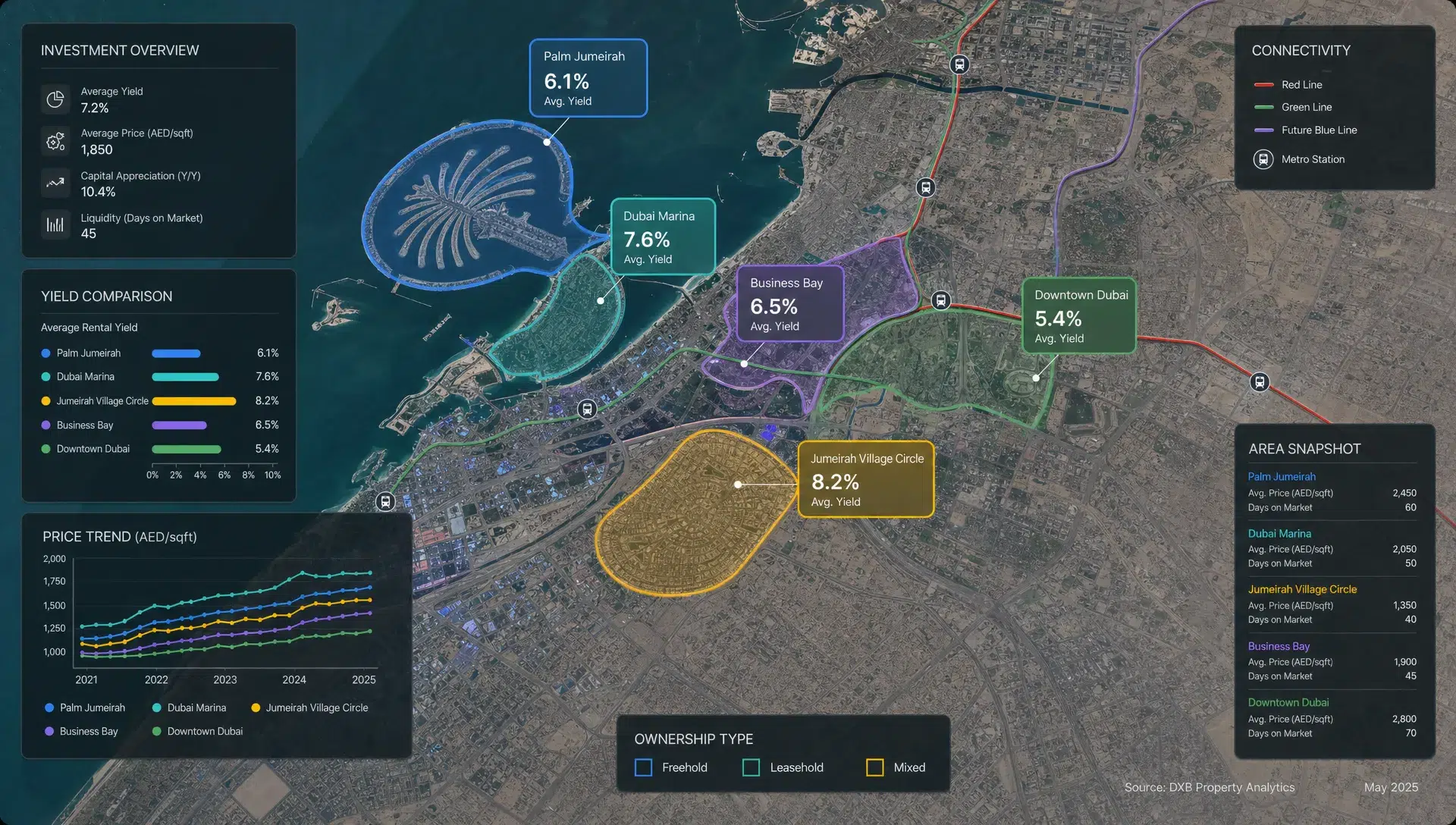
Buying an investment property for sale in the UAE is not just about finding a unit with an attractive asking price. The better question is whether the property can produce the return you expect, at the risk level you are willing to accept, in a market where location, ownership rules, tenant demand, service charges and exit liquidity can vary sharply from one building or community to the next.
For most investors, the strongest purchases come from disciplined evaluation. You need to look beyond headline ROI claims and test the numbers yourself. A waterfront studio, a suburban townhouse, a tenanted office and an off-plan apartment can all be valid investments, but they should not be judged with the same checklist.
This guide walks through a practical framework for evaluating investment property in Dubai and the wider UAE before you commit.
Define the investment goal before you compare listings
Start by deciding what the property needs to do for you. A unit bought for stable rental income should be evaluated differently from a unit bought for capital appreciation, short-term rental income or future personal use.
A rental-income investor usually prioritizes occupancy, tenant demand, net yield, building quality and predictable maintenance costs. A capital-growth investor may accept a lower initial yield if the area has major infrastructure upgrades, limited supply or strong end-user demand. A buyer planning to use the property later needs to weigh lifestyle value alongside financial return.
This first decision saves time because it narrows your search. It also prevents a common mistake: comparing unlike assets. A high-yield apartment in an older building may not be better than a lower-yield property in a prime community if the first has higher maintenance risk, weak resale demand or poor building management.
If you are still refining your wider buying criteria, Best Property's guide on how to choose the right property to buy is a useful starting point before you move into investment-specific analysis.
Check whether you can legally buy and own the property
Before assessing returns, confirm that the property is legally available to you as a buyer. Ownership rules in the UAE depend on the emirate, the location and the property type. In Dubai, foreign buyers can own freehold property in designated areas. Other emirates also have specific rules and ownership zones.
The UAE Government portal provides a useful overview of property ownership rules in the UAE, but you should still confirm the position for the exact project or plot with the relevant land department, developer or legal adviser.
Key checks include:
- Whether the property is freehold, leasehold or another ownership structure
- Whether non-UAE or non-GCC buyers are eligible to purchase in that location
- Whether the title deed, sale agreement or developer documents match the seller's details
- Whether there are mortgages, disputes, unpaid service charges or restrictions attached to the property
- Whether the property is ready, under construction or subject to a payment plan
Legal eligibility is not a box to tick at the end. It affects financing, resale, rental strategy and how easily you can exit the investment later.
Analyze the location through tenant demand
Location matters, but investors should judge it from the tenant's point of view. A beautiful community with weak rental demand can underperform, while a less glamorous area near strong employment hubs, schools, metro access or major roads may produce steadier occupancy.
In the UAE, demand drivers differ by segment. Dubai Marina, Downtown Dubai, Business Bay and Jumeirah Village Circle can attract very different tenant profiles. Abu Dhabi, Sharjah, Ras Al Khaimah and other emirates have their own patterns linked to employment, commuting, tourism, family living and affordability.
When you evaluate a location, ask who will realistically rent the property and why. A studio may appeal to a single professional who values metro access and building amenities. A townhouse may depend on family demand, school proximity, parking, community facilities and maintenance quality. A commercial unit needs footfall, licensing suitability, parking and business visibility.
Look for evidence, not assumptions. Review active rental listings, recent rental ranges where available, time-on-market signals and the volume of similar units in the same building or community. Dubai investors can also consult the Dubai Land Department rental index to sense-check rental expectations for many areas, although actual rents still depend on the exact building, condition, view, floor and lease terms.
Compare the asking price with true comparables
The asking price is only useful when compared with similar properties. Price per square foot helps, but it is not enough on its own. A lower price per square foot may reflect an awkward layout, poor view, high service charges, weak finishing, short leasehold term or an oversupplied building.
Build a small comparison set using properties that match as closely as possible:
- Same emirate and community
- Same building or nearby competing buildings
- Similar unit type, size, floor level, view and condition
- Similar occupancy status, vacant, owner-occupied or tenanted
- Similar handover status, ready or off-plan
When comparing listings, separate price from value. A unit priced below the market may be an opportunity, but it may also have a reason behind the discount. Best Property's guide on how to compare property on sale listings like a pro covers this comparison process in more detail, including how to avoid judging listings by headline price alone.
A good investment property should make sense against both current comparables and future resale demand. If a property is hard to explain to a future buyer, it may also be hard to sell.
Calculate gross yield, then net yield
Many listings promote gross yield, but serious investors focus on net yield. Gross yield is a quick first screen. Net yield shows whether the property still performs after costs.
The basic formulas are simple:
| Metric | Formula | What it tells you |
|---|---|---|
| Gross rental yield | Annual rent divided by purchase price, multiplied by 100 | A fast estimate before costs |
| Net rental yield | Annual rent minus annual costs, divided by total investment cost, multiplied by 100 | A more realistic income return |
| Cash-on-cash return | Annual pre-tax cash flow divided by cash invested, multiplied by 100 | Return on your actual cash if using finance |
| Capital growth | Future sale price minus purchase price, after sale costs | Potential appreciation, not guaranteed income |
For example, if a property is marketed with an attractive gross yield, test what happens after service charges, maintenance, vacancy, insurance, management fees and financing costs. A high gross yield can become average once all costs are included.
Do not rely only on the seller's rent estimate. Check live rental listings, recent rental evidence where available and the rent for similar units in the same building. If the property is already rented, review the lease terms, renewal date, payment structure and whether the rent is above or below current market levels.
For tenanted assets, the rent may look stable, but the contract can limit your ability to adjust income in the short term. If that is your focus, the guide on rental properties for sale as investments explains the extra checks that matter when buying with an existing tenant.
Model all purchase, holding and exit costs
A common investor error is calculating return from purchase price alone. In the UAE, the total investment cost includes transaction fees, broker fees, registration fees, mortgage-related costs if financed and future ownership expenses.
Costs vary by emirate and transaction type. In Dubai, the Dubai Land Department transfer fee is commonly 4 percent of the property value, in addition to other possible administrative, trustee, agency and mortgage registration costs. Other emirates have different structures, so confirm the exact charges before making an offer.
| Cost category | Examples to check | Why it matters |
|---|---|---|
| Acquisition costs | Transfer fee, registration, trustee fee, agency commission, legal review | Raises your true entry price |
| Financing costs | Valuation, arrangement fees, mortgage registration, interest payments | Affects cash flow and cash-on-cash return |
| Annual holding costs | Service charges, maintenance, insurance, property management | Reduces net rental yield |
| Rental friction | Vacancy, rent-free periods, marketing, tenant turnover | Lowers effective income |
| Exit costs | Agency fee, settlement charges, possible repair or staging costs | Affects final profit on resale |
Build a conservative model. Add a vacancy assumption even in strong rental areas. Include an annual maintenance reserve, especially for villas, townhouses and older buildings. For apartments, study the service charge history and whether charges are likely to rise.
If an investment only works with perfect occupancy, no repairs and rapid capital growth, the margin of safety may be too thin.
Evaluate building quality, not just the unit
The unit may photograph well, but the building or community can determine long-term performance. Tenants and future buyers notice lift wait times, parking access, security, maintenance response, cleanliness, amenities, water pressure, noise and common-area condition.
For apartments, look at the condition of corridors, elevators, lobby, gym, pool, parking and waste areas. Ask about service charges and whether any major repairs are expected. In older buildings, look for signs of water damage, poor air conditioning performance or recurring maintenance complaints.
For villas and townhouses, inspect the roof, waterproofing, air conditioning units, plumbing, exterior condition, garden irrigation, boundary walls and parking. A professional inspection or snagging report can be worthwhile, especially if you are buying a ready property or a newly handed-over unit.
Quality also affects resale liquidity. A well-managed building in a popular community may keep attracting tenants even when new supply enters the market. A poorly managed building may need to offer discounts to compete.

Decide whether ready or off-plan fits your risk profile
Ready and off-plan properties can both work as investments, but they carry different risks.
Ready properties provide more evidence. You can inspect the unit, review actual rent levels, check building occupancy and estimate service charges with more confidence. If the unit is vacant, you may be able to rent it soon after transfer. If it is tenanted, you can evaluate existing income.
Off-plan properties may offer staged payments and potential price appreciation before completion, but they depend heavily on developer delivery, project quality, handover timing and future market conditions. Delays can affect your cash flow plan, and the final product may differ from your expectations if you do not review specifications carefully.
When evaluating off-plan investment property, check the developer's track record, escrow arrangements, payment plan, handover schedule, cancellation terms, expected service charges and realistic rental demand at completion. Also consider future supply. If many similar units are due to complete in the same area, rents and resale prices may face pressure.
A ready property is not automatically safer, and an off-plan property is not automatically speculative. The right choice depends on your timeline, liquidity needs and tolerance for uncertainty.
Stress test the rental income
A rental projection should not be a single optimistic number. Build three scenarios: conservative, expected and upside. This helps you see whether the investment remains viable if rents soften, the property stays vacant longer than expected or costs rise.
Your conservative case should include a lower annual rent, a vacancy period and realistic maintenance. Your expected case can use current market evidence. Your upside case can include stronger rent or modest appreciation, but should not be the only scenario that justifies the purchase.
Pay attention to lease structure. Long-term residential rentals can provide stability, but income may adjust slowly. Short-term rentals can earn more in some areas, especially tourism-heavy locations, but they require licensing, furnishing, management, cleaning, utilities and more active operations. Rules and profitability vary, so confirm requirements before assuming holiday-home income.
For commercial properties, tenant covenant, lease length, fit-out responsibility, licensing suitability and vacancy risk are critical. A commercial unit can look attractive on paper, but income may be less predictable if the tenant pool is narrow.
Review financing and interest-rate sensitivity
If you use a mortgage, the investment must work after debt service. A leveraged purchase can improve returns when rents and prices rise, but it can also reduce cash flow and increase risk if interest costs climb or the property remains vacant.
Before making an offer, get a realistic view of your borrowing capacity, down payment, interest rate structure and monthly payments. Then test the numbers at higher rates and lower rent. Also include mortgage-related transaction costs and any early settlement or refinancing terms that could affect your exit.
Cash buyers should still model opportunity cost. Capital tied up in property cannot be used elsewhere, so the investment should compensate you for liquidity risk, ownership effort and market exposure.
The key question is not simply whether the bank will finance the property. The question is whether the property remains financially comfortable if the market does not perform exactly as planned.
Check exit liquidity before you buy
Every investment has an exit. Even if you plan to hold for many years, you should know who the future buyer might be.
A liquid property usually has a broad buyer pool. It appeals to both investors and end users, has a practical layout, sits in a recognizable location and is priced within a common budget range for that area. Unique properties can perform well, but they may take longer to sell if the buyer pool is smaller.
Ask these questions before committing:
- Are similar properties selling regularly in this building or community?
- Is the unit type popular with both tenants and buyers?
- Is the layout efficient or does it waste space?
- Does the property have any feature that could hurt resale, such as poor view, noise, limited parking or high service charges?
- Would the property still be attractive if market conditions became more competitive?
Do not treat resale value as a vague future bonus. It is part of your investment return.
Use a simple scoring framework
Once you have shortlisted properties, score them consistently. This helps remove emotion from the decision and makes trade-offs clearer.
| Evaluation factor | Suggested weight | What to assess |
|---|---|---|
| Location and tenant demand | 25% | Access, employment hubs, schools, transport, rental depth |
| Net yield and cash flow | 25% | Rent evidence, costs, vacancy, financing impact |
| Asset and building quality | 20% | Layout, condition, management, amenities, service charges |
| Legal and transaction clarity | 15% | Ownership eligibility, title, seller status, fees, lease terms |
| Exit potential | 15% | Resale demand, buyer pool, future supply, liquidity |
A property does not need a perfect score in every category. It does need a clear reason to buy. If the yield is average, the growth story should be strong. If the location is emerging, the entry price should reflect that risk. If the building is older, the income should justify the likely maintenance and resale considerations.
This framework is especially useful when comparing properties across different emirates or property types. It keeps the analysis focused on return, risk and liquidity rather than presentation.
Red flags that should slow down your decision
Some issues do not automatically mean you should walk away, but they do mean you need more investigation. Investors should be cautious when a listing has limited documentation, unclear ownership details, unusually high promised returns, pressure to pay quickly or rental projections that are far above comparable evidence.
Other warning signs include persistent vacancies in the same building, very high service charges relative to competing properties, visible maintenance problems, unresolved title or payment issues, poor communication from the seller or agent and a price that only looks attractive because key costs are missing.
If you are evaluating a residential unit, it is also worth reviewing broader due diligence steps such as ownership checks, total budgeting and inspection priorities. Best Property's guide to key checks before buying residential property for sale complements the investment lens covered here.
Frequently Asked Questions
What is a good rental yield for an investment property in the UAE? A good yield depends on the emirate, area, property type, age, service charges and risk profile. Compare net yield, not only gross yield, against similar properties in the same location. A lower-yield property in a liquid prime area may be stronger than a higher-yield property with weak resale demand.
Is Dubai better than other UAE emirates for property investment? Dubai has deep liquidity, strong international demand and a large rental market, but other emirates can offer different entry prices and tenant profiles. The better choice depends on your budget, target tenant, preferred risk level and exit strategy.
Should I buy a vacant or tenanted property? A vacant property gives you flexibility to set a new rent or occupy the unit, but it may produce no income until leased. A tenanted property can generate income from day one, but you must review the lease, rent level, renewal date and tenant terms carefully.
How do I know if an asking price is fair? Compare the property with similar units in the same building or community, then adjust for view, floor, layout, condition, occupancy and service charges. Price per square foot is useful, but it should not be your only metric.
Are off-plan properties good investments in the UAE? They can be, especially when the developer is reputable, the payment plan is suitable and future demand is strong. However, investors should account for delivery risk, future supply, handover timing and the lack of current rental income.
Find investment property for sale with better evidence
The best investment decisions in UAE real estate come from comparing the right data, asking disciplined questions and checking the full cost picture before you make an offer.
On Best Property, you can search investment property for sale across the UAE, filter by your preferred criteria, review detailed listings and connect directly with agents or owners. Use the numbers in this guide as your evaluation framework, then shortlist properties that fit your return target, risk profile and long-term plan.


Join The Discussion