
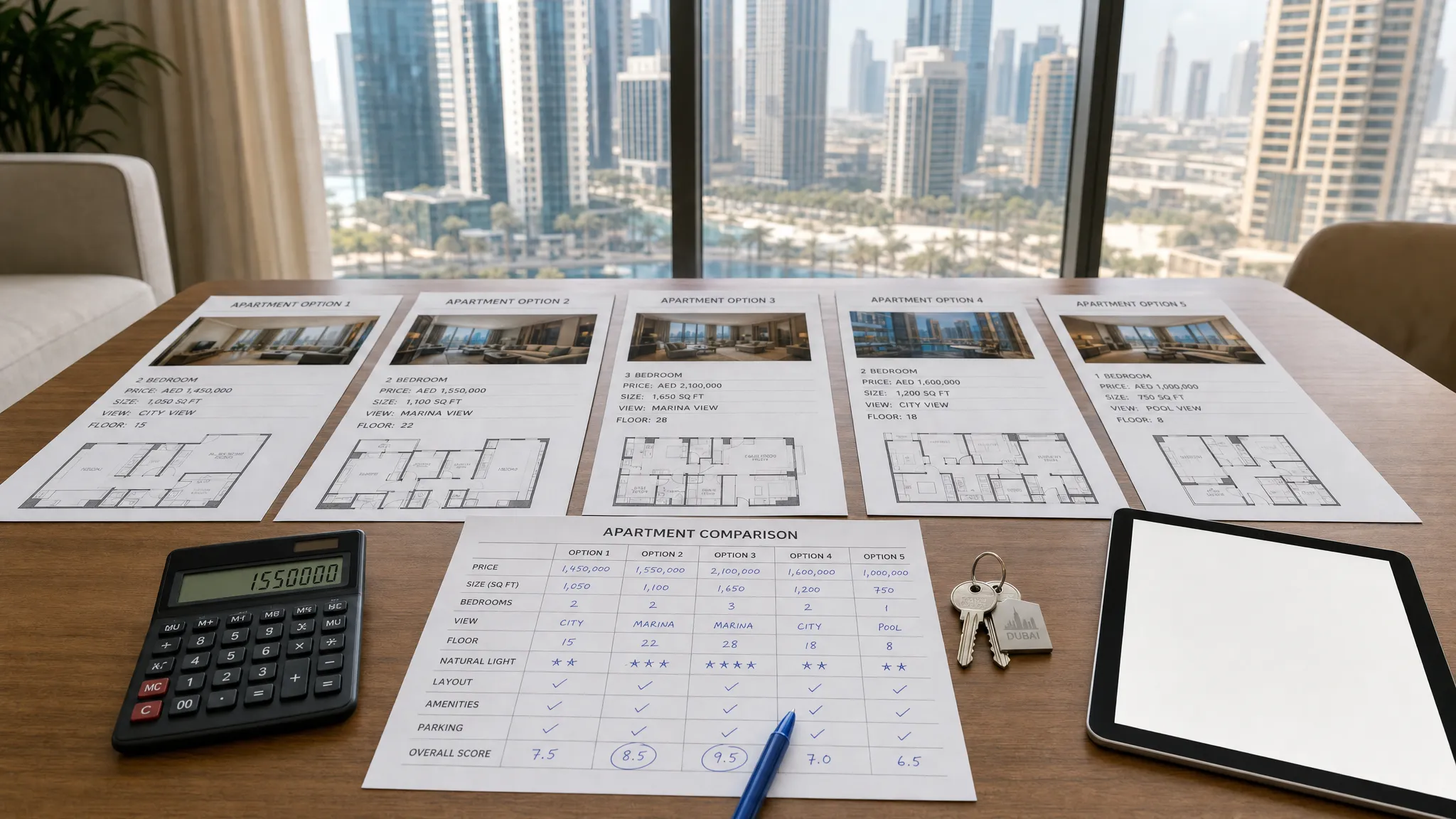
The UAE apartment market gives buyers a wide choice, from compact city studios and serviced residences to waterfront penthouses and family-sized units near schools, business districts, and transport links. That variety is a strength, but it can also make comparison difficult. Two listings may look similar on price and photos, yet differ sharply in ownership rights, ongoing costs, rental demand, building quality, and resale potential.
When comparing for sale apartments in the UAE, the smartest approach is not to start with the most attractive image or the lowest asking price. Start with the factors that determine whether the apartment fits your purpose, protects your capital, and remains easy to rent, live in, or resell later.
Below is a practical comparison framework to use before shortlisting, booking viewings, or making an offer.
First, define why you are buying
A good apartment for an end user is not always the best apartment for an investor. Before comparing listings, decide your primary goal.
If you are buying to live in the property, daily convenience matters most. Commute time, building amenities, noise levels, parking, layout, community feel, and access to schools or healthcare can be more important than headline rental yield.
If you are buying for rental income, you should compare tenant demand, net yield, occupancy risk, service charges, and how easily the unit can be maintained between tenants.
If you are buying for capital growth, focus on future infrastructure, supply pipeline, developer reputation, scarcity, and resale liquidity. An apartment in a popular building with steady buyer demand may outperform a larger but less liquid unit in a weaker location.
For international investors, business owners, or professionals relocating to the UAE, property decisions may also connect with residency, banking, company setup, and long-term structuring. In that case, it can be useful to get advice from specialists in UAE company setup and corporate structuring alongside your property search, especially if the purchase supports a broader move to the Emirates.
Compare location before comparing size
Location is usually the first serious filter because it affects lifestyle, rentability, appreciation, and exit value. In the UAE, “good location” does not mean the same thing for every buyer.
In Dubai, buyers may compare areas such as Downtown Dubai, Dubai Marina, Business Bay, Jumeirah Village Circle, Dubai Hills Estate, Palm Jumeirah, and Dubai Creek Harbour depending on budget and purpose. In Abu Dhabi, popular apartment markets include Al Reem Island, Saadiyat Island, Yas Island, Al Raha Beach, and the Corniche area. Sharjah, Ajman, Ras Al Khaimah, and other emirates can offer different affordability, yield, and lifestyle profiles.
When comparing locations, look beyond the name of the community. Compare the exact building position, road access, future construction nearby, walking distance to amenities, traffic at peak hours, and how the area performs for your target tenant or lifestyle.
A cheaper apartment can become expensive if it is hard to rent, far from demand drivers, or surrounded by future construction noise. A smaller apartment in a better-connected area may be easier to lease and resell than a larger apartment in a less active market.
Check ownership rules and eligibility early
Before you fall in love with a unit, confirm whether you are eligible to buy it and what ownership structure applies. Property ownership rules vary by emirate, nationality, project, and designated area.
In many parts of Dubai, foreign buyers can purchase freehold property in approved freehold areas. Abu Dhabi allows foreign ownership in designated investment zones. Other emirates also have their own rules, structures, and permitted areas. Always confirm the latest requirements through the relevant land department, developer, or licensed professional before paying a deposit.
The key comparison points are simple:
- Whether the apartment is freehold, leasehold, usufruct, or another permitted structure
- Whether non-UAE or non-GCC buyers can purchase in that specific project
- Whether the unit is registered, under construction, mortgaged, rented, or vacant
- Whether any restrictions apply to resale, leasing, or handover
This step is especially important when comparing apartments across different emirates, because legal assumptions from one market may not apply in another.
Compare total cost, not just asking price
The asking price is only one part of the purchase. A lower advertised price can be less attractive once you add transaction costs, service charges, repairs, furnishing, mortgage fees, and vacancy risk.
Common cost categories include government transfer or registration fees, agency commission, trustee or admin charges, mortgage-related costs, valuation fees, developer fees, maintenance expenses, and annual service charges. The exact amounts vary by emirate, property status, and transaction structure.
Use the table below as a simple first-pass comparison tool.
| Cost item | Why it matters | What to compare |
|---|---|---|
| Asking price | Sets the purchase baseline | Price per sq ft or sq m, recent comparable sales, negotiability |
| Transfer and registration fees | Adds to upfront cash needed | Emirate-specific rules and current fee schedule |
| Agency commission | Affects total acquisition cost | Commission rate, VAT, who pays it |
| Mortgage costs | Impacts cash flow and affordability | Interest rate, valuation, bank fees, early settlement terms |
| Service charges | Reduces net yield and affects resale | Annual cost, history of increases, facilities covered |
| Repairs and furnishing | Changes real move-in or rent-ready cost | AC, appliances, flooring, kitchen, bathrooms, furniture |
| Vacancy and leasing costs | Matters for investors | Expected vacancy period, marketing, property management fees |
A disciplined buyer compares the “all-in” cost of ownership, not just the portal price.
Look at price per square foot, but do not rely on it alone
Price per square foot is useful, especially when comparing apartments in the same building or micro-location. It helps you identify whether a listing is priced above or below similar units.
However, price per square foot can mislead if you compare different layouts, views, floors, building ages, or service levels. A high-floor sea-view apartment in a well-managed tower may justify a higher rate than a lower-floor unit facing traffic. A compact one-bedroom with efficient space can be more valuable than a larger apartment with wasted corridors.
When reviewing price per square foot, compare like with like. The best comparisons usually come from recent transactions in the same building, the same line or layout, and similar floor levels. Asking prices are useful, but actual transaction prices are more reliable.
Compare layout efficiency, not only bedroom count
Two apartments with the same bedroom count can feel completely different. In the UAE, apartment sizes and layouts vary widely, especially between older and newer buildings.
A good layout should make the most of the internal space. Look at bedroom proportions, storage, kitchen placement, balcony usability, natural light, bathroom access, laundry space, and whether the living area can be furnished comfortably.
For investors, layout efficiency affects tenant appeal. A well-planned studio near a metro station can lease faster than a poorly designed one-bedroom with awkward wasted space. For families, the difference between an open kitchen, closed kitchen, maid’s room, study, and extra storage can change the property’s practicality.
Do not compare only “studio vs one-bedroom” or “two-bedroom vs three-bedroom.” Compare how the space works in real life.

Review building quality and management
The apartment is only part of the asset. The building can make or break your experience and investment performance.
A strong building usually has consistent maintenance, reliable elevators, clean common areas, responsive security, well-managed parking, efficient cooling systems, and transparent service charge records. A weak building may suffer from frequent repairs, poor cleanliness, slow maintenance, high turnover, or declining tenant demand.
When comparing buildings, ask practical questions. How old is the tower? Who is the developer? Is the owners’ association active where applicable? Are facilities well maintained? Are there known issues with leaks, cladding, elevators, parking, or chiller systems? How many units are owner-occupied versus rented?
Do not rely only on glossy listing photos. Visit the lobby, parking levels, corridors, gym, pool, and surrounding streets if possible. A building’s condition often reveals more than the apartment staging.
Understand service charges and cooling costs
Service charges deserve close attention because they directly affect affordability and investment returns. They can vary significantly between buildings, even within the same area.
Higher service charges are not always bad if they support premium facilities, strong maintenance, and better resale appeal. But high charges in a building with average amenities or poor upkeep can weaken net yield and reduce buyer interest later.
Cooling costs are another important UAE-specific consideration. Some apartments have district cooling, some have chiller-free arrangements, and others use different billing structures. The monthly cost and responsibility can affect both landlords and tenants.
Before making an offer, compare annual service charges, cooling setup, utility expectations, and whether any special maintenance or building-related payments are pending.
Compare ready apartments and off-plan apartments differently
Ready and off-plan apartments require different comparison methods.
For ready apartments, you can inspect the unit, check the building, estimate immediate rent, and compare actual transaction data. You also know the current surroundings, occupancy, and condition.
For off-plan apartments, you are comparing promises, plans, payment schedules, developer reputation, escrow protections, construction progress, and handover risk. The payment plan may look attractive, but you need to assess whether the final price, completion timeline, and future supply still make sense.
Here is a simple comparison view:
| Factor | Ready apartment | Off-plan apartment |
|---|---|---|
| Inspection | Physical viewing possible | Based on plans, show units, and developer material |
| Cash flow | Can be rented or occupied sooner | Income usually starts after handover |
| Risk | Condition, tenancy, title, market price | Construction, delays, handover quality, market changes |
| Pricing | Easier to compare with recent sales | Depends on launch pricing and future supply |
| Payment | Often requires larger upfront funding | Usually staged payment plan |
Neither option is automatically better. The right choice depends on your risk tolerance, cash flow needs, time horizon, and confidence in the project.
Evaluate rental demand and net yield
If you are buying for investment, avoid judging returns by advertised gross yield alone. Gross yield is a starting point, but net yield is more important.
Gross yield is usually calculated as annual rent divided by purchase price. Net yield adjusts for service charges, maintenance, vacancy, management fees, insurance, and other costs. In some cases, the difference between gross and net yield can change the attractiveness of the deal completely.
To compare rental performance, look at realistic current rents in the same building or nearby comparable buildings. Consider tenant profile too. A building that attracts stable professionals or families may offer smoother occupancy than a building reliant on short-term speculative demand.
Short-term rental potential can be attractive in some UAE locations, but it also brings higher management needs, furnishing costs, regulatory requirements, seasonality, and operational risk. Compare it carefully against long-term leasing before assuming higher income.
Check view, floor, orientation, and noise
View and floor level can influence both lifestyle and resale value. Sea views, skyline views, park views, golf course views, and canal views often carry premiums, but the premium should be reasonable compared with similar transactions.
Orientation matters in the UAE climate. Direct sun exposure can affect cooling costs and comfort. Balcony usability also depends on wind, noise, dust, and privacy.
Noise is easy to underestimate. Visit at different times if possible, especially near highways, nightlife areas, schools, construction sites, or busy retail zones. A unit that feels peaceful during a midday viewing may feel very different during evening traffic.
Confirm parking, storage, and building access
Parking can be a major value factor, particularly in dense apartment districts. Confirm whether the apartment includes allocated parking, how many spaces are included, whether the space is on title or assigned, and whether visitor parking is available.
Storage is another practical issue. Some UAE apartments include basement storage or built-in wardrobes, while others do not. Families and long-term residents often value storage more than listing descriptions suggest.
Also compare access. Is the building easy to enter and exit during peak hours? Are elevators sufficient for the number of units? Is there separate service access for deliveries and movers? These details influence daily life and tenant satisfaction.
Review legal status, documents, and seller credibility
Before committing, verify the legal and transactional status of the apartment. The checks differ depending on whether the unit is ready, off-plan, mortgaged, tenanted, or owned by an individual or company.
Important documents and checks may include the title deed or ownership certificate, seller identity, mortgage clearance process, no objection certificate where required, tenancy contract, payment history, service charge statement, and developer handover documents for newer units.
If the apartment is rented, compare the tenancy terms carefully. A rented unit can generate income from day one, but it may also limit your ability to move in, renovate, or reset rent depending on local regulations and notice requirements.
This is where working with a reputable agent, conveyancer, or legal professional can reduce risk. Never transfer large sums without a clear, documented process and proper verification.
Compare financing options before negotiating
If you plan to use a mortgage, get pre-approval before making serious offers. It clarifies your budget and makes you a stronger buyer.
Do not compare mortgages only by interest rate. Compare down payment requirements, loan-to-value limits, arrangement fees, valuation fees, insurance requirements, early settlement charges, fixed versus variable rate terms, and processing time.
Mortgage eligibility can vary based on residency status, income type, employer profile, existing liabilities, and the property itself. Some banks may be more comfortable with certain buildings, developers, or property types than others.
A buyer with clear financing can negotiate more confidently and avoid losing time on apartments that do not fit bank criteria.
Think about resale before you buy
Even if you plan to hold the apartment long term, resale liquidity matters. Life plans change, markets shift, and investors may need to exit earlier than expected.
The easiest apartments to resell often share common traits: strong location, fair entry price, reputable building, practical layout, manageable service charges, good condition, and broad buyer appeal. Highly unusual layouts or overpriced niche units may take longer to sell unless they offer something genuinely scarce.
Before buying, ask yourself who the next buyer might be. An end user? An investor? A holiday home buyer? A relocating professional? If you cannot identify the future buyer pool, be cautious.
A quick comparison checklist for UAE apartment buyers
Use this checklist when shortlisting for sale apartments across the UAE:
- Purpose of purchase: end use, rental income, capital growth, relocation, or second home
- Location quality: transport, amenities, demand drivers, noise, future supply, and access
- Ownership eligibility: freehold or approved structure for your buyer profile
- Total cost: purchase price plus fees, service charges, repairs, furnishing, and financing
- Building condition: maintenance, facilities, management, parking, and reputation
- Unit quality: layout, view, floor, orientation, storage, and natural light
- Rental strength: realistic rent, net yield, vacancy risk, tenant profile, and leasing rules
- Legal status: title, tenancy, mortgage, NOC requirements, and seller credibility
- Exit potential: resale demand, comparable transactions, and buyer pool depth
This process may seem detailed, but it prevents expensive mistakes. The goal is not to find the cheapest apartment. The goal is to find the apartment that best matches your purpose at a fair price with manageable risk.
Frequently Asked Questions
What is the first thing to compare when buying an apartment in the UAE? Start with your buying purpose and location. Once you know whether the apartment is for living, renting, or long-term investment, you can compare price, ownership rules, building quality, and expected returns more accurately.
Are for sale apartments in the UAE available to foreign buyers? Yes, foreign buyers can purchase in many designated areas, especially in Dubai and selected investment zones in other emirates. Rules vary by emirate and project, so always verify ownership eligibility before paying a deposit.
Is price per square foot the best way to compare apartments? It is useful, but it should not be the only metric. You should also compare layout, view, floor, building quality, service charges, parking, rental demand, and recent transaction prices.
Should I buy a ready or off-plan apartment in the UAE? Ready apartments suit buyers who want immediate use, rental income, and physical inspection. Off-plan apartments may suit buyers who prefer staged payments and are comfortable with construction and handover risk.
How do service charges affect apartment investment returns? Service charges reduce net yield and influence resale appeal. A property with strong gross rent can become less attractive if annual charges, cooling costs, and maintenance expenses are high.
Find and compare apartments with more confidence
The best apartment purchase is rarely based on one attractive listing. It comes from comparing the right details in the right order: purpose, location, ownership, total cost, building quality, rental demand, and resale value.
Best Property in Dubai helps buyers and investors explore updated property listings across the UAE, compare options, view detailed information, and connect directly with agents or owners. Start your search with clear criteria, save the apartments that match your goals, and compare them side by side before making your next move.


Join The Discussion