

Buying your first home in Dubai is exciting, but it can also feel overwhelming. Listings move quickly, payment plans vary, and the difference between a good purchase and an expensive mistake often comes down to what you check before you make an offer.
If you are searching for a Dubai sale home for the first time, your goal is not simply to find a beautiful apartment or villa. Your goal is to understand the real cost of ownership, confirm that the property is legally clean, choose an area that fits your lifestyle, and move through the transaction with confidence.
This guide is written for first-time buyers who want a practical, buyer-focused overview before they start shortlisting homes for sale in Dubai.
Start with the basics: can you buy the home?
Foreign buyers can purchase property in designated freehold areas in Dubai. These areas allow non-UAE nationals to own property with rights recorded through Dubai's official real estate system. In other areas, ownership structures may differ, so always confirm the legal status of the property before falling in love with the floor plan or view.
The key terms you will hear are simple, but important:
| Term | What it usually means | Why first-time buyers should care |
|---|---|---|
| Freehold | You own the property in a designated freehold area | This is the common structure many foreign buyers look for |
| Leasehold | You hold long-term rights for a defined period | It can be suitable, but rights are different from freehold ownership |
| Ready property | Completed home you can inspect before buying | Easier to assess condition, service charges, and liveability |
| Off-plan property | Property bought before completion | Often has staged payments, but requires developer and contract checks |
For official information and transaction services, use the Dubai Land Department as your reference point. A licensed broker, conveyancer, or legal adviser can help you verify ownership documents, title deed details, and transfer requirements.
Build a real budget, not just a deposit target
A common first-time buyer mistake is calculating affordability based only on the advertised sale price. In Dubai, the sale price is only one part of the cash you need to complete the purchase and comfortably own the home afterward.
You should budget for the property price, down payment if using a mortgage, Dubai Land Department transfer fees, agency commission if applicable, trustee or administration charges, mortgage-related fees, valuation, insurance, service charges, moving costs, and furniture or renovation needs.
| Budget item | When it applies | First-time buyer note |
|---|---|---|
| Down payment | Mortgage purchases | Many buyers need a meaningful cash deposit before bank financing |
| DLD transfer fee | Most property transfers | The main government transfer fee is commonly 4 percent of the sale price |
| Agency commission | Often on secondary-market purchases | Confirm the percentage, VAT treatment, and payment timing in writing |
| Mortgage costs | If financing | Ask about valuation, arrangement fees, life insurance, and mortgage registration |
| Service charges | Apartments, villas, and communities | These recurring costs affect your monthly affordability |
| Move-in costs | After transfer or handover | DEWA, chiller deposits, maintenance, curtains, appliances, and furniture add up |
A safer approach is to set three numbers before viewing: your maximum purchase price, your total cash available to complete the transaction, and your comfortable monthly ownership cost. The third number matters most because it includes mortgage payments, service charges, utilities, maintenance, insurance, and community costs.
Mortgage or cash: decide early
If you plan to use a mortgage, start with bank pre-approval before you make serious offers. Pre-approval helps you understand how much you can borrow, what your monthly payments may look like, and whether the bank has conditions related to your income, employment, residency, age, or property type.
First-time buyers should compare more than just the headline interest rate. Look at fixed-rate period, variable-rate terms, early settlement fees, valuation requirements, insurance requirements, and how the lender treats bonuses or overseas income. A mortgage that looks cheap in the first year may be less attractive if future rate changes increase your monthly payment.
Cash buyers have a simpler approval path, but they still need to prepare proof of funds and understand payment mechanics. In Dubai, transfers often involve manager's cheques, trustee offices, and clear sequencing between buyer, seller, bank, and broker. Never rely on verbal instructions when large payments are involved.
Choose the right property type for your first purchase
Your first Dubai home should fit your life for at least the next few years. A property that looks like a bargain can become frustrating if the commute is too long, the layout is impractical, or the building has high recurring costs.
| Property type | Often suits | What to check carefully |
|---|---|---|
| Apartment | Singles, couples, small families, investors | Service charges, parking, lifts, building management, noise, view obstruction |
| Townhouse | Families wanting more space and community feel | Plot size, maintenance, access roads, school routes, future nearby construction |
| Villa | Buyers seeking privacy, outdoor space, and long-term use | Cooling costs, landscaping, renovation needs, community fees, villa condition |
| Off-plan home | Buyers who can wait and want staged payments | Developer record, escrow details, handover timeline, contract terms, future supply |
For first-time buyers, ready apartments can be easier to evaluate because you can inspect the exact unit, check the building, and understand current service charges. Villas and townhouses can offer more long-term comfort, but maintenance responsibilities are usually greater. Off-plan homes can work well when the developer is reputable and the payment plan fits your cash flow, but they require more patience and contract discipline.
Pick an area before you pick a unit
The best Dubai sale home is not always the cheapest property in your budget. Location shapes your daily routine, resale appeal, tenant demand if you later rent it out, and long-term satisfaction.
Before shortlisting units, map your normal week. Consider commute times during peak traffic, school runs, metro or road access, nearby supermarkets, gyms, parks, clinics, beach access, and how often you will host guests. Dubai communities can feel very different at noon, after work, and on weekends, so visit at different times if you can.
If you are still comparing neighborhoods, this overview of the best areas to buy property in Dubai can help you frame your search by budget, lifestyle, and investment potential.
Learn to read listings like a buyer, not a browser
A strong listing should make it easy to understand what is actually being sold. Look beyond the headline price and photos. Check the built-up area, bedrooms, bathrooms, parking, balcony size, floor level, view, furnishing status, occupancy status, handover date, service charges, and whether the photos belong to the actual unit.
Price per square foot is useful, but it is not enough on its own. A lower price per square foot may reflect a less desirable view, a rented unit with a long tenancy, high service charges, a less efficient layout, or future construction nearby. Similarly, a higher price may be justified if the home is vacant, upgraded, well located, or in a building with strong management.
For a deeper checklist, use this guide on how to read real estate listings like a smart buyer before you start comparing saved properties.
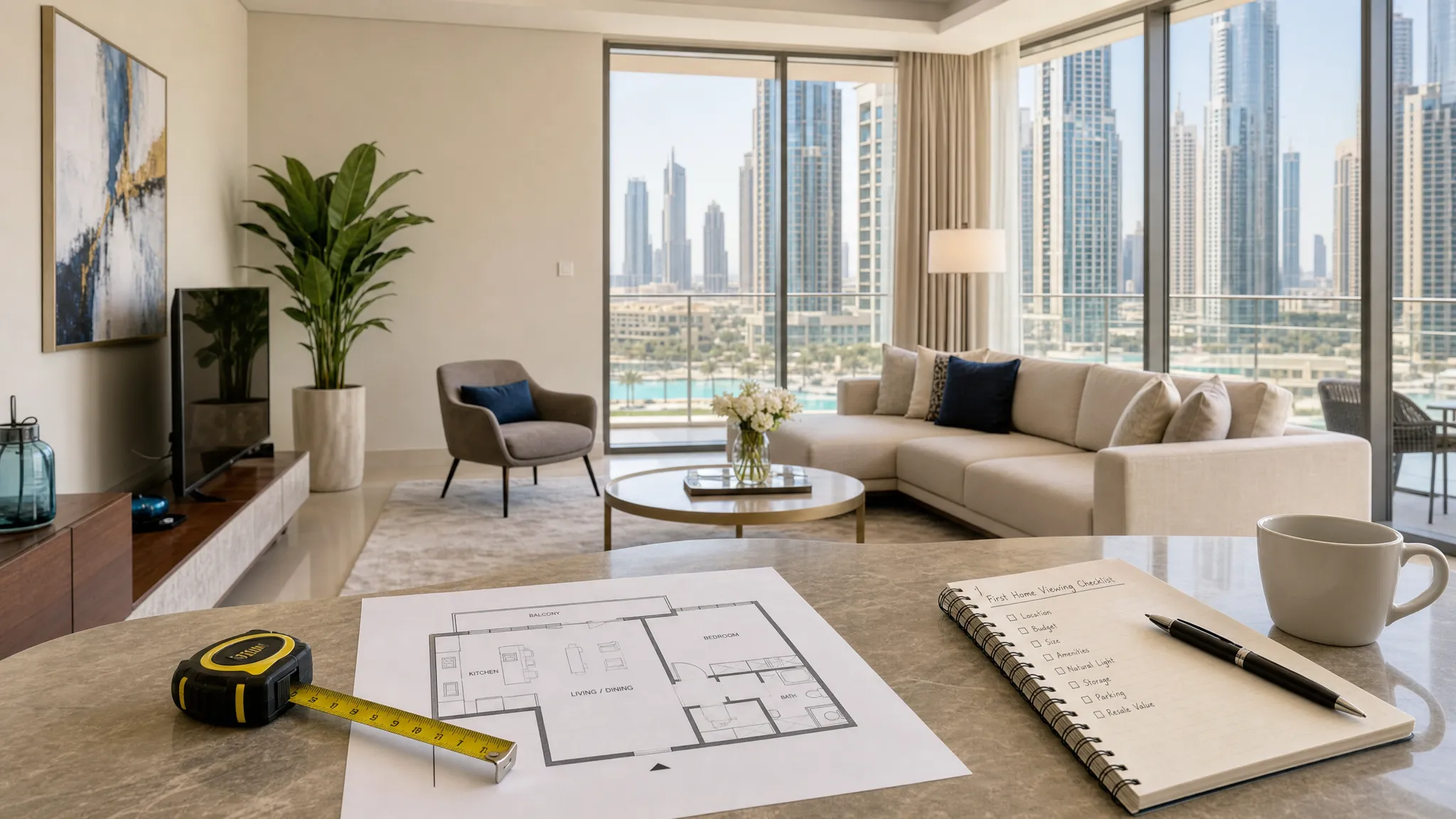
What to check during viewings
Viewings are where first-time buyers often get distracted. Natural light, views, staging, and furniture can make a home feel more polished than it really is. Slow down and inspect the property the way an owner will experience it.
Check air conditioning performance, water pressure, drainage, signs of leaks, window seals, balcony doors, kitchen cabinets, appliance condition, flooring, electrical points, storage, parking access, lift waiting times, lobby maintenance, security, noise, smell, and common areas. In villas and townhouses, pay extra attention to roof condition, waterproofing, outdoor drainage, garden irrigation, boundary walls, and signs of previous repairs.
Ask direct questions before making an offer. Is the property vacant or tenanted? Are there outstanding service charges? Is the seller the registered owner? Is there a mortgage on the property? Are any upgrades approved by the relevant authority or community manager? What is included in the sale, and what will be removed?
Red flags include:
- A broker or seller who cannot provide basic ownership or listing documentation.
- A price that is far below comparable homes without a clear explanation.
- Vague answers about occupancy, service charges, or handover timing.
- Pressure to pay a deposit before documents and terms are agreed.
- Photos or details that do not match the actual property.
From offer to transfer: understand the main steps
Once you find the right home, the process becomes more formal. In a typical secondary-market purchase, the buyer and seller agree on price and terms, sign a sale agreement, arrange deposit handling, obtain any required no-objection certificate, finalize mortgage approval if needed, and complete the transfer at an approved trustee or through the relevant official process.
The exact sequence can vary depending on whether the seller has a mortgage, whether the buyer is financing, whether the home is rented, and whether the property is ready or off-plan. This is why first-time buyers should not treat every transaction as identical.
Make sure the agreement clearly covers price, deposit, payment deadlines, transfer date, included items, vacancy date, penalty terms, mortgage timelines, and what happens if either party cannot complete. If a property is tenanted, review the tenancy contract, notice status, rent amount, and renewal timing carefully because it can affect your ability to move in.
For a broader procedural walkthrough, Best Property also has a detailed guide on how to buy a property in Dubai that explains the transaction flow in more depth.
Special notes for off-plan first-time buyers
Off-plan property can be attractive because payment plans may reduce the immediate cash burden and newer communities can offer modern amenities. However, first-time buyers should evaluate off-plan purchases differently from ready homes.
You are buying a future asset, so the developer's delivery record, project registration, escrow arrangements, construction progress, payment schedule, handover terms, and expected service charges matter. Ask whether payments go into an approved escrow account and confirm project details through official channels where possible.
Do not focus only on the monthly installment. Consider where you will live until handover, whether you can afford payments if your income changes, what happens if completion is delayed, and whether the future community will be fully developed when you move in.
If residency benefits are part of your motivation, check official UAE government guidance rather than relying only on marketing claims. Visa rules, eligibility, documentation, and property value conditions should always be verified through official sources or qualified advisers.
Common first-time buyer mistakes to avoid
The first mistake is letting emotion lead the process. A beautiful view or upgraded kitchen can hide weak building management, awkward layout, or a noisy location. Compare several similar homes before deciding whether a property is truly priced well.
The second mistake is ignoring service charges and maintenance. Two homes with the same sale price can have very different annual ownership costs. Ask for the latest service charge information and include it in your affordability calculation.
The third mistake is assuming all advertised listings are equally reliable. Listings can become outdated, prices can change, and availability can shift quickly. Use updated platforms, verify details with the agent, and ask for documentation before paying money.
The fourth mistake is skipping independent inspection. Even new-looking homes can have AC, plumbing, waterproofing, or electrical issues. A professional inspection or snagging report can be especially valuable before transfer or handover.
The fifth mistake is not planning your exit. Even if you plan to live in the home, life changes. A sensible first purchase should have resale or rental appeal, not only personal charm.
A simple first-time buyer checklist
Before you commit, make sure you can answer these questions confidently:
| Question | Why it matters |
|---|---|
| Is the property in a freehold area suitable for your ownership status? | Confirms whether the purchase structure matches your rights |
| Can you cover purchase price, fees, and post-transfer costs? | Prevents last-minute cash pressure |
| Have you compared similar properties in the same building or community? | Helps you judge fair value |
| Is the home vacant, tenanted, mortgaged, or under payment plan? | Affects transfer timing and your ability to move in |
| Are service charges and maintenance obligations clear? | Protects long-term affordability |
| Are all promises included in writing? | Reduces disputes after deposit or transfer |
If any answer is unclear, pause. In Dubai real estate, a short delay for verification is usually better than rushing into a purchase you do not fully understand.
Frequently Asked Questions
Can foreigners buy homes for sale in Dubai? Yes, foreign buyers can purchase property in designated freehold areas in Dubai. Always verify the ownership status, title details, and community rules before making an offer.
How much cash do first-time buyers need in Dubai? It depends on the property price, mortgage structure, and transaction costs. In addition to any down payment, buyers should budget for DLD fees, agency commission if applicable, mortgage costs, service charges, utility setup, and moving expenses.
Is it better to buy ready or off-plan for a first home? Ready homes are easier to inspect and may suit buyers who want to move in sooner. Off-plan homes can offer staged payments, but they require careful checks on developer reputation, escrow, contract terms, and handover timelines.
Should I use a broker when buying my first Dubai home? A qualified, licensed broker can help with market comparisons, documentation, negotiation, and transaction coordination. Still, buyers should verify information independently and make sure all terms are written clearly.
What should I check before paying a deposit? Confirm the seller's ownership, property status, agreed price, included items, vacancy terms, mortgage conditions, deposit handling, and transfer timeline. Never pay based only on verbal promises.
Find your first Dubai home with more confidence
Your first purchase should feel exciting, not uncertain. Take time to compare areas, read listings carefully, verify documents, and build a budget that reflects the full cost of ownership.
Best Property helps buyers explore homes for sale across Dubai and the UAE with advanced search filters, detailed listings, high-quality photos, virtual tours, favorites, comparison tools, and direct agent or owner contact. Start by comparing current options on Best Property and shortlist homes that match both your lifestyle and your long-term plan.


Join The Discussion